You gassed out in round two. Your partner wasn’t even that good. They just… kept going.
That’s not a fitness problem. It’s a conditioning problem. And the fix isn’t to run more laps. Most standard cardio training builds the wrong engine for jiu-jitsu. Here’s what nobody tells you when you start: BJJ scrambles through three different energy systems in a single five-minute round — and most “get fit for BJJ” advice only trains one of them.
A BJJ conditioning workout targets five energy systems in order: aerobic base, explosive power, grip and grappling strength, positional mat drills, and recovery. You don’t need marathon-level cardio — you need short, smart, mat-specific training. Build each phase and your gas tank catches up fast.
- BJJ uses three energy systems — train all of them, not just “cardio”
- The Stylso BJJ Conditioning Stack works five phases in the right order
- Recovery is a phase, not an afterthought — skip it and the other four don’t stick
What BJJ Actually Demands From Your Body
Most sports lean on one energy system. BJJ leans on three:
Alactic (0–10 seconds): the explosive burst. A double-leg, a guard pass, a roll-through. Pure power, no oxygen needed.
Lactic (10–90 seconds): the hard scramble. Back-and-forth fighting for position, wrestling in half guard, chasing a submission. This is where most people gas — they burn through lactic capacity in round one and crawl through round two.
Aerobic (90 seconds+): the long engine. Recovery between scrambles, steady pressure, staying composed on the bottom of side control. The bigger your aerobic base, the faster you recover between explosions.
Judo and wrestling athletes — who dominate the grappling cardio conversation — train all three with purpose. A judo practitioner’s randori session alternates explosive attacks with active recovery. Wrestlers use contrast conditioning: max-effort bursts followed by technical drilling at lower intensity. Both disciplines figured this out decades ago. The lesson for BJJ: structure matters more than volume.
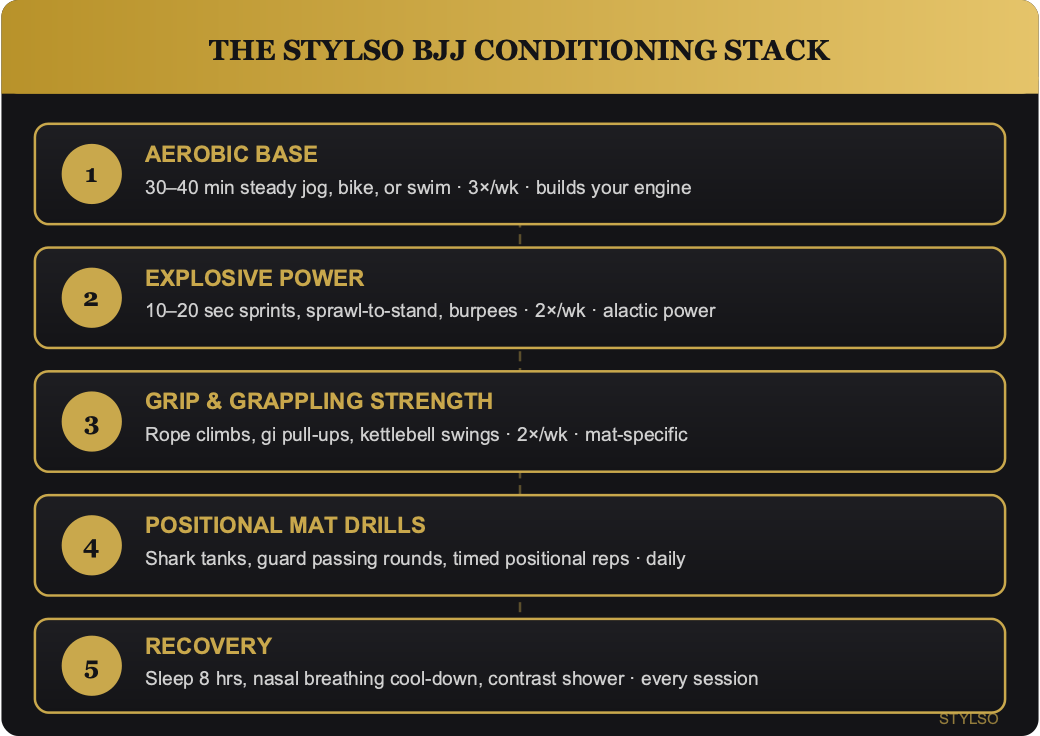
The Stylso BJJ Conditioning Stack (5 Phases)
This is the protocol. Work through it in order — each phase builds the one above it.
Phase 1 — Aerobic Base
What: 30–40 minutes of steady-state cardio. Jogging, cycling, rowing — anything where you can hold a full conversation.
When: 3× per week, on off-mat days or before drilling.
Why it matters: Your aerobic system is the recovery engine between scrambles. A bigger aerobic base means faster heart-rate recovery and more explosions per round before you fade. Without it, the other four phases won’t stick — you need the base to absorb them.
The drill: 30-minute jog at 60–70% max heart rate. If you’re breathing hard, slow down. The point isn’t to suffer — it’s to build engine size. You should be able to say a full sentence out loud the whole time.
Phase 2 — Explosive Power
What: 10–20 second max-effort intervals. Sprawl-to-stand, burpees, short sprints, jump squats.
When: 2× per week. Never the day before a hard rolling session.
Why it matters: BJJ’s highest-intensity moments are short. A double-leg, a guard escape, a back-take — two to eight seconds of pure output. You need your alactic system primed to fire hard, then recover fast. Longer intervals don’t train this.
The drill: 8 rounds of 10-second all-out effort, 50 seconds rest. That’s it. Go as hard as physically possible for 10 seconds. The rest period isn’t negotiable — it’s what lets you go hard again. Cut the rest and you’re training the wrong thing.
Phase 3 — Grip and Grappling Strength
What: Rope climbs, gi pull-ups, kettlebell swings, farmer’s carries.
When: 2× per week, ideally on the same day as explosive work.
Why it matters: Your grip dies before your lungs do. Any competitive grappler will tell you — the moment you can’t hold a collar grip or control a sleeve is when you start losing positions. Grip strength is a BJJ-specific bottleneck that general conditioning doesn’t fix. Check out our guide to building grip strength for BJJ for a full drill list.
The drill: 3 sets of gi pull-ups to failure (grab a folded gi over a pull-up bar), followed by 3×12 kettlebell swings. Farmer’s carries — hold two heavy weights and walk — are the most underrated grip builder there is.
A competition-grade gi with reinforced collar stitching makes grip work more realistic and harder on your hands in the right way. Train grip the way you’ll use it:
Phase 4 — Positional Mat Drills
What: Shark tanks, timed positional rounds, drilling sequences under fatigue.
When: Daily — this is your mat conditioning, the most direct form.
Why it matters: No off-mat conditioning fully replicates the metabolic demands of live rolling. Positional drilling while already tired teaches your body to execute technique under fatigue — the exact state you’ll be in during competition or a hard class. Combine this with the Stylso BJJ warm-up routine to prime the body before each session.
The drill: 5-minute shark tank — one person holds a dominant position (side control, back, mount), partners rotate in every 60 seconds fresh. The person in the middle never gets a break. After five minutes, swap. It’s the hardest 5 minutes in the gym and it builds the most mat-specific conditioning of anything on this list.
This is a cross-discipline trick from wrestling: conditioning coaches call it “top-man/bottom-man” intervals. The concept is identical to wrestling’s referee-position drills where one partner attacks continuously while the other defends. The overlap is real — wrestlers transitioning to BJJ often note that their conditioning adapts faster because of this shared training logic.
Phase 5 — Recovery
What: Sleep (8 hours), nasal-breathing cool-down, contrast showers, active mobility.
When: Every day. Not optional.
Why it matters: Recovery isn’t passive. It’s when your body actually builds the conditioning you trained for. Most grapplers add more sessions and wonder why their conditioning plateaus — they’re not recovering between sessions, so they’re just accumulating fatigue without adaptation.
The protocol: 5-minute nasal-only breathing cool-down right after training (closes the stress response fast), 500ml of water before you leave the gym, 20 minutes of hip flexor + shoulder mobility at home, 8 hours of sleep. That’s the full recovery piece. Skip any part and the other four phases work less. See the BJJ injury prevention guide for the full recovery + prevention breakdown.
The 4-Week BJJ Conditioning Plan
| Week | Focus | Key Sessions | Goal |
|---|---|---|---|
| Week 1 | Aerobic Base | 3× 30-min steady jog or bike | Heart rate holds below 140, full conversation possible |
| Week 2 | Explosive Power | 2× 8-round sprint protocol + base jogs | Sprint full-effort, recover in 50 seconds |
| Week 3 | Grip & Grappling | 2× gi pull-up + kettlebell sets + base jogs | Grip holds through round 4+ |
| Week 4 | Full Stack | Combine all phases + daily mat drills | Gas tank holds through a full class |
After four weeks, loop back to Week 1 but increase intensity: longer aerobic sessions, shorter rest in intervals, heavier loads on grip work.
Gear for BJJ Conditioning
You don’t need much. But you need what you need.
A gi for grip work and mat drills — it’s not optional if you’re training gi BJJ. The Stylso gi is pearl-weave, pre-shrunk, and IBJJF-approved. Built for regular washing after every conditioning session:
For kids starting their conditioning journey early — the same five-phase principles apply, scaled down. A proper kids’ gi makes Phase 3 grip work accessible and keeps training specific:
Free: BJJ Conditioning Workout Tracker
A printable 4-week conditioning plan — the 5 phases, a weekly training log, and a recovery checklist. Get it instantly.
FAQ
- What’s the best conditioning workout for BJJ?
- A 5-phase protocol: aerobic base (steady cardio), explosive intervals (10-sec sprints), grip and grappling strength (gi pull-ups, kettlebell), positional mat drills (shark tanks), and structured recovery. Train all three energy systems — alactic, lactic, and aerobic.
- How often should I do BJJ conditioning workouts?
- Three to four conditioning sessions per week alongside your mat time. Aerobic base 3× per week, explosive work 2×, grip work 2× (can overlap with explosive day). Sleep 8 hours — recovery is as important as the work.
- Can I do BJJ conditioning at home without a gym?
- Yes. Phases 1 (jogging/cycling) and 5 (recovery + mobility) need nothing. Phase 2 (sprints, burpees) works in any open space. Phase 3 needs a pull-up bar and a kettlebell. Phase 4 needs a partner and a mat.
- Will running improve my BJJ cardio?
- It helps build the aerobic base (Phase 1), which improves recovery between scrambles. But running alone won’t fix your conditioning — you also need the explosive, grip, and positional phases. Running is one tool, not the whole job.
- How long does it take to see conditioning improvements in BJJ?
- Most people feel a difference within 4–6 weeks of consistent training. The aerobic base shows up first — faster recovery between rounds. Explosive power takes 6–8 weeks to show in live rolling. Grip endurance is usually noticeable within 3–4 weeks of specific training.
- What’s the difference between BJJ cardio and BJJ conditioning?
- “Cardio” usually means aerobic endurance only. “Conditioning” covers that plus explosive power, strength endurance, grip endurance, and recovery — the complete set of systems BJJ actually taxes. Conditioning is the more accurate and complete concept for grapplers.