You’ve been drilling hip escapes on the dummy every morning. Twenty minutes. Every day. And last week in rolling, someone put you in mount and you froze — same spot, same move you’ve supposedly been drilling for a month. Zero transfer.
More sessions isn’t the answer. Focused sessions are. Here’s the part nobody writes down.
Two to three focused sessions a week is the sweet spot for most grapplers. Each session: 15–20 minutes. One technique. 50–100 clean reps. That’s it — and it works better than daily grinding because of how your nervous system actually encodes movement.
The Two Failure Modes
There are only two ways grapplers waste a grappling dummy.
The first is the dust collector. You buy it, do a few sessions, feel good, then drift back to watching instructionals. Three months later it’s in the corner wearing last year’s competition hoodie. Familiar.
The second is the daily grind. Every single morning — 30 minutes of random drilling, no structure, no goal. It feels like work. But your brain isn’t encoding anything useful when you’re cycling through familiar motions at half-attention. You’ve done a lot of reps. You haven’t built a motor pattern.
Here’s what both failure modes have in common: they treat the dummy like a fitness tool. It isn’t. It’s a motor pattern tool. Its job is to burn one specific movement into your muscle memory until it fires automatically in live rolling. That requires focused repetition — not volume, and not daily grinding through the motions.
How Often to Use a Grappling Dummy (By Level)
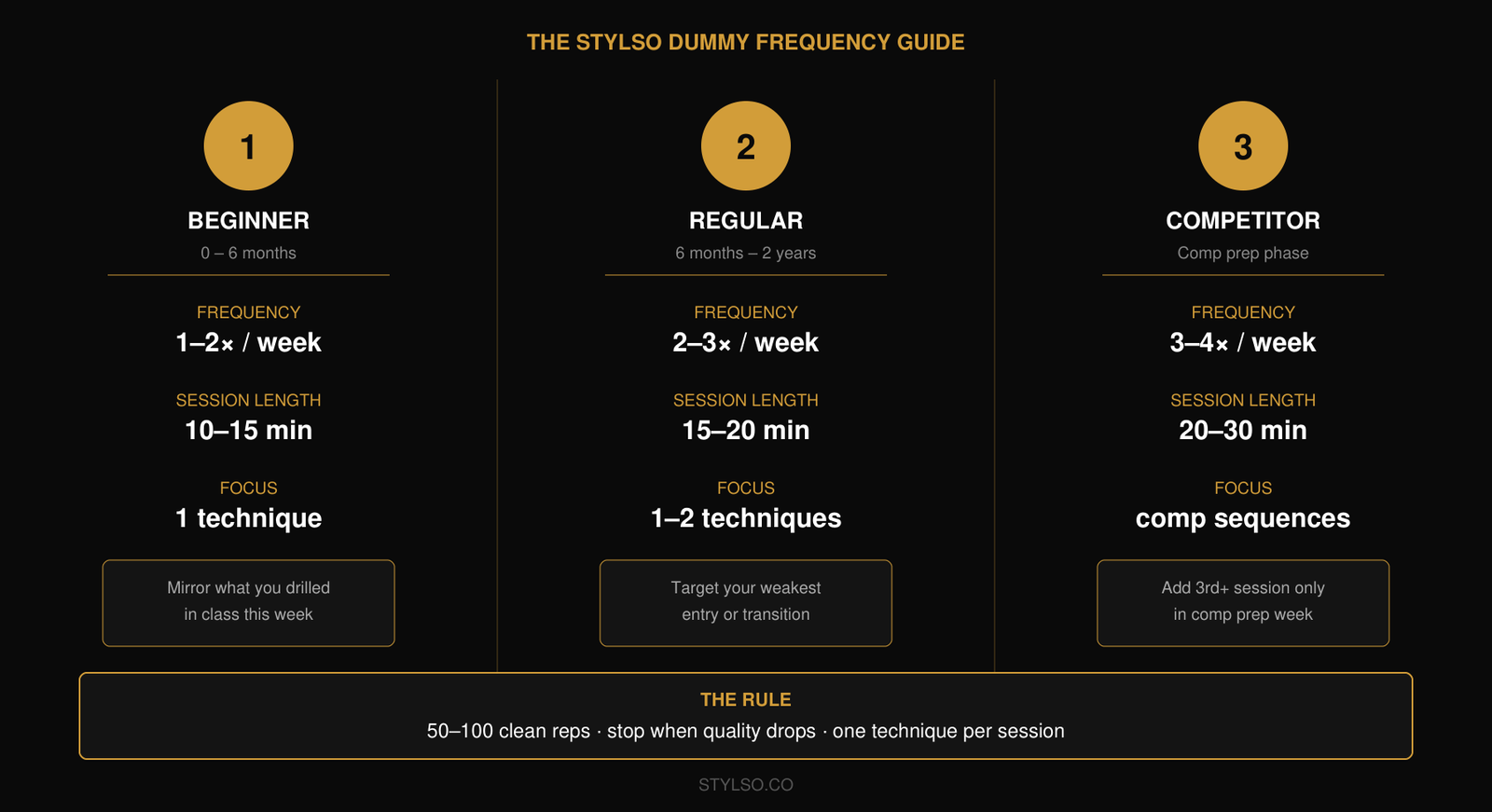
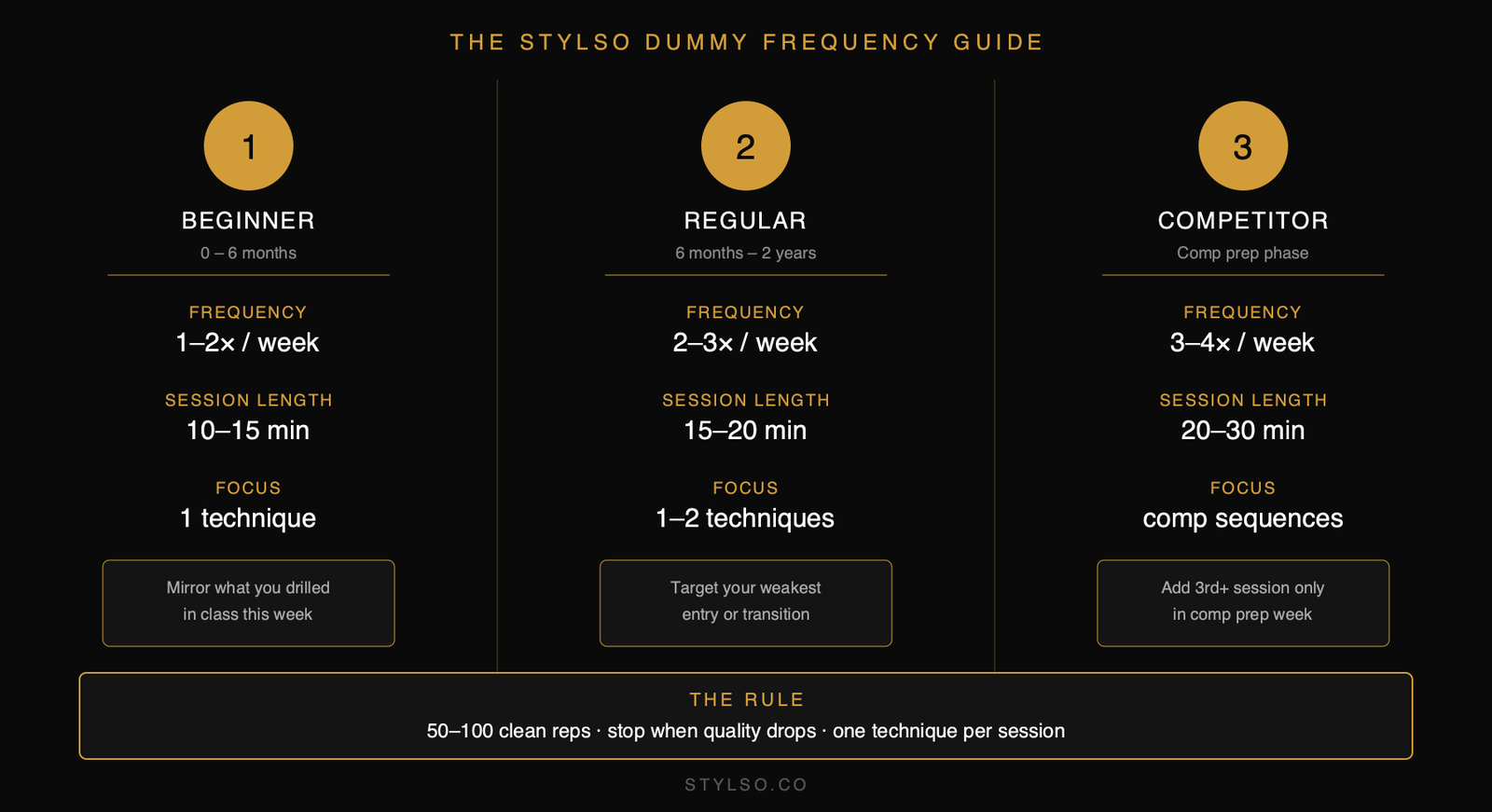
| Level | Sessions / Week | Session Length | Techniques Per Session | Shop |
|---|---|---|---|---|
| Beginner (0–6 months) | 1–2× | 10–15 min | 1 technique | Shop on Amazon |
| Regular (6 months–2 years) | 2–3× | 15–20 min | 1–2 techniques | Shop on Amazon |
| Competitor (comp prep) | 3–4× | 20–30 min | Comp sequences | Shop on Amazon |
Beginner (0–6 months): 1–2 sessions a week
Keep it simple. Pick the one technique your coach showed you this week — a hip escape, a guard pass entry, a single-leg finish. Do it on the dummy. Repeat it 50 times. Stop.
Don’t overthink the schedule. One or two sessions between classes. 10–15 minutes each. You’re not building a training system yet — you’re just reinforcing what you learned on the mat so it has a better chance of showing up next time you roll.
Shop Grappling Dummies on Amazon
Regular Trainer (6 months–2 years): 2–3 sessions a week
At this level, you know your weak spots. You’ve been tapped enough times to know what’s not there yet. That’s what you drill.
Slow guard recovery? Hip escape sequences. Sloppy single-leg? Entry reps — starting position to finish. Is your guard pass getting stuffed at the knee? Knee-slice entry reps, same setup, 50 times. You don’t need variety in one session. You need 50–100 clean reps of the one thing that’s costing you in rolling.
Two sessions is your baseline. Add a third when you’re in competition prep or when your coach is focused on a specific new sequence that week.
Competitor (comp prep phase): 3–4 sessions a week
Competition drilling is different. You’re not building new patterns — you’re sharpening specific sequences under the logic that they need to fire when you’re tired and the other person’s defending hard.
A competitor might drill their preferred takedown entry from their favourite tie-up, then the transition if the entry gets stuffed. Two techniques. 30–40 reps each. Focused. Done. The third and fourth session belong in comp prep week only — not as a permanent baseline. Your body needs recovery too. Daily high-volume dummy work in a normal training week is how grapplers plateau.
What Wrestling Can Teach You About This
Here’s the cross-discipline lesson that reframes the whole thing.
Wrestlers use heavy bags and wrestling dummies — but not the way most people think. They don’t spend an hour grinding on them. They do two or three short rounds, 10–15 minutes each, and every round has one specific technique. Drive, lift, finish. Or: level change, penetration step, secure the leg. They call it drilling for motor grooves.
The principle is this: your nervous system encodes a movement pattern through focused repetition, not through volume. A hundred sloppy reps teach you to move sloppily. Fifty clean reps of the same entry — same angle, same timing, same finish — builds the motor groove that shows up automatically in the last round of a match when your brain’s tired and your gas tank is low.
Judo has the same principle. Uchi-komi — entry drilling — is done in sets of 10–15 entries, then rest, then another set. Short. Rhythmic. One technique per set. That’s exactly what grappling dummy work should feel like.
So: every session, pick ONE entry or transition. Do 50–100 reps. Stop when the quality starts to degrade. You’ve done your dummy work.
How Long Each Session Should Be
15–20 minutes. Set a timer. Pick your technique before you step on the mat — not after.
This is the part that feels counterintuitive. Aren’t longer sessions better? No. The pattern holds across wrestling, judo, gymnastics, and most technical sports: the early minutes of a focused session are where real encoding happens. After 20–30 minutes on the same technique, quality degrades. You’re still sweating. But you’re not improving — you’re reinforcing sloppy form.
Short and sharp, twice a week. That’s more valuable than an hour of grinding every morning. Your body will also thank you at class.
A Simple Weekly Schedule That Works
If you train BJJ three times a week, here’s how dummy work fits in without burning you out:
- Monday: 15-minute dummy session — the technique you want to shore up this week
- Wednesday: class only — no dummy work; let the nervous system consolidate
- Friday or Saturday: 15-minute dummy session — same technique, or one follow-on transition
Two focused sessions. That’s it. Add a third in comp prep week. Don’t turn it into a four-day regimen unless you’re actively competing — the recovery cost isn’t worth the marginal gain for a regular trainer.
Key Takeaways
- 2–3 sessions per week is the sweet spot for most grapplers
- 15–20 minutes per session — stop when quality drops
- One technique per session, 50–100 clean reps
- Match dummy work to what you drilled in class that week
- Competitors: add a third session only in comp prep week, not as a permanent baseline
Shop Grappling Dummies on Amazon
Free: Grappling Dummy Weekly Training Planner
A printable weekly tracker with rep targets by level, a technique log, and the Stylso frequency guide — take it to your garage and start tonight.
Frequently Asked Questions
Can I use a grappling dummy every day?
You can, but it’s not the most effective approach. Daily drilling leads to pattern fatigue — the movements stop encoding sharply after too many sessions without recovery. Two to three focused sessions a week will outperform daily half-committed sessions for most grapplers. Quality beats frequency.
How long should a grappling dummy session be?
15–20 minutes of focused work on one technique. Set a timer before you start. Stop when the timer goes off — or earlier if the reps are getting sloppy. Longer doesn’t mean better for skill acquisition; sharpness matters more than duration.
What’s the best thing to drill on a grappling dummy?
Entries and transitions — not submission finishes. Hip escapes, single-leg entries, guard pass setups, back-take transitions. Save the finish for live rolling where you get real resistance and real feedback. The dummy is for burning the entry into your motor memory, not for finishing it.
Is a grappling dummy worth it if you already train BJJ 3 times a week?
Yes — especially because it gives you extra reps on specific patterns without the full energy cost of a live rolling session. Two focused 15-minute sessions between classes can meaningfully accelerate one specific technique you’re working on. It bridges the gap between classes.
Which type of grappling dummy should I get?
A sitting dummy is the most versatile starting point — hip escapes, guard passing, mount pressure, arm lock entries all work on a sitting dummy. A standing dummy adds takedown and throw entry work. A kids’ dummy is sized for younger athletes or smaller adults focused on hip-movement and bottom-position drills. Check current options on Amazon.
Find Your Grappling Dummy on Amazon