The first time someone tries to strip your grip in BJJ, it hits you fast — your arm isn’t just a tool, it’s a target. Most beginners learn this the hard way, tapping to submissions they didn’t see coming. Here’s what nobody tells you early on: the same arm your training partner is attacking is your most powerful weapon. Learn to hunt it from every position, and you stop being the person scrambling to survive. You become the one who sets traps.
BJJ arm locks work by extending or rotating the elbow, shoulder, or wrist joint past its natural range of motion. The five every beginner should learn — armbar, kimura, americana, omoplata, and wrist lock — cover every grappling position and form the base of an entire submission game.
Quick Takeaways
- The armbar is the single most transferable arm lock — it shows up in guard, mount, and dozens of transitions. Learn it first.
- The kimura and americana use the same figure-four grip style. Once you understand one, the other clicks fast.
- Wrist locks are powerful but restricted in IBJJF competition below brown belt. Drill them in the gym; know your ruleset before you compete.
Why Arm Locks Come Before Everything Else
It’s not arbitrary. Arm locks teach you something more valuable than the finish itself: positional control. To land a kimura, you need guard. To lock in an americana, you need mount or side control. To hit the armbar, you need either. The submission only becomes available once you’ve earned the position — so chasing arm locks forces you to care about positions from day one.
They’re also the safest submissions to drill with a new training partner. Unlike chokes, which cut off blood flow quickly, an arm lock builds pressure gradually. You can feel it tightening in time to tap. That makes the training environment calmer for both people on the mat.
The 5 Arm Locks Every Beginner Needs
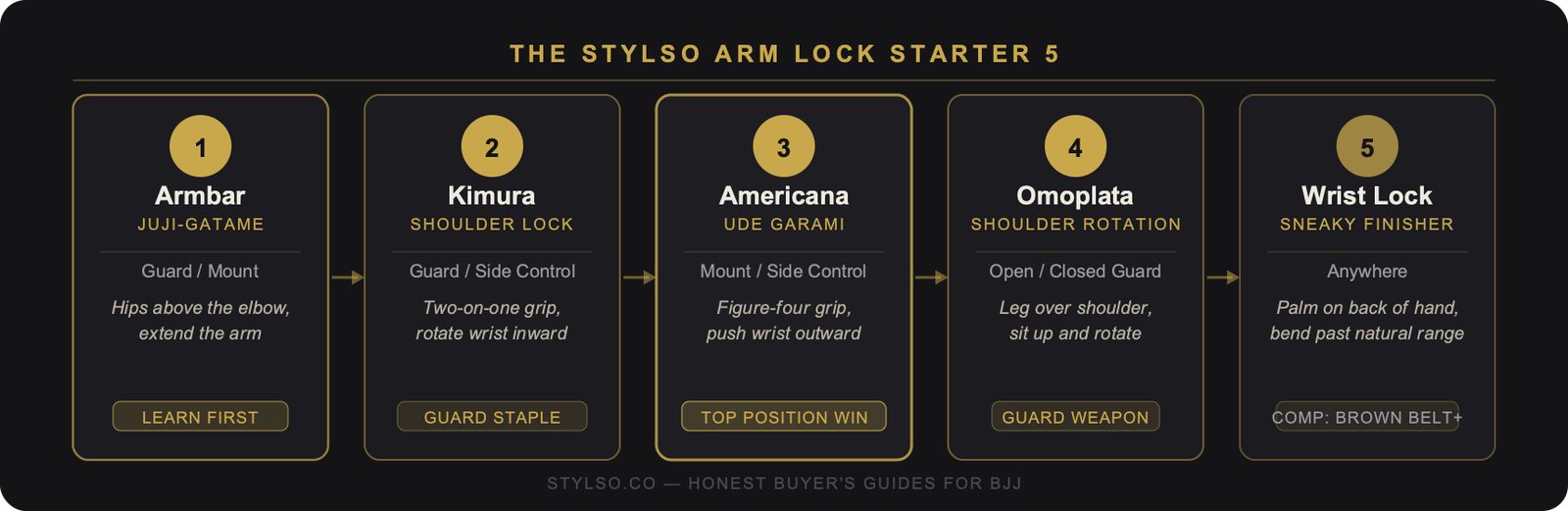
These five cover the full range of grappling positions. Learn them in roughly this order — each one teaches you something the next one builds on.
| Arm Lock | Best Position | Mechanism | Key Grip | Learning Curve | Shop |
|---|---|---|---|---|---|
| Armbar | Guard / Mount | Elbow extension | Two-on-one wrist, hips over joint | Moderate — timing takes practice | Shop |
| Kimura | Guard / Side Control | Shoulder rotation (inward) | Figure-four on opponent’s wrist | Moderate — grip is the submission | Shop |
| Americana | Mount / Side Control | Shoulder rotation (outward) | Figure-four, push wrist toward mat | Low — natural from top positions | Shop |
| Omoplata | Open / Closed Guard | Shoulder rotation (inward, from guard) | Leg over shoulder, sit and rotate | High — requires guard comfort first | Shop |
| Wrist Lock | Anywhere | Wrist extension or rotation | Palm on back of hand, push backward | Low — quick, often unexpected | Shop |
Shop Stylso Men's Gi on Amazon
How to Learn Each Lock
1. Armbar (Juji-Gatame) — Learn It First
In judo, the armbar is called juji-gatame — and judo got to this technique a full century before most BJJ practitioners were born. Here’s the lesson judo figured out that most beginners miss: your hips need to get above your opponent’s elbow, not level with it. That hip position is what generates the force. Try to armbar with your hip beside the arm, and it’s a wrestling match. Get your hip above the joint, and it’s a lever — your bodyweight versus a single elbow.
Solo drill you can do anywhere: lie flat on your back, bring both knees to your chest, then explode your hips upward toward the ceiling (the “hip pop” motion). Ten reps before every session. You’ll start feeling that exact movement in live rolls within two weeks.
2. Kimura — The Grip Is the Submission
You’ll find the kimura grip in wrestling takedowns, in judo (as gyaku ude garami — the reverse arm entanglement), and in every BJJ guard position. What beginners often miss: the two-on-one grip itself is the controlling element, not just a setup tool. Get your two hands on their wrist and you already control their shoulder. From guard, drill the entry without rushing the finish — build the grip tight and feel how their shoulder responds when you rotate their wrist slowly backward. That’s the reference point you’re training.
3. Americana — Your First Top-Position Win
The americana is often the first arm lock that lands in a real roll, because you’re already somewhere useful — mount or side control — when you find it. Pin their wrist flat to the mat. Slide your free arm under their elbow and build the figure-four grip. Now push their wrist toward the far hip while lifting their elbow away from the mat. Small motion, real pressure. It’s one of the friendliest arm locks to drill with a new partner because the tap usually comes well before it gets uncomfortable.
4. Omoplata — A Guard Weapon Worth the Wait
The omoplata asks you to control someone’s entire shoulder with your leg — which sounds wild until you’ve drilled guard for a few months. Don’t rush it. Start from closed guard, practice kicking your leg over their shoulder and sitting up. Don’t even think about finishing yet. Just find the position and feel how their shoulder responds when you sit tall and rotate your torso. The submission follows once the spot feels automatic. Try to skip straight to the finish and you’ll keep scrambling out of it.
5. Wrist Lock — Small Joint, Fast Tap
Wrist locks work because they attack a small joint with a large lever (your whole body weight). The setup is simple: get a palm on the back of their hand and bend it past its natural range — backward, sideways, or inward. They come on fast, which is both the appeal and the reason to drill them carefully. Your partner should tap the moment they feel any pressure — there’s no “almost” with a wrist lock.
Competition note: IBJJF rules restrict wrist locks to brown belt and above. Train them freely in the gym. Just know your ruleset before competition day.
What Your Gi Has to Do With Arm Locks
A loose gi gives your training partner extra fabric to grip when you’re attempting or defending arm locks — their wrist control gets stronger the more sleeve material they can grab. That’s a real mechanical disadvantage. A well-fitted gi removes that variable. You move cleaner, the technique stays honest, and you stop losing submissions to your own uniform. If you’re not sure where your fit sits, use the Stylso measuring guide to nail down your A-series size before your next training block. For the full lineup of beginner picks, our best BJJ gi for beginners guide covers the options worth knowing about.
Shop Stylso Men's Gi on Amazon
And if you’re already working on top control and want to put these arm locks to use in a live situation, the bjj mount escapes guide covers the counter-game — knowing how your partner escapes makes your arm lock setups sharper.
Free: The Stylso Arm Lock Starter Guide
A one-page printable quick-reference: 5 arm locks, key grip cues, and the solo armbar drill. No pitch — just the reference card.
Frequently Asked Questions
What’s the first arm lock a BJJ beginner should learn?
Start with the armbar. It’s the most common submission at every competition level and it works from more positions than anything else — guard, mount, and countless transitions. Once you understand the hip-over-elbow mechanic, the kimura and americana click faster too. See also our breakdown of beginner takedowns — getting to a ground position is step one.
Are arm locks safe to practice as a beginner?
Yes, with a cooperative partner who taps early. Arm locks build gradually — you can feel the pressure increasing well before any risk of injury. The rule is simple: tap the moment you feel it, not when it hurts. That’s true at white belt and it’s still the rule at black belt.
What’s the difference between a kimura and an americana?
Both use a figure-four grip on the arm. The difference is direction. A kimura rotates the shoulder inward — wrist pushed up toward the opponent’s head. An americana rotates it outward — wrist pushed down toward the mat and away from the body. That’s also why the americana feels more natural from mount and top side control, while the kimura tends to open up more from guard and bottom positions.
Are wrist locks allowed in BJJ competition?
It depends on the ruleset. In IBJJF competition, wrist locks are restricted to brown belt and above. Most other organizations — NAGA, local open mats, many regional tournaments — allow them at all levels. Check the specific ruleset before you compete. In regular training, they’re generally fine as long as both partners know they’re being drilled.
How long does it take to submit someone with an arm lock?
From a clean position, seconds. The delay for most beginners isn’t the technique — it’s hesitation and body positioning. Get your hips above the joint (armbar), build the grip before they can move (kimura), pin the wrist first then build the figure-four (americana). Set the position; the finish follows fast once it’s clean. Our guard passing guide covers how to earn those top positions in the first place.
Do arm locks work in no-gi BJJ?
Yes — all five of these arm locks work in no-gi. You lose the gi fabric for grip assistance, which makes some setups trickier. The kimura, in particular, needs a tighter grip in no-gi because there’s no sleeve to anchor onto. But the mechanics are the same. If you drill them in the gi, they carry across. For more on how the two games differ, see our gi vs no-gi guide.