Your first week of BJJ, that belt hits the mat four times a round. By week three, you don’t even notice you’re tying it. The trick isn’t muscle — it’s one knot, done right.
The direct answer: Find the center of your belt and press it just below your navel. Wrap both ends around your back, cross them, bring both to the front. Feed the top tail under all belt layers at your waist — both layers, not one. Finish with a square knot — right over left, then right under left. Both tails hang even, around 20–25 cm. Six steps, and you’re done.
- One knot matters: the square knot. It lies flat and stays tight during live rounds.
- The granny knot trap is everywhere: it looks the same but comes undone by round two — one small fix ends it.
- Ten slow reps before your first class and your hands will know the sequence without thinking.
What You Need
Just the belt that came with your gi. That’s it. If you don’t have a gi yet, the Stylso men’s gi ships with a white belt included — check it on Amazon and come back once it arrives.
Shop on Amazon — Stylso Men’s BJJ Gi
The Square Knot: 6 Steps
This is the standard method used at most academies. Learn it once, and you’re done.
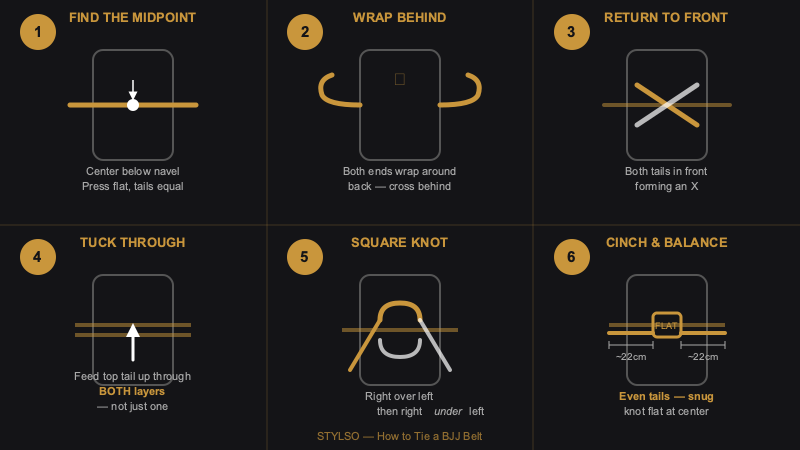
Step 1 — Find the midpoint. Fold the belt in half. That center crease sits flat against your stomach, just below your belly button. Tails should be roughly equal on each side.
Step 2 — Wrap behind. One end in each hand. Bring both around your back and cross them — right over left, or left over right. Pick one and stick to it. The cross happens behind you, not in front.
Step 3 — Return to front. Both ends come back to the front, forming an X just below the first layer of belt already at your waist.
Step 4 — Tuck up through both layers. Take the top tail and feed it up through both layers of belt at your waist — not just one, both. Pull it all the way through until the tail hangs even with the other side. This is the step most white belts skip, and it’s exactly why the knot slides.
Step 5 — Cross and close the square knot. Right end over left, then right end under left. The knot should sit flat across the center of your belt — not twisted, not diagonal, just flat.
Step 6 — Cinch and balance. Pull both tails until the knot is firm at your centerline. Aim for even length on each side — around 20–25 cm (8–10 inches).
Go slow the first few times. By rep five, your hands know the pattern.
Square Knot vs. Granny Knot
These two look almost identical when you finish tying them. They behave nothing alike once you start rolling.
| Feature | Square Knot ✅ | Granny Knot ❌ |
|---|---|---|
| How it lies | Flat, parallel crossing | Diagonal, crooked |
| During rolling | Stays tight — tightens slightly | Loosens and unravels |
| After class | Easy to untie | Sometimes locks tighter |
| Final cross direction | Changes direction (right over → right under) | Same direction twice |
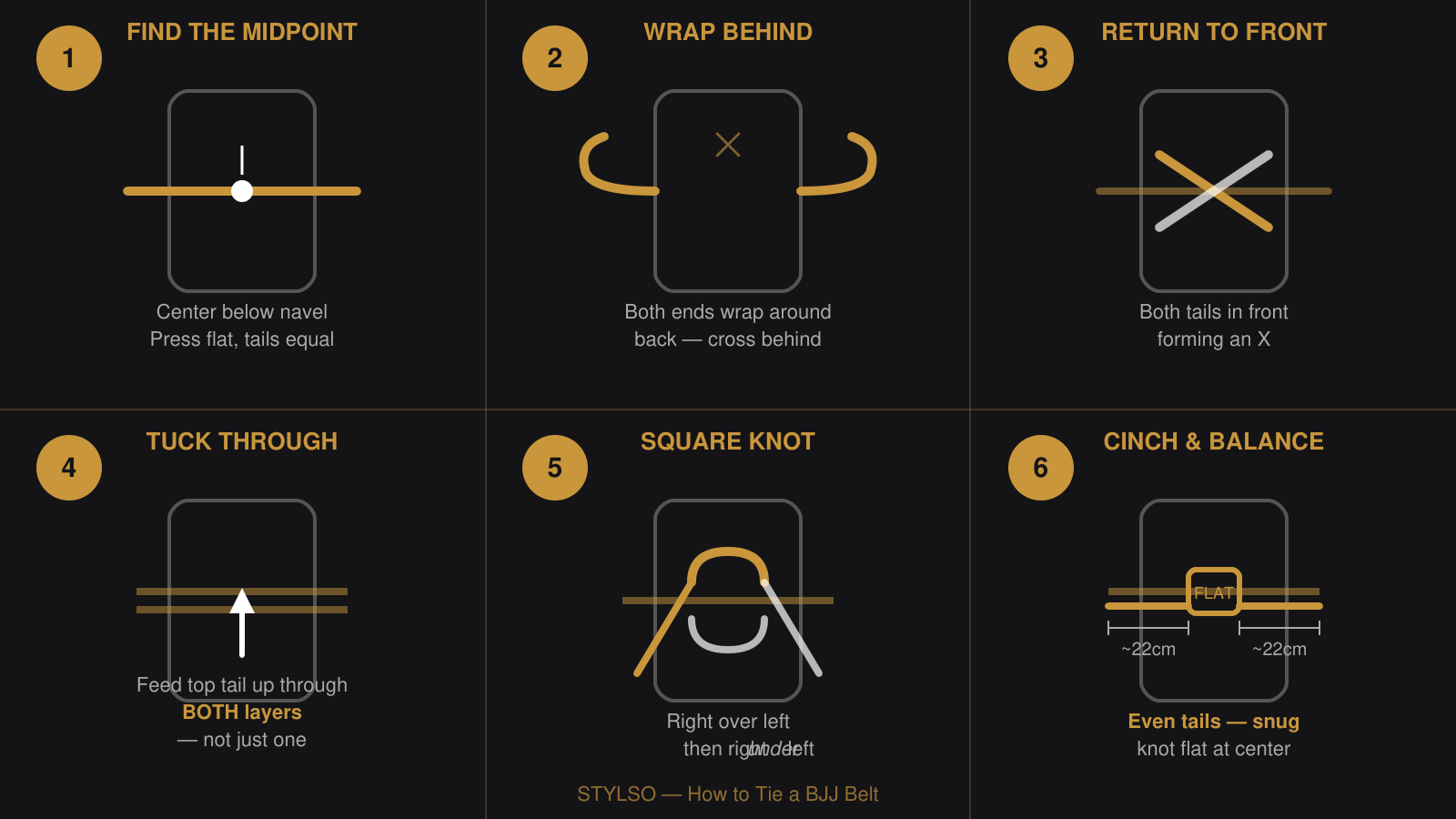
The fix is one step: when you do the final cross, change direction. Right over left, then right under left. If you go the same direction twice, you get a granny knot. That tiny reversal is the whole difference.
Common Mistakes White Belts Make
- Tucking through only one layer — it should be both. Single-layer tucks are the biggest reason knots slide sideways.
- Both crosses going the same way — that’s a granny knot. Reverse on the second cross.
- Tails way too long — anything over 30 cm flaps during drilling and annoys everyone within elbow range.
- Knot off-center — the final cinch should sit at your navel line, not off to one side.
The 10-Rep Pre-Class Drill
Here’s the part nobody tells you. You could watch the steps a hundred times, or you could tie and untie your belt 10 times before your first class — and have it permanently.
Stand in front of a mirror. Tie it, check the flat knot, untie, repeat. Don’t rush — each rep should be cleaner than the last. By rep eight, your hands are leading and your brain is just watching. That’s muscle memory, and it’s faster than thinking during a live round.
Judo players have done this for over a century. Tying the obi before a session is part of the ritual — it signals that serious training has begun. Borrow that mindset. Tie it deliberately, and your whole warm-up has a different weight to it.
Belt Length: How Much Should Hang?
Around 20–25 cm (8–10 inches) on each side is standard. Shorter than that and you don’t have enough to work with when cinching. Longer and the ends flap during drilling.
If your belt comes extremely long, it’s fine to fold it once before wrapping. The snugness at your waist matters more than any length rule. Firm enough that you can’t easily pull the knot loose — not so tight it digs in when you breathe or post on the mat.
Now Make Sure the Gi Fits, Too
Tying the belt right is step one. Wearing a gi that actually fits is step zero. If you’re not sure about your size, our size guide has the full Stylso A-series chart — men and kids, all measurements, one page.
→ BJJ Gi Size Guide — Find Your A-Size
→ Best BJJ Gi for Beginners — Our Honest Picks
→ Best Budget BJJ Gi — Quality Without the Price Tag
Shop on Amazon — Stylso Kids’ BJJ Gi
Free: BJJ Belt Quick-Reference Card
A one-page cheat sheet — the 6 steps, the square vs granny knot comparison, and the 4 common mistakes. Print it. Put it in your gym bag. Get it instantly.
FAQ
How do you tie a BJJ belt for beginners?
Find the center of the belt and place it at your navel. Wrap both ends behind your back, cross them, bring both to the front. Feed the top tail under both belt layers at your waist. Finish with a square knot — right over left, then right under left. Both tails hang even at around 20–25 cm.
What is the correct knot for a BJJ belt?
The square knot. It lies flat, stays tight during rolling, and is easy to untie after class. Avoid the granny knot — it looks similar but loosens during movement because both crosses go the same direction instead of reversing.
Which side goes on top when tying a BJJ belt?
Most academies teach right over left for the wrap and the final cross, but there’s no universal rule. Pick one side, stay consistent, and make sure the knot lies flat. Ask your coach if your school has a preference — some do.
How tight should a BJJ belt be?
Firm enough that you can’t easily pull the knot loose, but not so tight it digs into your ribs when you breathe or post on the mat. Snug at your centerline is the goal. You’ll get a feel for it after a few classes.
How long should the belt tails be?
Around 20–25 cm (8–10 inches) on each side is standard. Too long and the ends flap during drilling; too short and you don’t have enough to cinch the knot properly.
Why does my belt come undone during rolling?
Almost always a granny knot instead of a square knot. The fix: on the final cross, change direction — right over left, then right under left. One small change, and the knot stays through a full round.
Stylso Editorial Team — honest buyer’s guides for BJJ gear. No fake specs, no prices. Every recommendation ties to a real product. “Check the current price on Amazon.”