Most BJJ injuries are preventable. A ten-minute warm-up, one piece of protective gear, and the habit of tapping before it hurts — that’s 80% of the battle. Here are the five rules that keep you on the mat instead of nursing a swollen elbow on the couch.
The "Injuries Are Part of BJJ" Myth
You’ll hear it in every gym: "Getting hurt is just part of the sport." There’s a grain of truth there. BJJ is physical and accidents happen. But most training injuries aren’t accidents. They’re patterns — same finger, same knee, same scenario, same choice to push through instead of tap.
The grappler who trains for ten years without a single trip to urgent care doesn’t have better luck. They tap faster, warm up every time, and wear the right gear. That’s it. Here’s what that actually looks like.
Rule 1: Tap Early — Not When It Hurts
This one sounds obvious. It isn’t easy.
Ego is the #1 injury risk in BJJ. When your arm’s getting bent and you’re thinking "I can still escape this" — that’s how tendons tear. The submission that really hurts you isn’t the one you got caught by clean; it’s the one you fought for three extra seconds.
Tap at 70%. Not when it’s agony. Before it gets there. You won’t care in five years how many taps you gave in Wednesday sparring. You’ll care a lot if you spend six months in physical therapy.
A lesson judo brings to the mat: in randori (their version of sparring), the tap is quick, clean, and respected — it ends the scramble so both people reset and go again. Bring that same culture to your training. Tap early. Reset. Keep going.
Rule 2: Warm Up — Every Single Time
Cold muscles don’t absorb force well. Here’s what that means in practice: you come straight from a desk job, skip the warm-up, your partner hits a fast armbar, and your elbow says no.
Ten minutes is enough. You don’t need a yoga class. Try this before every session:
- 2 min — light movement: shrimping, hip circles, shoulder rolls
- 3 min — dynamic stretching: leg swings, thread-the-needle, cat-cow
- 3 min — light drilling at 50%: a guard pass, a single-leg, whatever you’re working
- 2 min — positional flow at low resistance
Ten minutes. Non-negotiable, before every roll.
Rule 3: Protect Your Ears Before It’s Too Late
Cauliflower ear is the most preventable BJJ injury there is — and one of the most common. Repeated friction and impact on the outer ear causes blood to pool under the cartilage. If it sets, it’s permanent.
Ear guards fix this. They feel strange for about two sessions. Then you forget they’re on. The trade-off is simple: wear them during rolling, or accept that your ears might look like crumpled putty within the year.
Look for a low-profile model with adjustable straps that fits comfortably under the gi collar.
Rule 4: Tape Your Fingers Before They Break
Finger injuries are the tax of playing gi BJJ. Collars, sleeves, sleeve grips — fingers take a constant beating. Tape doesn’t make you look fragile. It makes you smart.
The buddy-tape method: tape a vulnerable or previously injured finger loosely to the one next to it. A half-inch strip across the middle knuckle is usually enough. You can still grip. You cut lateral stress by a significant margin — which is most of what causes sprains.
Don’t wait until something’s swollen. Tape before rolling, every session, if you play any collar or sleeve game.
Rule 5: Know Sore from Hurt
Muscle soreness 24–48 hours after training is normal. Sharp joint pain mid-roll is not. Knowing which one you’re dealing with is the skill nobody teaches white belts.
If you feel a pop, snap, or sudden sharp pain — stop. That roll is done. Pushing through a real injury turns a one-week problem into a three-month one.
Recovery is training. Sleep, hydration, rest days — these are as much a part of BJJ as drilling. A principle from wrestling conditioning: your body adapts during rest, not during the grind. You get stronger in the downtime.
If the same spot hurts more than twice, see a doctor. The weeks you lose to a checkup are nothing compared to the months you lose by ignoring it.

The Right Protective Gear — Quick Reference
You don’t need much. Here’s what actually matters:
| Gear | What to look for | Who needs it | Shop |
|---|---|---|---|
| Ear Guards | Low-profile, adjustable straps, fits under gi collar | Anyone who rolls gi or no-gi | Shop on Amazon |
| Finger Tape | ½-inch athletic tape with enough stretch to grip through | Gi players; anyone with prior finger injuries | Shop on Amazon |
| Knee Sleeve | Low-profile compression sleeve, fits under gi pants | Wrestlers, passing-heavy players, anyone 30+ | Shop on Amazon |
| Mouth Guard | Thin profile (SISU-style); doesn’t block breathing | Anyone sparring — gi collars snap, elbows fly | Shop on Amazon |
Fit Your Gi Right — It Reduces Risk Too
Bad gi fit creates injury risk in ways you don’t notice at first. A gi that’s too large tangles during scrambles — you get caught in your own collar. One that’s too small restricts movement and loads your joints at awkward angles. A properly fitted gi lets you move cleanly and cuts down on friction injuries.
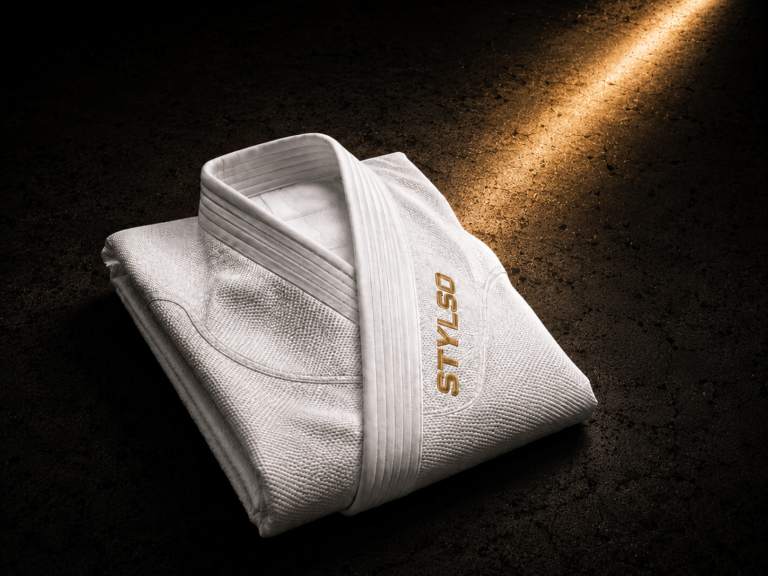
Stylso’s pearl-weave gi comes in A0 through A5 for adults and K000 through K4 for kids — pre-shrunk and IBJJF-approved. If you’re between sizes, size up. You want mobility, not a vacuum seal. Check our size guide for exact measurements.
Free: BJJ Injury Prevention Checklist
The Stylso 5-Shield system on one page — pre-roll checks, the buddy-tape method, warm-up routine, and a 4-week habit stack. Get it instantly.
Key Takeaways
- Tap at 70% — before it hurts, every time. Ego is the real injury risk.
- Ten-minute warm-up before every session. Not optional.
- Ear guards every roll — cauliflower ear doesn’t un-set.
- Buddy-tape vulnerable fingers before you roll, not after they’re swollen.
- Sharp joint pain or a pop means stop immediately. Muscle soreness is fine.
- Recovery is part of training — sleep, hydrate, take rest days.
- A gi that fits right lets you move right and reduces friction injuries.
Frequently Asked Questions
What are the most common BJJ injuries?
Finger sprains, elbow strains from armbars fought too long, knee ligament issues, and cauliflower ear. Most are preventable with early tapping, protective gear, and a consistent warm-up routine.
How do I prevent cauliflower ear in BJJ?
Wear ear guards every time you roll. If you feel a lump forming after training, get it drained quickly by a doctor. Once the cartilage hardens, it’s permanent — there’s no undoing it.
Should I tape my fingers even if they’re not injured?
Yes — especially if you play heavy collar or sleeve grips. Prevention tape before a session beats reactive tape after a sprain. Half-inch strips, buddy-tape method, every roll.
How long should I rest a BJJ injury?
Depends on the injury. A minor finger sprain: 3–7 days of no full gripping. An elbow strain: 1–3 weeks off from pressure. Knee issues: see a doctor. When in doubt, rest longer than you think you need to.
What protective gear should a BJJ beginner buy first?
Finger tape and a mouth guard first — cheap, immediately useful, and cover the most common beginner injuries. Add ear guards after your first few sessions of live rolling. Knee pads if you’re a wrestler or do a lot of takedowns.
Can BJJ injuries be completely avoided?
Not completely — it’s a contact sport. But most training injuries follow predictable patterns: not tapping early, skipping warm-ups, no protective gear. Fix those three and you’ll cut your injury rate dramatically.