Stylso — BJJ gis and combat-sports apparel, built for athletes who train.
Can you use a judo gi for BJJ? Many gyms will let you try it short-term. But a judo gi and a BJJ gi are built differently — collar, sleeves, jacket, weave — and those differences show up fast on the mat. For competition, a judo gi fails the inspection every time.
- A judo gi has a wide, stiff collar — your training partner will find collar chokes you didn’t expect.
- IBJJF inspects collar width and jacket fit at check-in. A judo gi fails both.
- For BJJ training and competition, get a BJJ gi. It’s the right tool for the job.
Can you use a judo gi for BJJ?
You’ve probably seen this question on Reddit. Someone shows up to their first class with a judo gi. It’s a gi. It covers the body. So what’s the problem?
Here’s the honest answer: at many recreational BJJ gyms, a judo gi is fine for a few casual sessions. Coaches are usually relaxed about beginners borrowing or wearing what they have. Short-term, for drilling and rolling at a casual gym, it’s not the end of the world.
But competition is a completely different story.
IBJJF competition rules are specific. The collar must meet exact width and stiffness standards. The jacket must fit within defined measurements — no excess fabric, no oversized skirts. A judo gi has a wide, stiff collar and a long, loose-skirted jacket. It fails both checks at the inspection table. You won’t be allowed to compete. Full stop.
There’s also a practical problem even for casual training. The judo gi’s wide collar gives your training partner a grip advantage you didn’t sign up for. Collar chokes come faster. That’s not great when you’re still figuring out the basics.
If you’re training BJJ as a beginner, the right gear matters more than most people admit. A proper BJJ gi puts you on even footing from day one.
BJJ gi vs judo gi: the 5 real differences
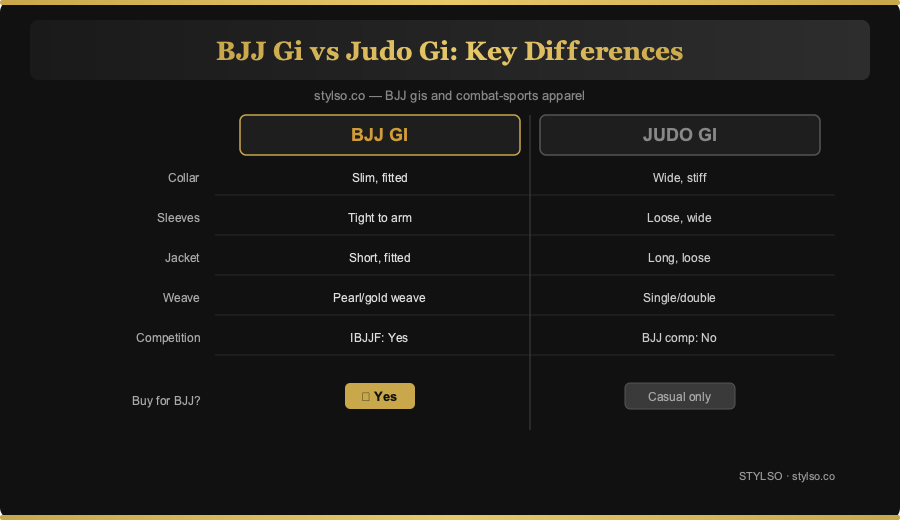
Here’s the breakdown. These aren’t minor details — each one affects how you train, how you grip, and whether you pass inspection.
| Feature | BJJ Gi | Judo Gi |
|---|---|---|
| Collar | Slim, fitted — often foam or rubber reinforced. Harder to grip. | Wide and stiff. Built for kumi-kata grip-fighting. Easy to grab. |
| Sleeves | Tight to the arm. Limits sleeve grips on you. | Loose and wide. Designed for sleeve grips in throws. |
| Jacket | Short and fitted. Cut for guard work and movement on the ground. | Long and loose-skirted. Built for standup throws and kumi-kata. |
| Weave | Pearl weave or gold weave — lighter, durable, competition standard. | Single or double weave — heavier, less common in BJJ. |
| Competition | IBJJF-approved (white, blue, black). Passes collar and fit inspection. Shop on Amazon → | Fails IBJJF collar and fit inspection. Not allowed in BJJ competition. |
The Stylso pearl-weave gi is pre-shrunk and IBJJF-approved in all three legal colors. It’s built for BJJ — not adapted from another sport.
Which gi should you actually buy?
If you train BJJ, buy a BJJ gi. That’s the short answer.
Here’s a small story that makes it concrete. Your first roll in a judo gi, your training partner will find grips you didn’t know were there. The wide collar is basically a handle. The loose sleeve gives them a wrist lock setup before you’ve even figured out your guard. You’ll spend that roll defending grips instead of learning technique.
A BJJ gi removes that disadvantage. The fitted collar and tight sleeves mean you’re not giving away free grips. You learn the actual game faster.
Don’t train in a judo gi and then wonder why everything felt harder than it should have.
If you’re new and looking for a guide, start with our best BJJ gi for beginners roundup. If you’ve already decided and want to check your size, scroll down to the A-series chart.
What judo teaches BJJ players about grips
Here’s the interesting part. Even though a judo gi isn’t right for BJJ competition, judo has something real to teach every BJJ player.
It’s called kumi-kata — the judo grip-fighting system. Every gi grip game in BJJ traces back to it. The collar grip, the sleeve grip, the inside-sleeve entry — all of it originated in judo’s standing game.
The inside-sleeve grip is particularly useful. In judo, players grab the gi sleeve cuff from the inside — meaning your hand goes under and around the sleeve — to set up seoi-nage (shoulder throw). That same grip transfers directly to BJJ’s half-guard game.
In half-guard, the inside-sleeve grip on your opponent’s near arm controls their balance. It sets up the half-guard sweep. It feeds the deep-half entry. Once you’ve felt it, you don’t forget it.
The bigger lesson from kumi-kata is this: prevent the grip before it’s established. Don’t wait until someone has collar control to fight back. Kill the grip at the wrist. This mindset improves guard retention in ways that drilling alone can‘t teach.
Want a quick drill? Try this before your next roll: spend 5 minutes just fighting for the inside-sleeve position — your hand inside your partner’s sleeve cuff, fighting off their grips. You’ll immediately feel how it disrupts your partner’s posture. That same grip locks in your half-guard sweeps the moment you hit the ground.
This is the kind of cross-sport thinking that builds a complete BJJ game. The weave of your gi affects how it holds up to repeated grip-fighting. Pearl weave handles it well.
Your size: Stylso A-series
Stylso gis are pre-shrunk pearl weave. Measure by height and weight — use both, not just one. If you’re between sizes, size up. The weave settles after the first few washes and holds its shape after that.
| Size | Height (cm) | Height (in) | Weight (kg) | Weight (lbs) |
|---|---|---|---|---|
| A0 | 162–168 cm | 64–66 in | 64–70 kg | 141–154 lbs |
| A1 | 168–170 cm | 66–67 in | 70–77 kg | 154–170 lbs |
| A2 | 170–178 cm | 67–70 in | 77–86 kg | 170–190 lbs |
| A3 | 178–188 cm | 70–74 in | 86–102 kg | 190–225 lbs |
| A4 | 185–193 cm | 73–76 in | 104–118 kg | 229–260 lbs |
| A5 | 190–200 cm | 75–79 in | 118–136 kg | 260–300 lbs |
Not sure between A2 and A3? Check our A2 vs A3 gi sizing guide — it goes deeper on how to measure and what to expect from the fit.
Kids’ gi? We’ve got a K-series. See the best BJJ gi for kids for sizing and recommendations.
Free: BJJ Gi Buyer’s Cheat Sheet
The 5 differences between a BJJ gi and a judo gi, the full A-series size chart, and a Shop button — one printable page.
Frequently asked questions
- Can I use a BJJ gi for judo?
- You can train casually in a BJJ gi at some judo clubs, but it won’t pass IJF competition inspection. Judo’s grip game relies on the wide collar and long jacket. A BJJ gi’s slim collar and short cut limit the judo-specific grips coaches need to drill. For serious judo training, get a judo gi.
- What makes a gi IBJJF-legal?
- The IBJJF checks collar width (must fit within a gauge), jacket length (must reach your thigh), sleeve fit (must have a gap between sleeve and forearm when arm is extended), and color (white, blue, or black only). A judo gi’s collar is too wide and its jacket too long and loose — it fails on multiple points.
- Is a judo gi heavier than a BJJ gi?
- Usually, yes. Judo gis often use single or double weave fabric that runs heavier than the pearl weave common in BJJ gis. The weight difference is noticeable after a long class — especially in the jacket. Pearl weave is lighter and more breathable while still being durable.
- Can I wear a rashguard under my gi?
- Yes. Most BJJ gyms allow it — and many encourage it. A rashguard adds a layer between your skin and the mat, reduces mat burn, and wicks sweat. IBJJF rules allow a short-sleeve or long-sleeve rashguard under the gi jacket at most adult divisions. Check your specific competition’s rules. See our best rashguard for BJJ guide.
- How does pearl weave differ from judo weave?
- Pearl weave uses a specific cross-weave pattern that creates a lighter, tighter fabric with good durability. It’s the most common weave in competition BJJ gis. Judo single or double weave runs heavier and is designed for the pulling and throwing loads of judo. For BJJ, pearl weave offers the best balance of weight and durability. Read more in our pearl weave vs gold weave guide.
- What size gi should I order?
- Use the A-series chart above. Measure both your height and your weight — if they point to different sizes, go with the one that fits your weight, then check the height. If you’re right on the border, size up. Stylso gis are pre-shrunk, so what you receive is what you’ll wear.
Stylso Editorial Team | About Stylso