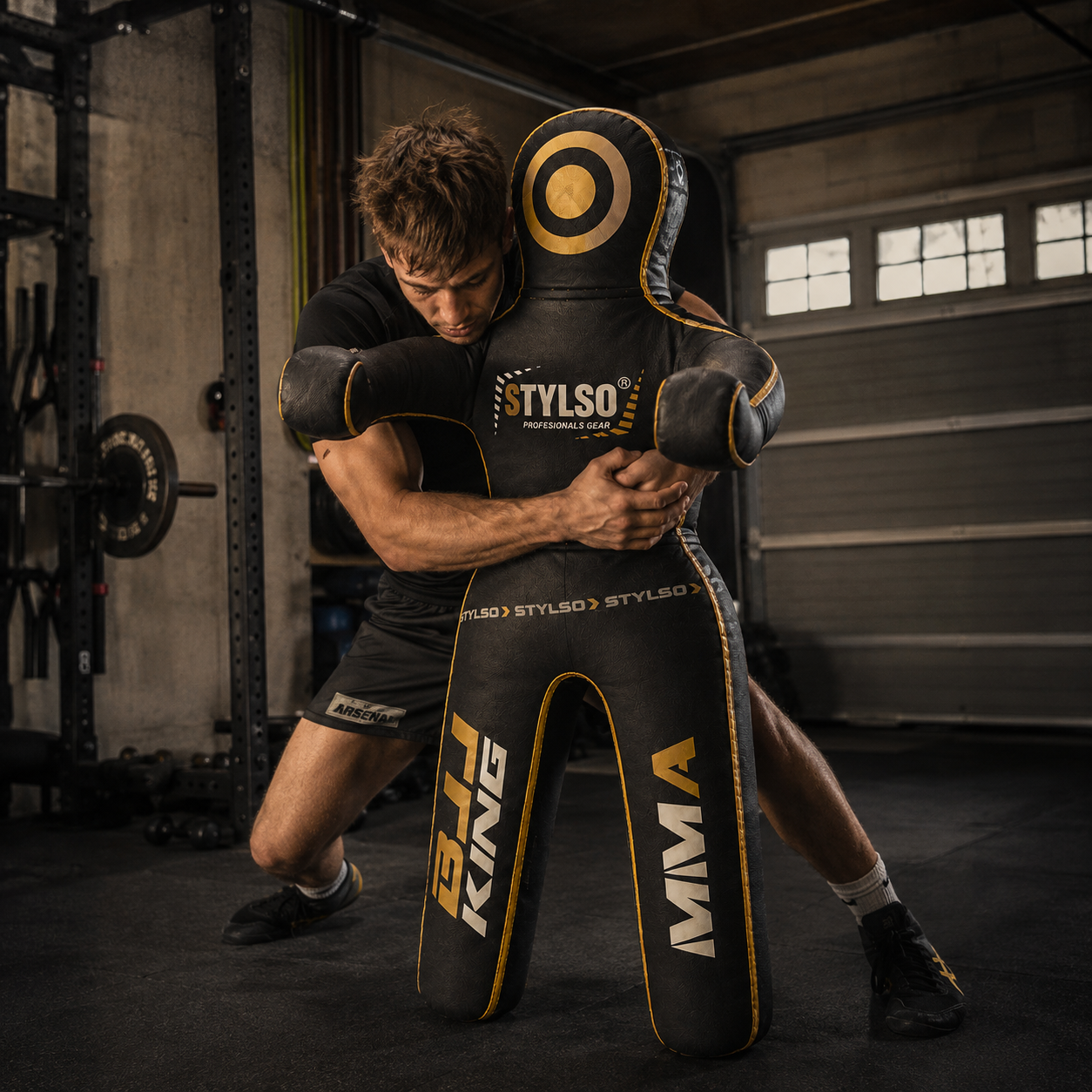
BJJ strength training isn’t about getting bigger. It’s about building strength in the exact positions your body needs on the mat — loaded hips, pulling arms, a core that resists rotation. These 7 exercises hit those patterns directly. Two sessions a week and you’ll feel it in your base, your grip, and your last hard round.
- The 7 BJJ strength exercises — and what each one trains on the mat
- How to program them around your rolling schedule (two 30-min sessions a week)
- The wrestling and judo carry-overs that upgrade every position
Stylso designs its own BJJ gis and combat-sports gear — built for grapplers who want honest picks, not hype. Every recommendation here links to Amazon; we never post a price.
Why Gym Strength Doesn’t Always Transfer
Here’s what nobody tells you when you start lifting for BJJ: bench press doesn’t build the strength you need to survive bottom mount. Leg press doesn’t give you takedown power. Bicep curls don’t build grip endurance.
It’s not that those lifts are useless. It’s that the mat demands something different — strength in awkward angles, under fatigue, while someone’s actively trying to off-balance you. That’s a different kind of strong.
Most grapplers find this out the hard way. You’ve been training consistently, you feel fitter than ever, and then a Tuesday night sparring partner half your size just muscles your guard open. Their hips wouldn’t budge. Your grip broke at three minutes. You knew every position — but your body couldn’t hold it.
That’s the gap between gym strength and mat strength. Here’s how to close it.
The 7 BJJ Strength Training Exercises That Actually Transfer
Each of these targets a movement pattern that shows up directly in grappling — from passing guard to finishing a takedown to surviving bad positions late in a session.
| # | Exercise | Primary Target | BJJ Transfer | Shop |
|---|---|---|---|---|
| 1 | Romanian Deadlift (RDL) | Posterior chain (hamstrings, glutes, low back) | Takedown penetration, double-leg drive, hip extension in top position | Shop → |
| 2 | Pull-ups / Lat Pulldown | Back (lats, rhomboids, rear delts) | Collar and sleeve grip endurance, posture under guard pressure | Shop → |
| 3 | Goblet Squat | Legs and hips (quads, glutes, hip flexors) | Standing base, guard passing, knee shield, sit-up guard | Shop → |
| 4 | Dead Bug | Deep core (anti-rotation, spinal stability) | Guard maintenance, recovering from bad positions, frame holding | Shop → |
| 5 | Farmer’s Carry | Grip, traps, whole-body tension | Grip endurance, staying tall and tight when you’re gassed | Shop → |
| 6 | Single-Leg Deadlift | Glutes, hamstrings, single-leg balance | Scramble stability, one-leg takedown base, sprawl mechanics | Shop → |
| 7 | Hanging Scapular Retraction | Lats, shoulder girdle | Shoulder health, pulling power, injury prevention in top position | Shop → |
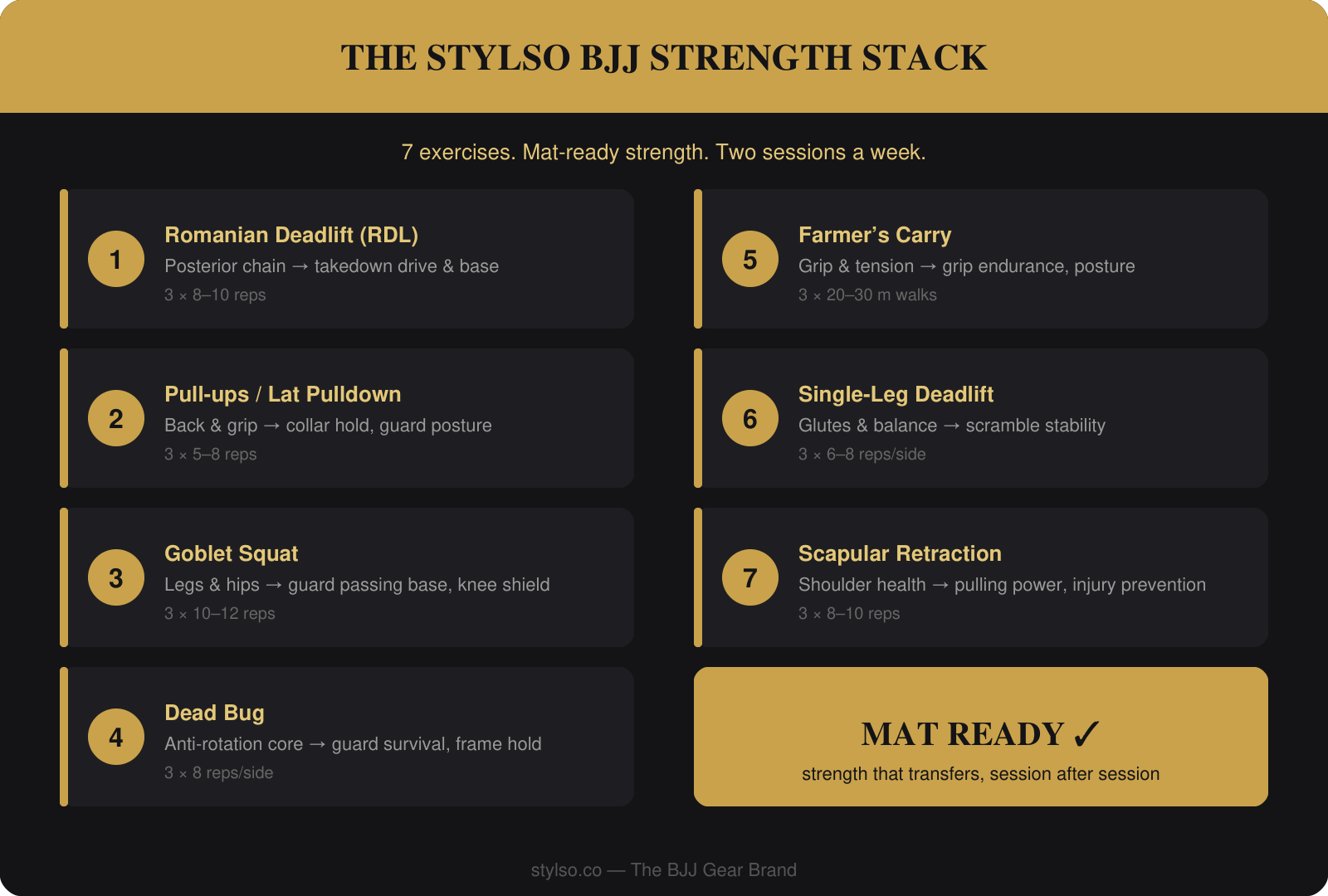
Let’s break each one down — what it does, how to do it, and why it shows up on the mat.
1. Romanian Deadlift (RDL)
If you only do one lift from this list, make it the RDL. It builds the posterior chain — hamstrings, glutes, and low back — the same chain that fires when you shoot a double-leg, extend into top pressure, or sit to your base after getting swept.
Stand with feet hip-width apart. Hold a barbell or dumbbells. Hinge from your hips — back flat, weight close to your legs — until you feel a stretch in your hamstrings. Push your hips forward to stand. 3 sets of 8–10 reps, twice a week.
You’ll notice it first in your base. Suddenly you don’t get swept as easily. That’s the posterior chain doing its job.
Train in gear that moves with you. The right gi doesn’t restrict your hinge pattern — it works with your range of motion, not against it.
Shop the Stylso Men’s BJJ Gi on Amazon
2. Pull-ups / Lat Pulldown
Your collar grip dies first. It happens to everyone — around the three-minute mark in a hard round, your forearms feel like concrete and your sleeve grip just lets go. Pull-ups fix that.
They build the lats, rear delts, and the entire pulling system that keeps your grips alive under fatigue. Can’t do a full pull-up yet? Start with a resistance band or a lat pulldown machine. Aim for 3 sets of 5–8 bodyweight reps — or 3 sets of 10–12 on the machine with controlled form.
Add pull-ups and you won’t be the person whose grips give out first. That’s worth more than almost any other single lift for BJJ.
3. Goblet Squat
A goblet squat is a squat with a weight held at your chest — a dumbbell, kettlebell, or even a loaded backpack. It teaches you to squat tall and upright, hips open, which is the same position you need when you’re trying to pass someone’s guard or post up after a sweep.
It also opens tight hip flexors, which every grappler fighting for flexibility on the mat needs. 3 sets of 10–12 reps. Go deep. Keep your chest up the whole time.
4. Dead Bug
This one surprises people. It looks too simple. It’s not.
Lie on your back. Arms pointed at the ceiling. Knees bent at 90 degrees. Slowly lower one arm and the opposite leg until they almost touch the floor — keep your low back pressed flat the entire time. Return. Alternate sides.
That bracing pattern — holding your spine neutral while your limbs fight the movement — is exactly what keeps you in guard when someone’s trying to stack you or flatten you out. It’s also what protects your low back over thousands of reps of sitting to guard and recovering from bad spots. 3 sets of 8 reps per side.
Most grapplers ignore core training because rolling feels like enough. But rolling trains your core reactively. The dead bug trains it intentionally. Do both.
5. Farmer’s Carry
Pick up something heavy. Walk with it.
That’s the whole exercise — and it’ll do more for your grip endurance, posture under fatigue, and general toughness than almost anything else on this list. Use dumbbells, kettlebells, or loaded bags. Walk 20–30 meters. Turn around. Walk back. Rest. Repeat 3 times.
You’ll feel it in your traps, your forearms, and a dozen smaller muscles you didn’t know you had. On the mat, you’ll feel it when you’re in round 5 and still holding a tight sleeve grip on a wet gi.
6. Single-Leg Deadlift
In a scramble, you’re almost never on two feet. You’re posting one leg, reaching with the other, fighting for position from an awkward base. The single-leg deadlift trains exactly that pattern — unilateral strength and balance you can’t get from bilateral lifts.
Hold a light dumbbell in one hand. Hinge from the hip of the opposite leg — let the non-standing leg extend behind you for balance. Return slowly. 3 sets of 6–8 reps per side. Go lighter than you think. Control is the whole point.
7. Hanging Scapular Retraction
Hang from a pull-up bar with straight arms. Keeping your elbows locked, pull your shoulder blades down and together — like you’re trying to put them in your back pockets. Hold 2 seconds. Release slowly. 3 sets of 8–10 reps.
This isn’t glamorous. Nobody posts videos of scapular retractions. But shoulder injuries end more grappling careers early than almost anything else — and this one move, done consistently, keeps the shoulder girdle strong and healthy under the constant pulling and twisting of BJJ. Don’t skip it.
The Cross-Discipline Edge: What Wrestling and Judo Already Figured Out
Wrestling coaches have known this for decades: the hip hinge is the foundation of almost every grappling movement. The level change in a penetration step, the extension at the end of a double-leg, the sprawl — all of it comes from a trained posterior chain. That’s why the RDL is first on this list, and why wrestlers who transition to BJJ often feel strong on the mat from day one.
Judo adds a different layer. Judoka do pull-ups, hanging work, and towel-grip exercises as a standard part of training — not as a supplement, but as a core drill. Their collar grips are usually the tightest in the room. If your sleeve or lapel grip breaks before your training partner’s, their grip program is probably to blame.
Borrow from both. Train the hip hinge like a wrestler. Train the grip like a judoka. You’ll have something most pure BJJ athletes don’t — and it’ll show up in the third round, when technique alone stops being enough.
Want to see how to structure all of this around your weekly rolling? The Stylso 3-Day Training Plan shows exactly how strength work fits around mat time without killing your recovery.
How to Program This Around Your Rolling
Two strength sessions a week is enough. More isn’t better if you’re also rolling 3–4 times. Fatigue kills skill — and skill is the whole point.
| Day | Session | Strength Block |
|---|---|---|
| Monday | BJJ rolling | — |
| Tuesday | Strength A (25–30 min) | RDL · Goblet Squat · Dead Bug |
| Wednesday | BJJ rolling | — |
| Thursday | Strength B (25–30 min) | Pull-ups · Farmer’s Carry · Scapular Retraction |
| Friday | BJJ rolling | — |
| Saturday | Optional: mobility + single-leg work | Single-Leg Deadlift |
| Sunday | Rest / recovery | — |
Keep strength sessions short. Warm up, hit the exercises with good form, and done. The goal isn’t to be exhausted — it’s to be stronger on the mat. The mat is where the work shows.
If cardio is the limiting factor before strength, build your gas tank first — then layer this program on top.
Three Things Not to Do
- Don’t max out before rolling. Keep strength work moderate. You’re training to be functional, not impressive in the gym. Heavy single reps before a hard session are asking for an injury.
- Don’t skip grip training. Farmer’s carries and pull-ups aren’t exciting. They’re necessary. Your grip is the last thing between you and getting peeled off a choke.
- Don’t neglect shoulder health. One shoulder injury can sideline you for months. The hanging scapular retraction takes 3 minutes and it earns its place every single session.
Also: train in gear that moves with you. A badly fitted gi restricts your range of motion, bunches up in the wrong places, and gets in the way of the very patterns you’re trying to train. Get the fit right — then the exercises do what they’re supposed to do. Check the Stylso size guide if you’re not sure what size you need.
And once you’ve got the strength base, this injury prevention guide covers what to do when something starts to feel off — because it will eventually, and the smart response matters.
Shop the Stylso Men’s BJJ Gi on Amazon
Free: The Stylso BJJ Strength Starter Pack
7 exercises, a weekly program, and a printable training checklist — get the full PDF instantly.
Frequently Asked Questions
How often should I do BJJ strength training?
Twice a week is the sweet spot if you’re rolling 3–4 times. One strength session leads to better recovery; two sessions builds real strength progressively over weeks and months. More than two and you’ll feel it negatively in your rolling quality — fatigue beats technique every time.
Can I do BJJ strength training at home with no equipment?
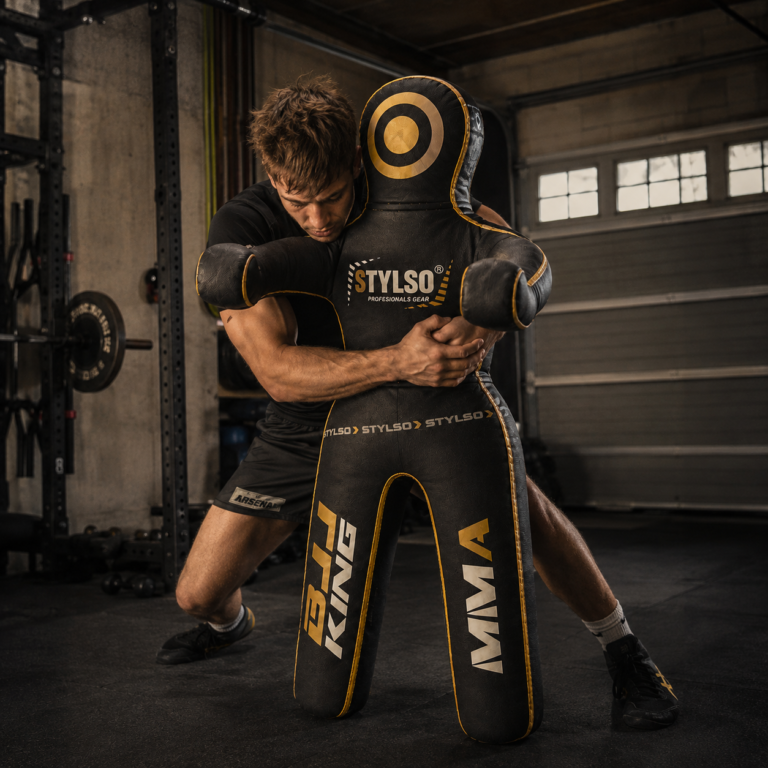
Yes. Dead bugs, single-leg squat progressions, and push-up variations cover the basics. Add a pull-up bar and a pair of dumbbells and you’ve got everything on this list. A grappling dummy helps you add resistance to BJJ-specific movement patterns — here are the solo drills worth doing alongside this program.
Do I need to lift heavy to get stronger for BJJ?
Not necessarily. Moderate weight with good form beats heavy weight with sloppy mechanics. For most of these exercises, working at 60–75% of your max effort is plenty. Control matters more than the number on the plate — and it reduces injury risk considerably.
Will strength training slow me down or make me stiffer?
No — not with these exercises. The movements here are all hip-hinge, pull, carry, and stabilization patterns that improve athletic movement, not restrict it. Keep your training balanced with your rolling and you’ll actually move better on the mat, not worse. The mistake is doing powerlifting-style max-effort work on top of a full BJJ schedule.
How do I know if the strength training is actually helping my BJJ?
Watch your mat performance before the numbers on the bar. Is your base harder to move? Are your grips lasting longer into hard rounds? Are your scrambles more stable? Those are the real measures. Then track your RDL reps and pull-up count — when both go up, and the mat performance improves with them, the program is working.