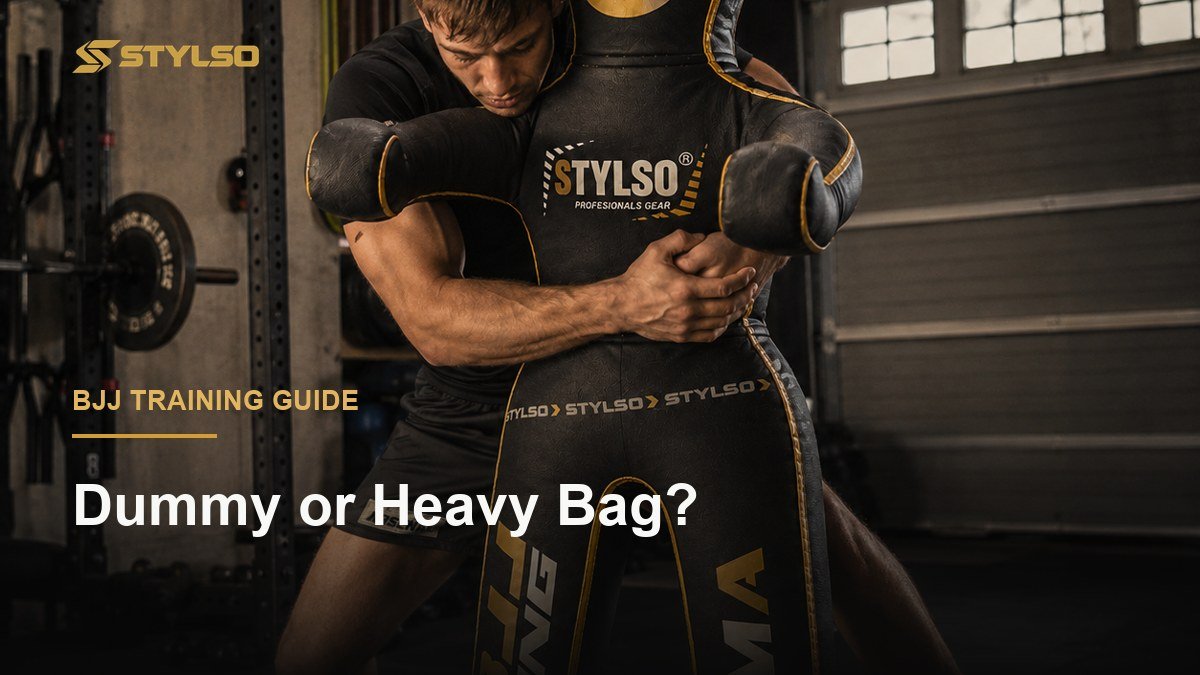
For BJJ, a grappling dummy is the better tool. It lets you drill takedowns, guard passing, submissions, and hip escapes — the exact movements BJJ rewards in live rolling. A heavy bag trains striking combos and cardio. Both are useful, but for pure BJJ drilling, the dummy wins every time. Check the current price on Amazon.
Key Takeaways
- A grappling dummy trains the movements BJJ actually scores: takedowns, guard passing, submissions, and escapes.
- A heavy bag builds striking power and cardio — great for MMA, but it can’t replace ground-game drilling.
- For BJJ-only training, buy the dummy first. Add the bag later if you also train striking or MMA.
Here’s what nobody says when you’re setting up a home training space: specificity beats volume. An hour on a heavy bag is an hour you’re not drilling guard passes. Your body learns exactly what you repeat — nothing more.
I’ve watched this mistake play out over and over. A white belt buys a heavy bag because it’s cheaper and easier to find. Six months later, they’re punching with better form but still getting swept by the same half-guard. The problem isn’t effort. It’s the wrong tool.
What a Heavy Bag Actually Trains for BJJ
A heavy bag is a striking tool. Here’s what it genuinely does well:
- Punch and kick combinations — footwork, timing, and power generation
- Dirty boxing clinch work — short punches and elbows from close range (an MMA staple)
- Explosive cardio — rounds on the bag build your gas tank fast
- Takedown entries — you can shoot in from a bag, but you can’t finish the takedown or go to the ground
That last point is the key problem. In BJJ, a takedown isn’t done until you’re through the legs and in a dominant position. A bag stops the movement exactly where the real BJJ work begins.
There’s nothing wrong with a heavy bag — it works exactly as advertised. The issue is when it gets sold to grapplers as a “BJJ training tool.” It’s a boxing and MMA tool with a very partial crossover to grappling.
What a Grappling Dummy Trains for BJJ
For solo BJJ drilling, nothing touches the dummy. Here’s what you can actually practise:
- Takedowns, start to finish — shoot, lift, trip, and land in mount or side control
- Guard passing — stack pass, torreando, over-under: feel the hip and shoulder mechanics instead of just reading about them
- Submission drilling — armbar, triangle, rear naked choke: the geometry has to live in your body before it works on a live partner
- Hip escapes and bridging — the defensive movements that keep you alive on the mat
- Top game details — mount pressure, back control positioning, side control transitions
Here’s the wrestling lesson that changed how I think about all of this. In judo and wrestling, coaches call it uchi-komi — thousands of repetitions of the throw entry, without ever completing the throw. Just the grip, the hip load, the entry. Over and over. It’s not about full throws. It’s about writing the movement into your nervous system until it’s automatic.
Your body doesn’t care whether the weight on your shoulder is a training partner or a 40-pound vinyl dummy. Clean reps with the right contact points and the right resistance pattern — that’s what builds the motor program. That’s what shows up in live rolling three weeks later.
A dummy gives you those reps. A heavy bag can’t — because the contact points, the movement angles, and the finish are all wrong for grappling.
Head-to-Head: Grappling Dummy vs Heavy Bag
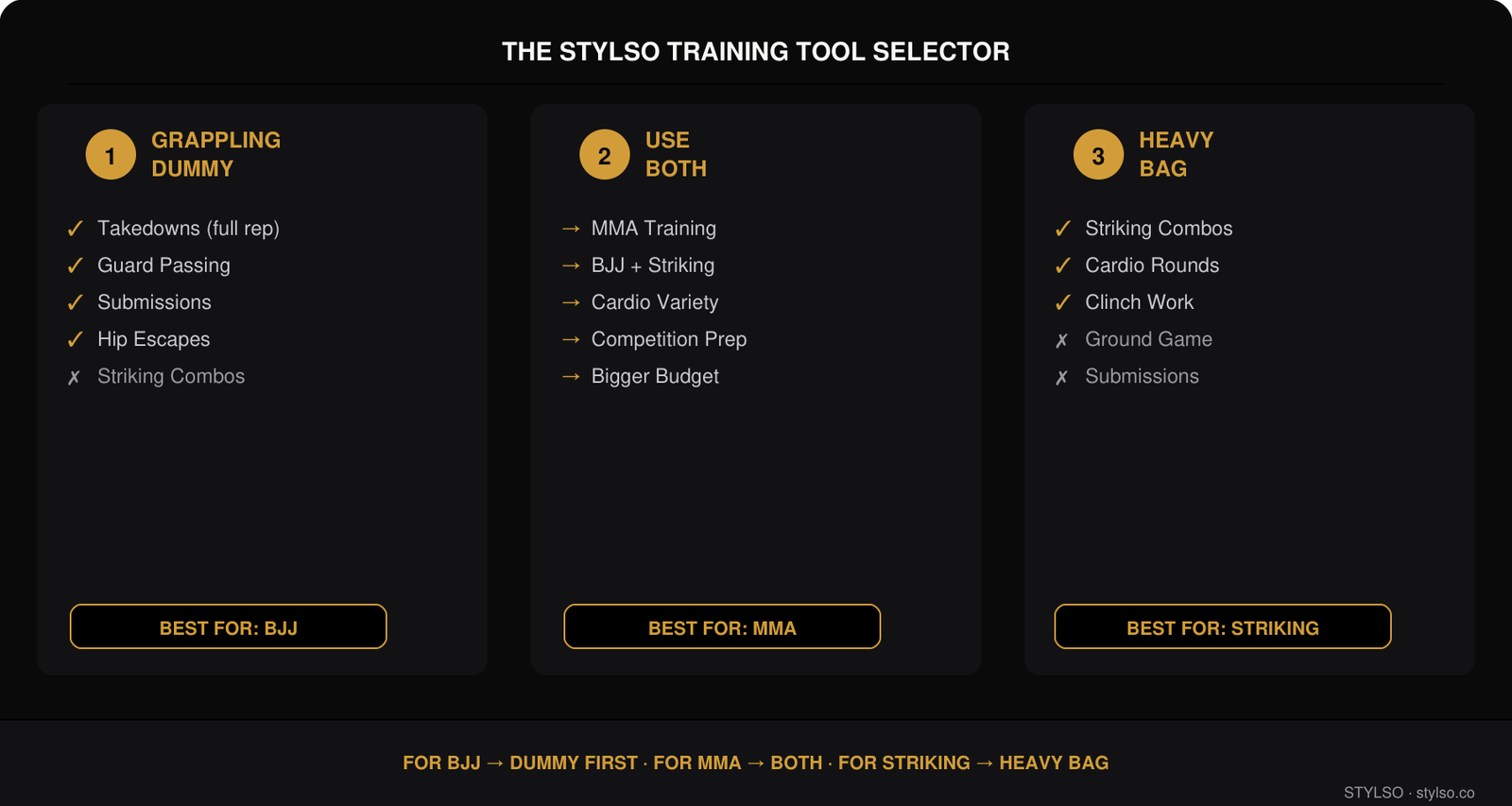
| Skill / Use Case | Grappling Dummy | Heavy Bag |
|---|---|---|
| Takedowns (full rep) | ✅ Yes | ⚠️ Entry only |
| Guard Passing | ✅ Yes | ❌ No |
| Submissions (armbars, chokes) | ✅ Yes | ❌ No |
| Hip Escapes / Bridging | ✅ Yes | ❌ No |
| Striking Combinations | ❌ No | ✅ Yes |
| Cardio Rounds | ⚠️ Limited | ✅ Yes |
| Clinch / Dirty Boxing | ❌ No | ✅ Yes |
| BJJ Drilling ROI | 🏆 High | Low |
| MMA Drilling ROI | Medium (grappling only) | 🏆 High (striking) |
| Shop | Shop on Amazon → | Shop on Amazon → |

Buy the Grappling Dummy First If…
The dummy is the right first purchase for:
- BJJ training — gi or no-gi
- Improving submissions, sweeps, and ground movement
- Solo drilling at home without a regular training partner
- Building a home mat space focused on grappling
The Stylso grappling dummy comes in sitting and standing versions. The sitting dummy covers guard work, armbars from mount, and back-take drilling — the most common BJJ techniques you’d want to solo-drill. The standing dummy handles takedown entries, hip throws, and stand-up transitions. If you’re choosing one to start, the sitting version covers more of the BJJ ground game.
Shop on Amazon — Grappling Dummy
When a Heavy Bag Makes Sense
Get the bag — or add it later — if:
- You also train MMA, Muay Thai, or boxing alongside BJJ
- You want striking-specific cardio rounds
- You already have the dummy and want to close the striking gap
A heavy bag doesn’t hurt your BJJ. Cardio is cardio. If you run four rounds on the bag after 20 minutes of focused dummy drilling, your gas tank thanks you. Just don’t count bag rounds as BJJ technique work — they’re serving a different purpose.
Using Both: A Simple Structure That Works
If you have both tools — or you’re planning for it — here’s a clean training structure:
- Days 1, 3, 5: 20 minutes of dummy work. One technique focus per session (one submission, one guard pass, one takedown entry). Don’t mix — specificity is the point.
- Days 2, 4: 3–4 rounds on the heavy bag for striking cardio, then 10 minutes of dummy drilling to close on grappling.
The rule: always end on grappling. If rolling is the sport, the last thing your nervous system practises before you cool down should be grappling movement. That’s the carry-over principle from wrestling coaching — and it applies to your home gym too.
Free: The Stylso Training Tool Guide (PDF)
One-page decision guide: which tool builds BJJ skill, when to use both, and a 4-week home drilling schedule you can start today.
Frequently Asked Questions
Can you do BJJ on a heavy bag?
Not effectively. You can drill a takedown entry and some clinch pressure, but you can’t do guard passing, submissions, or hip escapes. For BJJ ground game, you need a grappling dummy or a live partner.
Is a grappling dummy worth it for beginners?
Yes. Beginners benefit most from drilling fundamentals — hip escapes, armbars, guard passes — without the pressure of live rolling. A dummy lets you go slow, feel the movement, and build the motor pattern before you need it in a real match.
How heavy should a BJJ grappling dummy be?
About 50–70% of your body weight works for most drilling. Light enough to move fast, heavy enough to give real resistance. Too light and the mechanics feel off; too heavy and you risk your lower back. Check the current options on Amazon for the right size for your weight class.
What’s the difference between a sitting and standing grappling dummy?
A sitting dummy is for guard work, submissions from guard and mount, and back-take entries. A standing dummy handles takedown entries, hip throws, and stand-up transitions. Both serve different parts of the BJJ game — the sitting version covers more ground for most grapplers starting out.
Can a heavy bag help with BJJ takedown practice?
It can help with the very first step — the entry and the shot. But you can’t complete the takedown, go to the ground, or work a dominant position. A grappling dummy lets you drill the full sequence: entry, lift, trip, finish in mount or side control.
Written by the Stylso Editorial Team — BJJ gear & training guides from a brand that designs and sells its own gi and grappling dummy line on Amazon. We never publish a price, a fabricated spec, or a fake rating. Every recommendation goes to Amazon so you can check the current price yourself.