The fastest way out of mount is the bridge-and-roll or the elbow-knee escape — but only if you move early, before your opponent settles their weight. Survive the first few seconds, keep a frame, and one of these four methods gets you to guard or half-guard almost every time. Here’s the full system, ranked by when each one works best.
Quick Takeaways
- Move early — mount is hard to escape because people wait too long, not because it can’t be escaped.
- The bridge-and-roll and elbow-knee escape handle most situations at white and blue belt. Learn those first.
- Frame before you shrimp. One forearm under the throat, one on the hip — buy that breath before you move.
Why Mount Feels Impossible (And Why It Isn’t)
Your first time stuck in mount, you feel crushed. Arms flail. Hips go nowhere. That’s normal — and it doesn’t mean the position is unescapable.
Here’s what nobody tells you early on: mount isn’t hard because you can’t get out. It’s hard because most people wait too long. The longer you stay flat, the heavier your training partner feels. They settle. They adjust. Your options close down fast.
The fix is timing. Move the second you feel mount — before they’ve loaded their weight — and suddenly you’ve got leverage. Wait until they’re fully settled and posting their hands? Now it’s genuinely difficult.
Panic is the other killer. Burning energy with random escape attempts before you’ve framed does more damage than the mount itself. Frame first. One breath. Then pick your method and move with intention.
The 4 BJJ Mount Escapes — When to Use Each
| Method | Best When | Works No-Gi? | Level |
|---|---|---|---|
| Bridge & Roll | Opponent upright, posting one hand | Yes | Beginner |
| Elbow-Knee Escape | Opponent heavy on you, settled weight | Yes | Beginner |
| Frame Escape | Opponent leans forward hunting a choke | Yes | Intermediate |
| Heel-Drag | Wide, heavy base you can’t bridge | Somewhat | Intermediate |
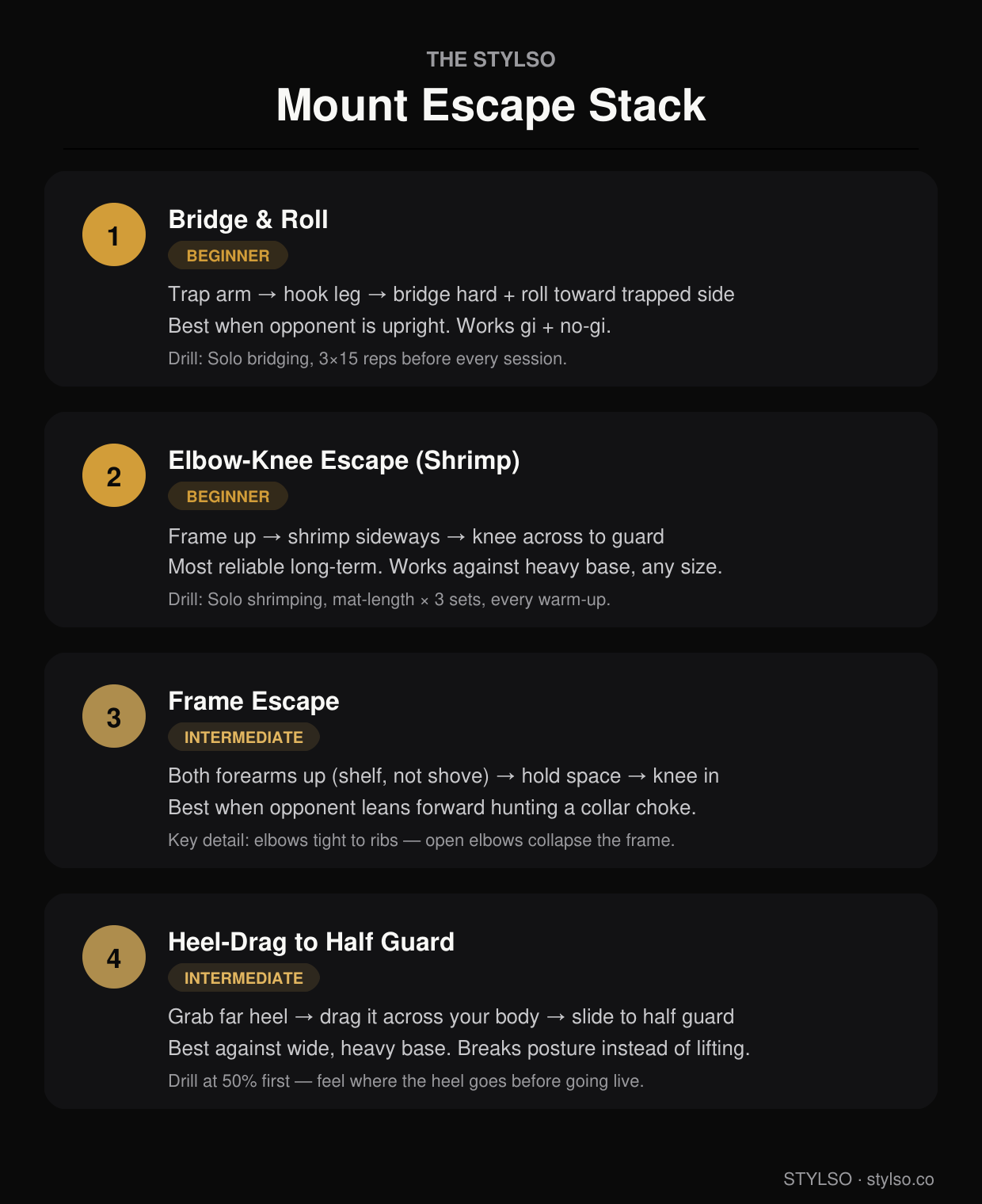
Don’t try to learn all four at once. The bridge-and-roll and elbow-knee escape handle about 90% of mount situations at white and blue belt. Start there, drill them until they’re automatic, then add the others.
Method 1 — Bridge and Roll (Trap and Roll)
This is your fastest exit when it works. If your opponent is riding high and posting one hand, you can flip them before they adjust.
- Trap the arm. Grab their wrist and pin it to your chest. That hand is now stuck — their base on that side is gone.
- Hook the leg. Lock your same-side foot around their ankle or hook behind their knee.
- Bridge and roll — hard. Drive your hips straight up (the bridge) and rotate toward the trapped side. Both moves at the same time. The bridge is the power; the roll is the direction. Half a bridge won’t flip anyone.
- Follow them over. Stay chest-to-chest. Don’t let go. You land in their guard — that’s the goal.
The drill: Solo bridging, 3 sets of 15 reps, before every session. Your bridge should be explosive enough to pop your training partner clean off the mat. If it isn’t, you’ve found a gap — fix it here.
Hip mobility fix: Lie flat, feet near your glutes. Drive hips as high as possible, hold 2 seconds, lower. 15 reps. Do this before rolling and your bridge gets stronger within weeks — and your guard retention gets better with it, since the same hip strength shows up everywhere on the mat.
A well-fitted gi matters here too. A loose gi lets your opponent grab extra fabric and slow the roll. A close-cut, preshrunk gi stays out of their hands — the fabric isn’t a liability.
Method 2 — Elbow-Knee Escape (Shrimp)
This one’s the keeper. It works when your opponent is too heavy to bridge — you’re not moving them, you’re moving yourself.
- Frame first. One forearm under their throat (palm up, not into their face), one hand on their hip. This buys you a second of breathing room.
- Small bridge, then shrimp sideways. A tiny hip lift — just enough to create a gap — then shoot your hips to one side. Think sideways, not up. You’re making space, not trying to flip them.
- Sneak the knee in. Bring your bottom knee across their hips toward your chest. Half guard is good. Full guard if they give you room.
- Repeat the other way if needed. If they cut the angle and close the gap, shrimp again in the opposite direction. Keep going until the knee is through.
The drill: Solo shrimping — 20 reps from one end of the mat to the other. It looks awkward. It’s the single most important solo drill in BJJ. Every good grappler you’ve ever watched has put thousands of reps into exactly this movement.
Cross-discipline lesson: Judo players develop exceptional hip mobility from constant throwing and ground transitions. The same relaxed hip isolation that drives harai-goshi and uchi-mata — loose hips, no wasted tension — is what makes a shrimp escape effective. If you ever drill with a judoka, watch how they move on the ground: calm, low energy, efficient. That’s the model. Your escape shouldn’t look like a fight with the floor.
Method 3 — Frame Escape
When your opponent is leaning forward hunting a choke, the frame escape keeps you safe and opens space for the knee.
- Both forearms up — parallel or slightly crossed across their chest. You’re building a shelf, not a shove. Shoving burns energy and they just lean back into you. Hold the frame; don’t push it.
- Elbows tight to your ribs. This is the one thing most people get wrong. An open elbow collapses the whole frame. Keep elbows tucked, wrists strong, and the frame holds.
- Shrimp under the frame. Same elbow-knee mechanics — now your knee comes in while the frame holds the space open. One motion into the other.
The frame escape is as much posture as it is movement. Get the elbows right and the rest follows. Get them wrong and you’re just pushing air.
Method 4 — Heel-Drag to Half Guard
For the training partner who has a genuinely wide, heavy base you can’t bridge. Instead of moving their hips, you move their feet.
- Reach for the far heel with both hands. You’re going around and past your own hip to get there. Commit to the reach.
- Drag the heel across your body. Pull it toward you and across. Their knee drops as their base breaks — they can’t stay wide if you’ve moved the anchor.
- Slide into half guard. As their base collapses, your knees come up. You’re looking for half guard or a butterfly hook.
This feels awkward the first time. Drill it slowly in positional sparring — you need to feel exactly where the heel goes before you can execute it under pressure. Don’t rush it to live rolling.
How to Train Mount Escapes So They Actually Stick
Knowing the move on paper doesn’t mean you’ll hit it live. Here’s what actually works:
- Positional sparring, not just full rolls. Ask your training partner to start in mount — you on bottom — every round for a week. You can’t drill mount escapes if you’re never in mount during training. This sounds obvious; most people never do it.
- Slow first, then live. Work the mechanics at 50% speed before adding intensity. Fix the habit first, then add the pressure. A half-formed habit just gets you tapped faster.
- One method per week. Pick the bridge-and-roll and stick with it for seven straight days. Don’t switch. Depth beats breadth at white belt — you want one move that’s automatic, not four moves that are shaky.
Related guides: BJJ Takedowns for Beginners · BJJ Guard Passing Tips · How to Build BJJ Cardio
Gear for Ground Work
Tight positional work stresses your gi more than standing drills. A close-cut, preshrunk gi doesn’t bunch up in the back and give your opponent something to grab.
| Who It’s For | What to Look For | Stylso Pick |
|---|---|---|
| Adult training in gi | Close cut, preshrunk pearl weave — no excess fabric | Men’s A-Series Gi |
| Kids starting BJJ | Soft, durable, full range of motion | Kids’ K-Series Gi |
Free: The Stylso Mount Escape Checklist
4 methods, key drills, and a 4-week training plan — one printable page, no fluff.
FAQ — BJJ Mount Escapes
Which mount escape should a beginner learn first?
Start with the bridge-and-roll and the elbow-knee escape. They’re the two that show up everywhere at white and blue belt, they reinforce each other (bridging builds the hip strength the shrimp needs), and they both work in gi and no-gi. Don’t move to the frame or heel-drag until these two are automatic.
Do BJJ mount escapes work in no-gi?
Yes — all four methods work without a gi. The mechanics are identical. The difference is you can’t use collar-and-sleeve grips to trap the arm for the bridge-and-roll, so you rely on wrist control and body locks instead. The elbow-knee escape and frame escape translate directly with zero adjustment.
How do I stop my opponent from taking mount in the first place?
Prevention is easier than escape. When someone passes your guard to side control, immediately frame and bring your knees toward your chest. Most people give up mount during the transition from side control — they flatten out and stop fighting for frames. Address the pass, not the mount. Our guard passing tips guide covers the mechanics from both sides.
My training partner is much heavier than me — does any of this work?
Yes, but timing matters even more. A heavier opponent who’s fully settled is harder to bridge. Attack the elbow-knee escape early — the moment you feel mount, not after they’ve loaded their weight. The shrimp escape works across any size differential when applied before they settle. Size is an advantage in mount; timing is your counter.
How long does it take to reliably escape mount in BJJ?
Most white belts see real improvement within 4–6 weeks of intentional positional drilling. Key word: intentional. One month of asking your partner to start in mount each session beats a year of random rolls where mount happens to you occasionally. The reps are there — you just need to put yourself there on purpose.
Do these mount escape mechanics apply to MMA ground defense?
Directly. The bridge-and-roll and elbow-knee escape are taught verbatim for MMA ground defense — the body mechanics are identical. The major difference: in MMA you’re managing strikes from mount, so the frame becomes a survival tool first. Frame to protect, then escape. The same sequence, with an added layer of urgency.