Round three. You got the takedown, took top position — and then nothing. Your arms go heavy. Your breathing’s ragged. Your opponent starts moving again, and now you’re just trying to survive.
It’s not because you’re unfit. It’s because BJJ cardio isn’t regular cardio. And most people are training the wrong type.
Quick answer: To build BJJ cardio, train sport-specific energy systems — grappling rounds (3–5 minutes), sprint intervals at the 15-second work-rest ratio, and daily solo drilling for your aerobic base. Add deliberate breathing work and real recovery. This 5-step stack builds the endurance that holds up in round five, not just round one.
Stylso — BJJ gis & combat-sports apparel.
- BJJ cardio is built with rounds and intervals — not long runs alone
- A grappling dummy lets you drill solo aerobic sets any time, no partner needed
- Recovery and sleep are when the gas tank actually locks in
Why BJJ Cardio Isn’t Like Other Fitness
A 5K run is slow, steady-state work. A grappling match is the opposite. Think 20-second scrambles, a few seconds of breathing room, then another scramble. Wrestlers call this the alactic-aerobic mix — fast bursts with very short recovery windows, over and over.
That’s why someone who runs marathons can still gas out in round two on the mat. Their aerobic engine is huge, but it’s not built for the on/off demand of grappling. Your body has to recover fast between bursts, not just last a long time.
The fix is to train the actual pattern. Here’s how.
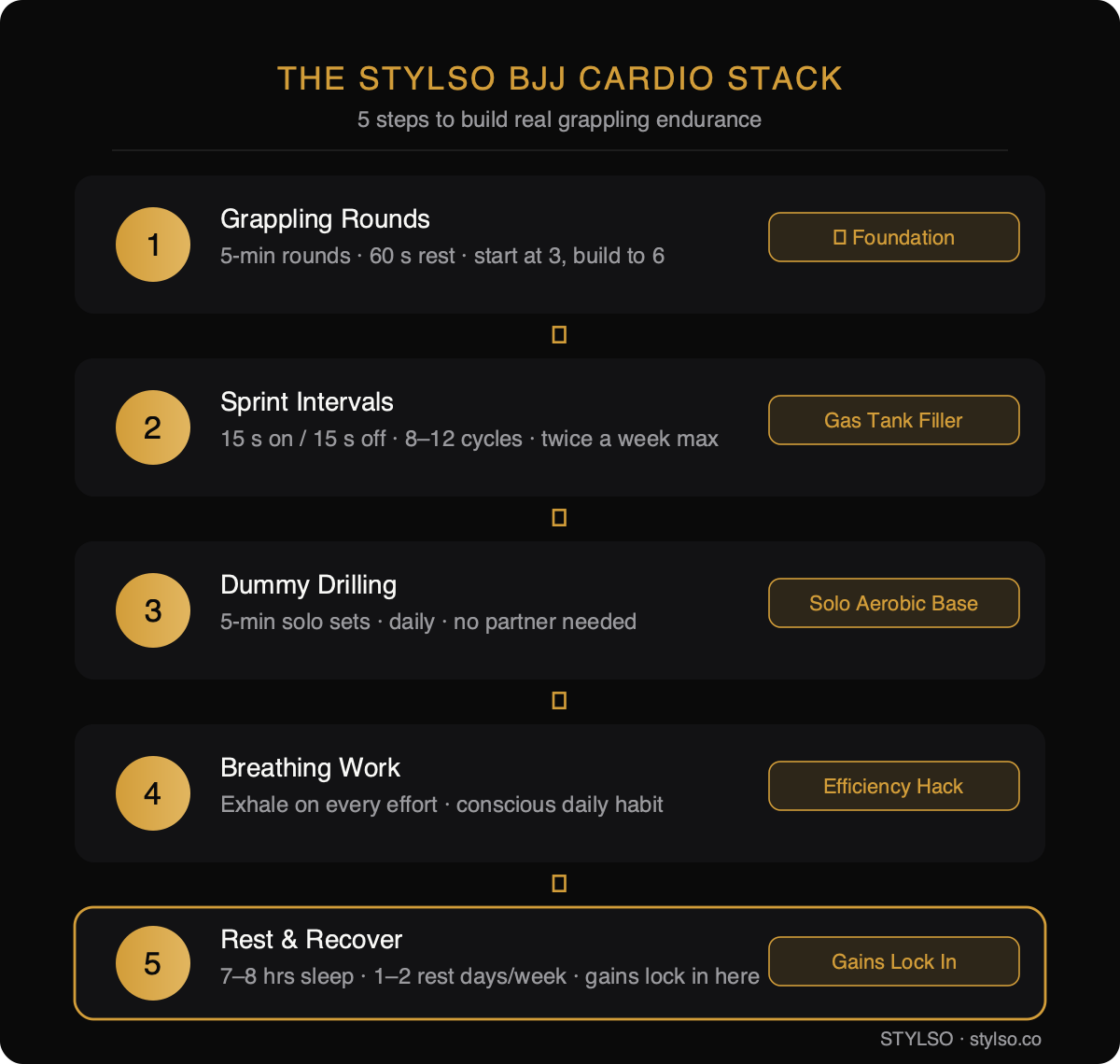
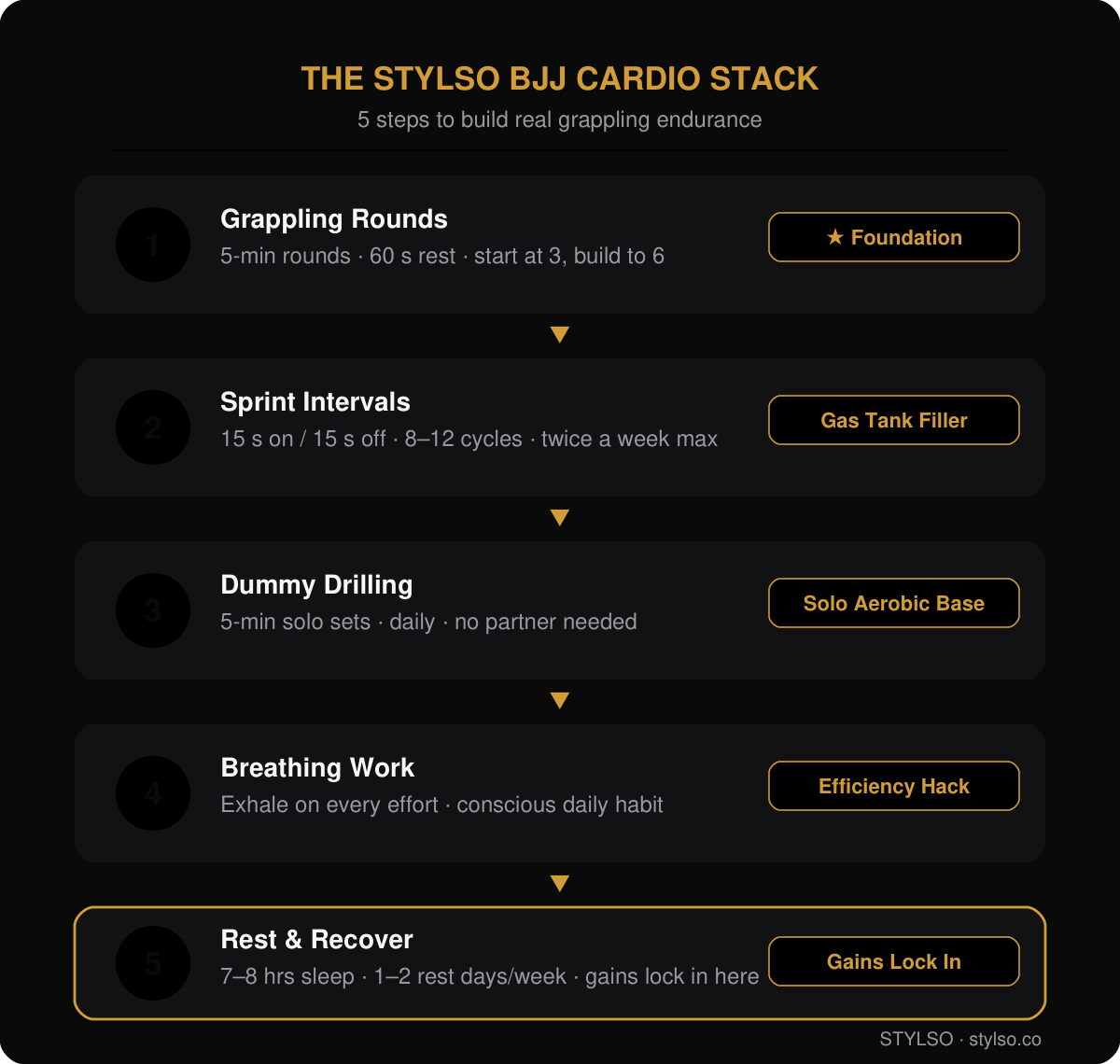
The Stylso BJJ Cardio Stack
Five training habits, stacked in order. You don’t need all five from day one. Start with Step 1 and add one per week — don’t rush the stack.
Step 1 — Grappling Rounds
This is the most important thing on this list. Five-minute rounds. Sixty seconds of rest. That’s the whole formula.
Start at 3 rounds per session. Build to 6 over 4–6 weeks. You can’t fake your way through live sparring — every round is real conditioning. If you’re brand new, ask your coach for positional drilling rounds instead of full sparring. The cardio demand is identical; the technical pressure is a bit lower.
Consistency beats intensity here. Three honest mat days a week beats one brutal day. Show up. Do the rounds. That’s Step 1.
Step 2 — Sprint Intervals
Here’s the ratio BJJ actually uses: 15 seconds of max effort, 15 seconds of rest, repeated. That’s the scramble-pause pattern. Match it off the mat.
Jump rope, stationary bike, treadmill — 15 on / 15 off for 8 to 12 cycles. Do this twice a week, not every day. More intervals don’t mean more cardio. Done wrong, they drain your legs for sparring, which is the last thing you want.
Two smart interval sessions a week is plenty when you’re also putting in regular mat time.
Step 3 — Dummy Drilling
Here’s the part nobody tells you: drilling solo reps at pace is cardio training. Pick one move — hip escapes, single-leg shots, guard pass setups — and rep it non-stop for five minutes. You’ll feel the burn in exactly the right places.
A grappling dummy makes this far more useful. The standing dummy handles full-resistance takedown reps, choke setups, sweep practice — the kinds of moves that actually build your aerobic base. And you can do it at 10 PM when the gym’s closed, on a rest day from sparring, or just when you need extra volume without the joint wear of live drilling.
Shop Stylso Grappling Dummy on Amazon
Step 4 — Breathing Work
Wrestlers train this deliberately. Most BJJ beginners don’t — and it costs them rounds.
Here’s the pattern: when you’re in a tight spot — under mount, fighting for underhooks, stuck in a scramble — you hold your breath. Every white belt does it. That’s the main thing draining your gas in 60 seconds. Your lungs aren’t the problem. Your breathing pattern is.
The fix is simple. During drilling, consciously exhale on every effort. Out-breath on the hip escape. On the guard pass. On the single-leg shot. Wrestlers, yoga coaches, and sports scientists all teach the same thing: intentional exhales on effort let you go twice as long on the same lung capacity. It’s not a soft technique — it’s physiology.
Try it today. Pick any drill, rep it for 60 seconds, and force yourself to breathe out on every single rep. Notice the difference at the 45-second mark.
Step 5 — Rest and Recover
This is where the actual adaptation happens — not on the mat.
Your aerobic base doesn’t grow during training. It grows during sleep. 7–8 hours. That’s not optional if you want cardio gains. Train hard 3–4 days a week, rest 1–2 days. Your training partner who always seems fresher than you? They probably sleep more.
Hydrate between rounds, not just after. Dehydration tanks your cardio faster than almost any fitness gap. And wash your gi after every session — clean gear means no mat bacteria, no skin issues pulling your focus away from training.
BJJ Cardio Methods — What Works
| Training Method | Best For | Sessions/Week | Mat Transfer | Shop |
|---|---|---|---|---|
| Grappling Rounds | Complete cardio | 3–4 | ★★★★★ | — |
| Sprint Intervals | Explosive capacity | 2 | ★★★★ | — |
| Dummy Drilling | Solo aerobic base | Daily OK | ★★★★ | Shop Dummy |
| Steady-State Running | General fitness | 1 | ★★ | — |
| Breathing Work | Efficiency (free) | Daily | ★★★★★ | — |
Gear That Supports the Work
You don’t need much. A gi that fits and something to drill with.
The Stylso men’s gi is pearl-weave, pre-shrunk, and IBJJF-approved. Training in a gi that fits properly means one less thing breaking your focus mid-round — no stretched collar catching your chin, no jacket that gaps wrong. Small thing, but it adds up over a session. And the Stylso standing grappling dummy handles the solo drilling step at home.
Check current pricing on Amazon for both — no prices listed here.
Shop Stylso Men’s BJJ Gi on Amazon
Shop Stylso Grappling Dummy on Amazon
Also see: BJJ Training Schedule for Beginners — a full week-by-week plan. Or How to Get Better at BJJ Faster for the habit stack beyond cardio.
Free: The BJJ Cardio Checklist
Your week-by-week gas tank builder — the 5-step stack mapped out, with drills, interval plans, and a recovery guide you can print and follow.
Frequently Asked Questions
How long does it take to build BJJ cardio?
Most people notice a real difference in 4–6 weeks of consistent rounds plus intervals. Full adaptation — where round five feels manageable — takes 3–4 months of structured training. Start the Stack this week; you’ll feel the shift before the month is out.
Is running good for BJJ cardio?
One easy run a week helps your aerobic base — it’s not useless. But it won’t replace grappling rounds. BJJ uses a different energy pattern than distance running. Intervals and mat time should come first.
Can I build BJJ cardio without sparring?
Yes. Dummy drilling and intervals build a solid base. But live sparring is the only place to train mental cardio — staying calm under load, pacing yourself, breathing when someone’s trying to finish you. Get on the mat as much as you can.
Why do I gas out even when I’m fit?
BJJ uses muscle groups and movement patterns your normal workouts don’t hit. Your cardiovascular fitness might be solid, but your grappling-specific muscles fatigue fast. Grappling rounds and dummy drilling fix this directly — the adaptation is sport-specific.
How many days a week should I train for BJJ cardio?
Three to four mat sessions a week, plus two interval sessions off the mat. Rest days matter as much as training days. Don’t skip them.
Written by the Stylso Editorial Team — about us. Stylso designs and sells its own gis and grappling dummies on Amazon. Affiliate links above: we earn a commission on qualifying purchases at no extra cost to you. We never state a price or fabricate a spec — check Amazon for current pricing.