Tape BJJ fingers using X-tape for PIP joint sprains, buddy tape for two-finger stability, or a ring-loop for minor soreness. Use 0.5-inch athletic or zinc oxide tape — rigid, not stretchy. Always start with a base loop below the joint. That base loop is what keeps the whole job from sliding off mid-roll.
- X-tape (H-tape) is the standard for injured PIP joints — two anchor loops, two cross strips.
- The base loop is the most important strip you’ll lay — skip it and the tape slides off in 15 minutes.
- Buddy tape is for minor instability only; ring-loop is compression, not support.
- What wrestlers do before every match that most BJJ grapplers never think about.
Why BJJ Specifically Wrecks Fingers
Third round of sparring. You shoot for a cross-collar grip, your partner counters, and your ring finger bends sideways at the middle knuckle. Not broken. You’ve been here before. You shake it out and finish the round, then spend the drive home wondering if you should just stop grabbing sleeves.
BJJ finger injuries aren’t like basketball jams — one hard impact, one dramatic swollen finger. In grappling, it’s cumulative. Hundreds of collar grips, sleeve tugs, mat posts, scissor grabs per session. The joints wear down over weeks and months. That’s why grapplers don’t stop training — they tape the finger, grip lighter, and keep going. The problem is most people tape wrong.
Here’s what most tutorials skip: the tape job fails because the base loop is either missing or too loose. Every cross strip needs something to stick to. Without that anchor, the tape slides toward your fingertip in about 15 minutes of rolling. The fix is one extra strip. We’ll cover it below.
What You Need
- Zinc oxide or athletic tape — 0.5-inch (1.25 cm) width. Narrow enough for a single finger, rigid enough to hold the joint angle. Don’t use stretchy kinesiology tape — it’s designed for muscles, not PIP joint stability.
- Scissors or pre-torn strips — cut 3–4 strips before class so you’re not fighting the roll when you’re already warmed up.
- Clean, dry skin — tape doesn’t stick to sweat. A paper towel wipe before you apply is enough.
3 Methods — Which One Fits
| Method | Best For | Joint | Strips Needed |
|---|---|---|---|
| X-Tape (H-Tape) | PIP joint sprains, ligament soreness, competition prep | Middle knuckle (PIP) | 4 strips, ~5 min |
| Buddy Tape | Minor instability — two fingers taped together | Full finger + neighbor | 2 strips, ~2 min |
| Ring-Loop | General soreness, compression only | Any area | 1 strip, ~1 min |
Not recommending a specific tape brand here — what’s best depends on your skin sensitivity and preference for latex vs. non-latex. Search for zinc oxide, 0.5-inch width, from a brand with grappler or climber reviews. Those two sports push the same finger joints the same way.
Browse Grappling Finger Tape on Amazon →
The Stylso H-Tape Method (X-Tape, Step by Step)
Four strips. Five minutes. Works for the index, middle, ring, or pinky. Most grapplers use this one in competition and hard training.
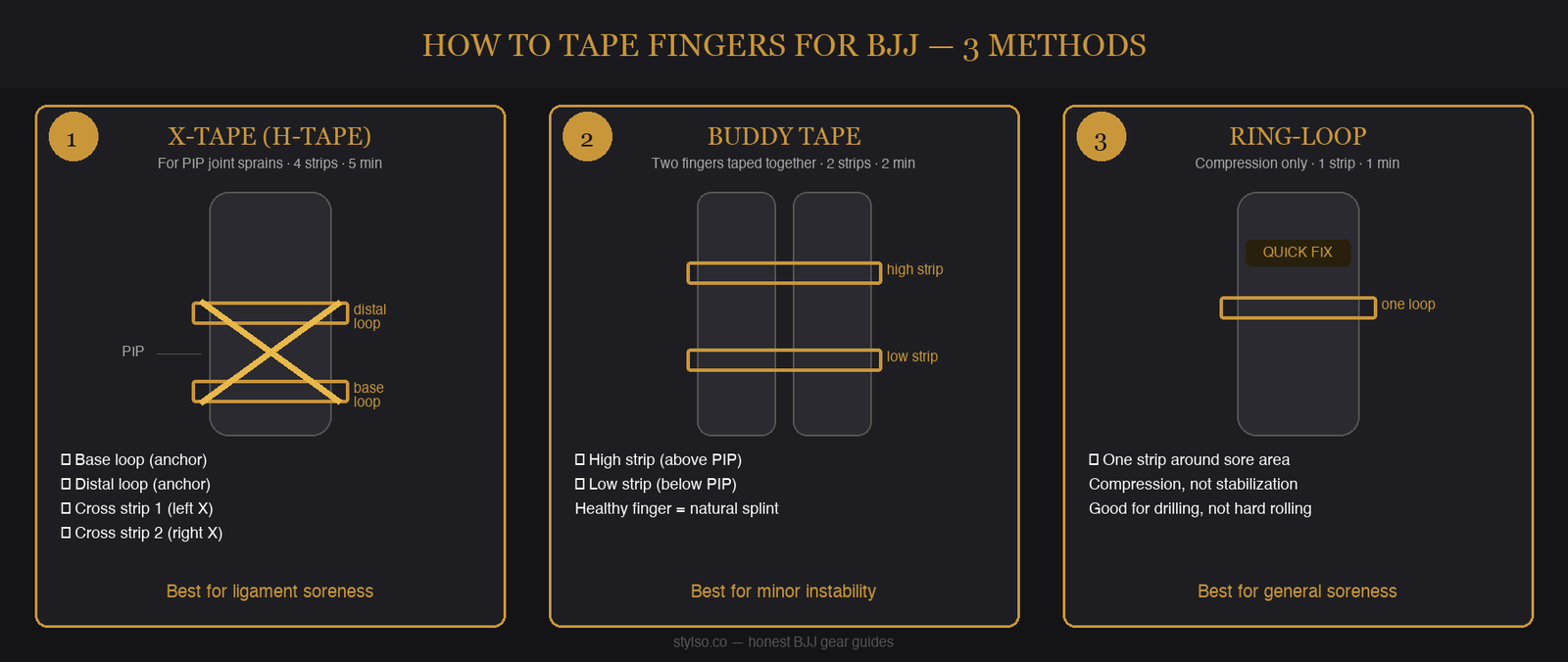
- Base loop (the anchor). Wrap one strip around the proximal phalanx — that’s the base segment below the PIP joint. Snug, not tight. You should still feel your fingertip normally. Press firmly for 10 seconds. This is the anchor for everything else.
- Distal loop. Same thing, one strip above the PIP joint — the segment toward your fingertip. Second anchor. You now have one sore joint sandwiched between two tape loops.
- Cross strip 1. Start at the base loop, angle diagonally across the PIP joint, end at the distal loop. Left leg of the X.
- Cross strip 2. Opposite angle. Right leg of the X. Press both cross strips flat. Done.
The joint can still flex up and down — you need that for gripping. What you’ve cut is the lateral movement (sideways stress) that tears ligaments during collar fights. Reapply before every training session, not just when it hurts. Tape the finger when it’s recovering, not after it re-injures.
A Wrestling Lesson: Tape the Anchor, Not the Pain
Freestyle wrestlers tape their fingers before every match — not because they’re injured, but because grip fatigue changes joint angles. A tired hand grips differently. The PIP joint angle shifts under load. That’s when ligaments catch at odd moments.
The rule Olympic-level grip athletes follow: protect the base of the joint, not the tip. That’s exactly the H-tape logic. The base and distal loops are the structural anchors. The cross strips just hold the angle. Tape the attachment points, not the sore spot.
For BJJ, collar grips come from the base of the fingers. When a PIP joint swells, your grip mechanics shift up toward the fingertip — weaker angle, burns your forearms faster, loses pressure in the second round. One taped finger, done right, keeps your whole hand working for the full session.
Buddy Tape and Ring-Loop: Quick Reference
Buddy tape: one strip above the PIP joint, one strip below it, on two fingers together. The healthy finger acts as a natural splint. Use it for minor instability — when there’s mild soreness but full range of motion. Don’t buddy tape if a finger is visibly bent, has sharp point pain at rest, or feels numb. Those need a doctor, not tape.
Ring-loop: one strip wrapped around the sore area, nothing more. Compression only. It reduces sensation feedback (reminds you not to post on the finger), but doesn’t stabilize the joint. Good for light drilling when the finger’s just aching — not for hard training with collar grips.
When to Tape — and When to Stop
- Minor soreness, normal range of motion, no swelling at rest → tape it, train lighter on grips.
- Mild swelling, some stiffness, still flexes → tape, monitor. Reduce collar grip intensity.
- Visible deformity, sharp pain at a specific point, numbness → stop. See a sports medicine doctor or physio before training again.
Most BJJ finger injuries are grade 1 or grade 2 PIP sprains. Sore, annoying, manageable with tape and a week of lighter training. Grade 3 — a partial or full ligament tear — feels and looks very different. The joint doesn’t hold a grip properly. Tape won’t fix that. Don’t try.
Key Takeaways
- X-tape is the strongest BJJ finger tape method — base loop, distal loop, two cross strips.
- Start with the base loop. It’s the only reason the tape job holds through rolling.
- Buddy tape = two fingers together; ring-loop = compression only. Neither replaces X-tape for real joint soreness.
- Tape before every session during recovery — prevention, not reaction.
- Bent, numb, or swollen at rest = see a doctor before training.
Free: BJJ Hand & Grip Health Checklist
5 checks before and after every session — tape method, grip fatigue signals, post-training recovery steps, and when to rest vs. train through. One page, printable.
Frequently Asked Questions
What tape should I use for BJJ fingers?
Zinc oxide athletic tape in 0.5-inch width is the standard. It’s rigid (holds the joint angle), sticks well to dry skin, and holds through sweat better than most alternatives. Kinesiology tape (the stretchy kind) is for muscles — it doesn’t stabilize a PIP joint. Check the current options on Amazon.
How tight should BJJ finger tape be?
Snug enough to feel resistance when moving sideways, loose enough that your fingertip still has normal sensation. If the tip goes numb or changes colour, it’s too tight. Unwrap and redo the base loop slightly looser — it’s a quick fix.
Can I train BJJ with a taped finger?
Yes, for minor sprains and soreness. Tape manages an existing injury — it doesn’t heal it. Go lighter on collar grips, let the finger rest during specific drills when you can. It’s a judgment call based on how much pain you’re actually in, not how well the tape looks.
How many strips do I need to tape one BJJ finger?
Four for a full X-tape job: two anchor loops plus two cross strips. Two for buddy taping. One for a ring-loop. Cut them all before class — you won’t want to be messing with a tape roll during a technique round.
Why does my finger tape keep falling off during BJJ?
Missing base loop, or one that’s too loose. The base loop (below the PIP joint) is the anchor — without it, the cross strips have nothing to hold and slide toward your fingertip within minutes of rolling. Start there every time, press firmly for 10 seconds before adding anything else.
Should I tape fingers before every BJJ session?
If one’s recovering from a sprain, yes — preventive taping through the healing period is smarter than waiting for re-injury. Healthy fingers with no soreness don’t need tape. Some grapplers tape their two main grip fingers (index and ring) routinely as habit, especially before competition training. That’s a personal call, not a rule.
Related guides: BJJ Gi Collar Grips: 4 Types Every Grappler Should Know · White Belt BJJ Gear List · Best BJJ Ear Guard · How to Improve Your BJJ Guard