For most grapplers, full-length compression spats in a poly-spandex blend are the go-to — they protect your knees in guard, stop mat burns on your thighs, and keep everything in place through every scramble. The right length depends on how you train. Here’s the honest breakdown and where to Shop on Amazon.
- Full-length spats protect your knees and thighs — best for guard-heavy games and no-gi
- Poly-spandex blends (87–90% polyester) wick sweat fast and hold their stretch through hard rounds
- Pair spats with a BJJ rashguard for full no-gi coverage, or wear them solo under your gi
Stylso designs its own BJJ gis and grappling gear — honest buyer’s guides for grapplers who want real answers, not hype. Every recommendation links to Amazon; we never post a price.
What Makes a BJJ Spat Worth Buying
The mat at your gym is woven foam. It grips floors — and skin. Five minutes into your first guard pass, you’ll have knee raspberries on both legs without protection. A good pair of spats fixes that completely.
Three things actually matter:
Material. Look for 87–90% polyester with a spandex mix — that blend wicks sweat fast, dries between rounds, and holds its stretch after a hundred washes. Avoid cotton-blend “gym leggings” sold as spats. They absorb sweat, stay wet all session, and don’t slide cleanly against the mat.
Compression level. Mild to moderate is right. Enough pressure to keep the fabric in place during a scramble — not so tight that your hip flexors feel restricted from your first hip escape. If you have to peel them on, they’re too tight.
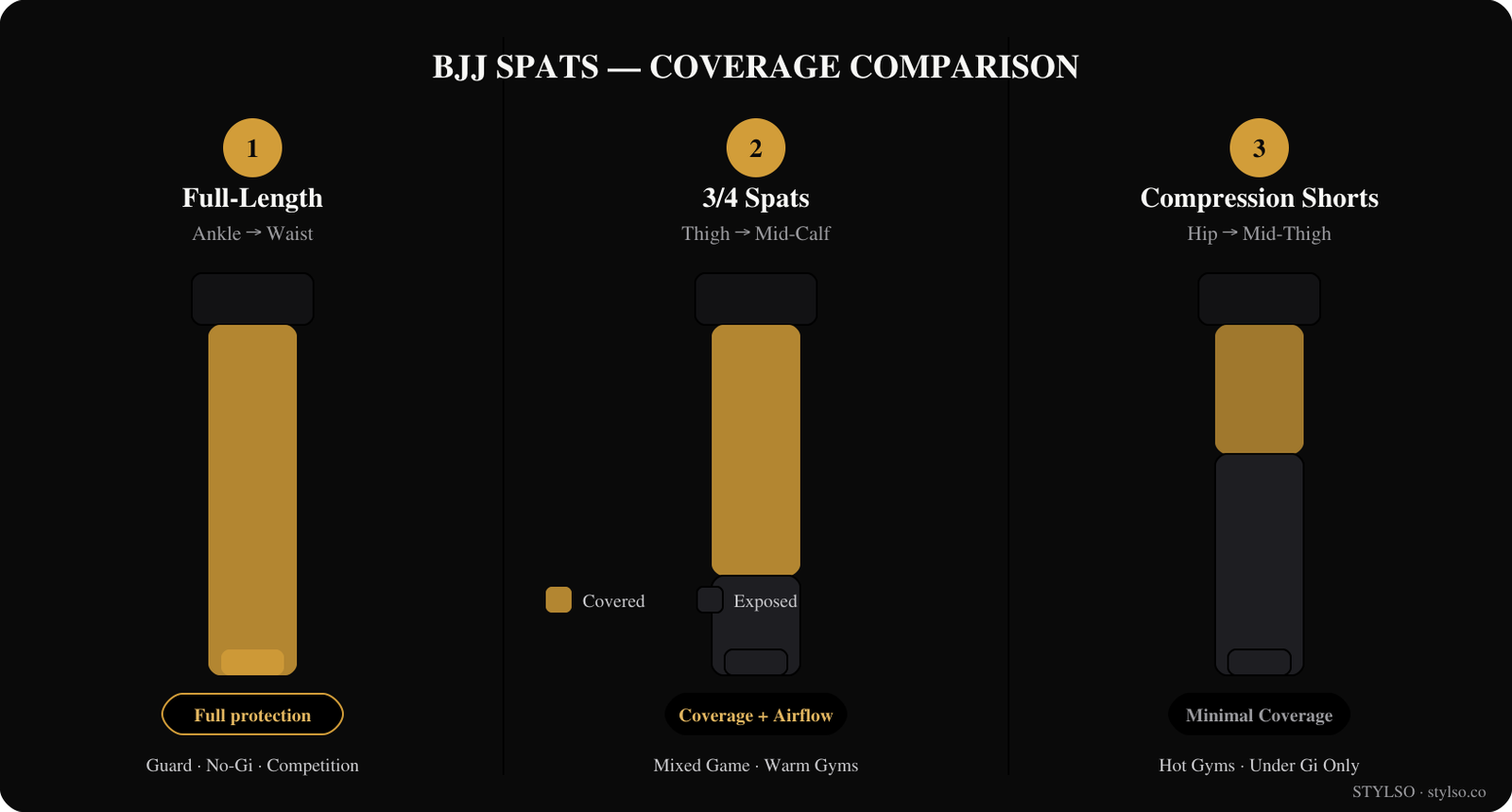
Length. This is the main decision. Full-length covers ankle to waist. Three-quarter reaches mid-calf. Compression shorts cover hip to mid-thigh. Most grapplers land on full-length and never look back — but we’ll break all three down honestly below.
Full-Length vs 3/4 vs Compression Shorts — The Honest Breakdown
You don’t need ten products listed. You need to know which type fits your training — and who each one’s wrong for. Here it is straight:
| Type | Coverage | Best For | Skip If | Shop |
|---|---|---|---|---|
| Full-length spats | Ankle to waist | Guard players, no-gi, mat-burn prone, competition | You run extremely hot in a gym with no AC | Shop → |
| 3/4 spats | Thigh to mid-calf | Mixed games, warmer climates, wrestlers transitioning to BJJ | You play deep half or heel hooks regularly (knee exposed) | Shop → |
| Compression shorts | Hip to mid-thigh | Hot gyms, under a gi for minimal bulk | No-gi guard players — no knee or thigh protection | Shop → |
Check the current price on Amazon before you buy — prices shift, and the listing has the brand’s own size guide too. Don’t skip that step. Spats half an inch too small in the waist feel fine in the store and like a tourniquet after two rounds.
Sizing BJJ Spats — Get It Right the First Time
Here’s the sizing rule that saves a return: size up if you’re between sizes. Spats are designed snug, but the fabric stretches once you’re moving. A size that feels tight in the fitting room feels exactly right after your first five-minute round. A size that feels “just right” off the shelf starts rolling down the moment you go to high guard.
Measure your natural waist — not your hips. The waistband fit is the failure point, not leg length.
| Waist Circumference | Typical Spats Size | Notes |
|---|---|---|
| 28–30 in (71–76 cm) | S | Most teen / lighter-framed adults |
| 30–32 in (76–81 cm) | M | Most common adult fit |
| 32–34 in (81–86 cm) | L | Standard large; check brand’s own chart too |
| 34–36 in (86–91 cm) | XL | Size up if you’re between L and XL |
| 36–40 in (91–102 cm) | 2XL | Larger frames — also check thigh circumference |
Thigh circumference matters more than most people expect. If you have larger legs, a waist-correct size might still be too tight in the thigh mid-roll. Check both measurements before ordering.
If you’re also sizing a gi, our BJJ gi measuring guide walks you through the process — spat sizing follows the same measure-twice logic.
Gi or No-Gi — Spats Work for Both
Most people first hear about spats in a no-gi context. They’re standard under board shorts for no-gi grappling — the gear equivalent of a rashguard on top. But wearing them under a gi is just as useful, and a lot of white belts skip this and regret it.
Under a gi, spats add a friction layer between your skin and the gi pants fabric. Gi fabric is rougher than it looks — it’s the reason your inner thighs are raw after heavy guard drilling. Spats eliminate that. They don’t add much warmth. The gi pants do most of the insulating. What spats do is protect your knees through constant kneeling and pivoting on that woven mat surface.
Still figuring out whether gi or no-gi is right to start? Our gi vs no-gi guide breaks down both formats honestly for beginners.
The Wrestling Trick That Makes Your Spats Last Twice as Long
Wrestlers figured this out before BJJ existed as a sport. Compression gear breaks down from heat, not from wear. The spandex fibres that give compression its stretch get destroyed by hot dryers — not by hard rounds. One hot-dry cycle a week is about ten sessions of invisible damage. Six months later your spats feel looser and slide down every time you go to closed guard. That’s not wear and tear. That’s heat damage.
The fix: cold wash, inside out, hang dry. Every session. No exceptions.
Here’s a drill that goes with this lesson: before your first round, do ten shrimping reps and ten bridging reps on the mat. It warms your hips and lower back, tests your spats’ full range of motion (if they pull on a bridge, the fit or fabric is off), and fires up the muscles you’ll use all session. Two minutes. It’s what wrestlers and judoka do before every practice. BJJ players who skip it feel it in their hip flexors by round three.
And always wash your spats after every session — not every other session, every one. Warm, damp compression gear in a closed bag for 24 hours is exactly what staph bacteria needs. Cold wash. Air dry. Full care details in our gi washing guide — the same rules cover all compression gear.
Three Mistakes Most Grapplers Make with Spats
1. Buying gym leggings and calling them spats. Fashion leggings and yoga pants are cut differently, pill against the mat, and have raised seams in the wrong places. The waistband rolls under a gi belt. Buy gear built for grappling.
2. Sizing too small for “more compression.” It’s the most common mistake. A too-small pair doesn’t compress better — it just restricts your triangle and cuts off circulation during long guard sessions. Correct fit is snug, not strangling.
3. Skipping them under the gi. “I’ll overheat.” You won’t — not more than you already do in a gi. Spats under a gi are one of the smallest equipment swaps that pays off every single session in reduced skin wear and better hygiene. For a full look at what goes where under a gi, our underlayer guide covers every option.
Free: BJJ No-Gi Gear Checklist (Printable PDF)
One page: every no-gi layer explained, sizing rules, what to avoid, wash-and-care tips for compression gear. Get it instantly.
Frequently Asked Questions
Are BJJ spats different from regular compression pants?
Yes. BJJ spats are cut for grappling — they stretch in the hip flexor range (triangle setups, high guard, hip escapes), have flat-lock seams that don’t dig during rolls, and use fabrics rated for repeated mat contact. Regular gym compression pants often have raised seams and don’t hold up to the same friction.
Should a beginner buy spats or compression shorts?
Buy full-length spats. You don’t know yet which positions you’ll default to — full coverage protects your knees and thighs while you figure that out. Compression shorts can come later when you know you run hot or live in single-leg territory.
Do spats help with mat burns?
Yes — that’s one of the main reasons grapplers wear them. Mat burns on the inner thigh, knee, and shin are common in guard-heavy training. Full-length spats create a fabric barrier between your skin and the mat surface that prevents most of them entirely.
Can you wear spats without a rashguard?
You can. Spats and a T-shirt is a valid setup for casual gi training. For no-gi, pairing spats with a rashguard gives you full coverage and a proper hygiene barrier. Spats solo on the bottom work fine in both contexts.
How do you stop spats from rolling down during rolls?
Two things fix it: the right waist fit (size up if between sizes — see the table above), and tucking your rashguard or undershirt into the waistband. If they still roll after those two fixes, the waistband elastic is worn out. That’s your cue to replace them.