BJJ solo drills at home let you build real mat skills — hip escape, bridge, takedown entries, guard frames — without a training partner. The Stylso Solo 7 Circuit takes about 20 minutes and needs no equipment for six of the seven drills. Done regularly, it keeps your movement sharp between sessions.
- 7 drills, ~20 minutes, no partner — a complete home BJJ session you can start today
- Each drill targets a real skill you use every round: guard retention, escapes, takedowns, guard attacks
- Add a grappling dummy for drill 7 and the circuit covers guard passing — the one move you can’t shadow properly
Why Solo Drilling Actually Works
You’ve missed three classes this week. Work, travel, a tweaked knee — pick one. You tell yourself you’re not getting worse. But you are. Not because you’re weak. Because motor patterns fade when you don’t reinforce them.
Here’s the thing nobody says out loud: wrestlers have shadow-wrestled for decades. Judoka solo-rep their uchi-komi — grip drills and throw entries — hundreds of times a week without a partner. Karate practitioners drill kata alone for years before they ever spar. Solo training isn’t new. It’s just underused in BJJ.
Most of your movement problems on the mat are motor-pattern issues, not strength or fitness. You can’t execute a clean hip escape under pressure because your body hasn’t drilled the path enough times. Solo drilling burns that path in. Over and over, at home, at your own pace.
The catch is you have to pick the right drills. Most people do forward rolls for ten minutes and call it done. That’s not a session. This is.
One tip from yoga and mobility work: slow the movement down. Go half-speed on the hip escape. Feel where your hips want to go wrong. Fix it there, not in class when someone’s already passed.
The Stylso Solo 7 Circuit
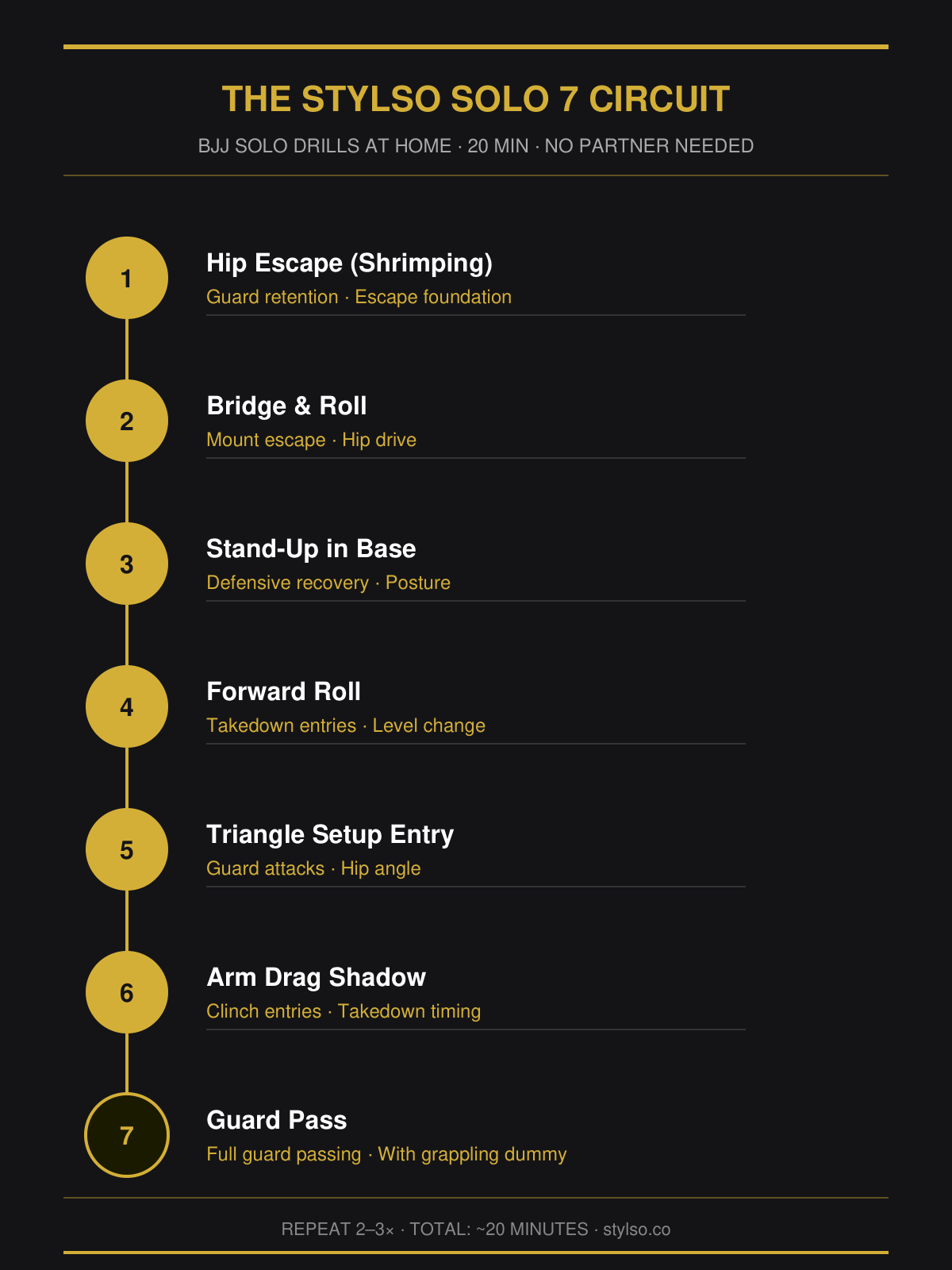
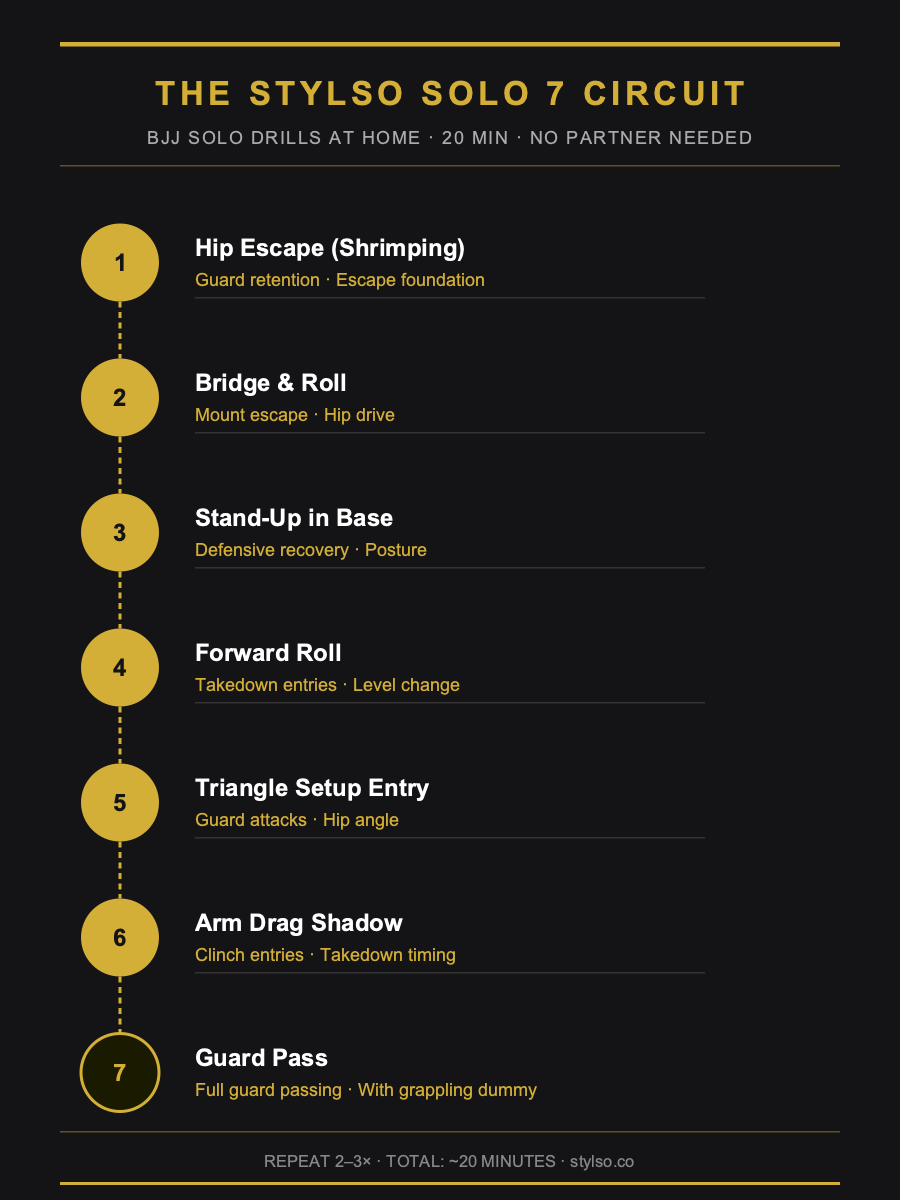
Do these in order. That’s the circuit. It starts on your back and ends on your feet and moves through the positions you’ll hit in every roll. Two or three rounds takes about 20 minutes.
-
Hip Escape (Shrimping)
The single most important movement in BJJ. You’ll use it to recover guard, frame off a pass, and survive bad spots on the mat. Start flat on your back. Bridge, turn onto your side, push your hips away from your head. Repeat all the way to the wall and back. Do two lengths.
What it builds: guard retention, escape foundation, hip mobility.
-
Bridge and Roll
Your out from bottom mount. Lie flat, feet on the floor, arms tight to your sides. Drive your hips up and over one shoulder explosively. Land on your side. Reset. Repeat 10 each direction. The power comes from your hips, not your upper body — feel the difference.
What it builds: mount escape, hip drive, explosive base.
-
Stand-Up in Base
You’re in someone’s guard or just got swept. You need to get up right, not wrong. Start seated. Plant one foot, extend one knee, stand up in a staggered stance — lead hand low, chin tucked. Drop back to seated, switch sides. 10 each side. This one shows up every roll.
What it builds: defensive recovery, posture, base under pressure.
-
Forward Roll
Not a gymnastics roll — a level-change roll. This is how you practice shooting angles and getting low without face-planting. Start standing. Drop to your lead knee, tuck your chin, roll over one shoulder and come up in a staggered stance. Switch shoulders each rep. 10 total.
What it builds: takedown entries, level change, comfort on the mat.
-
Triangle Setup Entry
Lie on your back in guard position. Shoot your hips to one side, swing your leg across, and lock the triangle angle — heel behind knee, tight. Don’t just flop around. Focus on the hip turn. That angle is where most triangles die. 10 each side, slow and precise.
What it builds: guard attacks, hip angle, submission entry timing.
-
Arm Drag Shadow
Stand in fighting stance. Shoot one hand forward to grab a phantom sleeve. Pull it across your body, step to the outside, change levels. You’re drilling the clinch entry and takedown timing. Wrestlers call this “shots and slides” — they do hundreds solo before they ever touch a partner. 15 each side.
What it builds: clinch entries, takedown timing, level change under pressure.
-
Guard Pass (With Grappling Dummy)
This is the one drill that needs something to work against. Shadow-passing guard doesn’t teach you much — you can’t feel the hip weight, the angle, or where the leg blocks. With a grappling dummy seated in front of you, work your toreando pass, your leg drag, your knee slide. 5 minutes of focused reps here beats 20 minutes of aimless shadow work.
What it builds: full guard passing, reading hip resistance, finishing mechanics.
Quick Reference: The Stylso Solo 7
| # | Drill | Skill Built | Time | Gear |
|---|---|---|---|---|
| 1 | Hip Escape | Guard retention · escapes | 3 min | None |
| 2 | Bridge & Roll | Mount escape · hip drive | 2 min | None |
| 3 | Stand-Up in Base | Defensive recovery | 2 min | None |
| 4 | Forward Roll | Takedown entries | 2 min | None |
| 5 | Triangle Entry | Guard attacks · hip angle | 3 min | None |
| 6 | Arm Drag Shadow | Clinch · takedown timing | 3 min | None |
| 7 | Guard Pass | Full guard passing | 5 min | Grappling dummy |
The One Piece of Gear That Changes Everything
Six of the seven drills need nothing but floor space. You don’t need a mat, a rack, or any kit. But drill 7 — the guard pass — is where solo drilling hits a wall if you skip the dummy.
Shadow-passing guard teaches you the idea of a pass. A grappling dummy teaches you the mechanics. There’s a real difference. You learn to read the weight of a guard, adjust your angle when hips shift, and actually finish a pass against something that resists. Ten focused minutes on a dummy will show up in your next class.
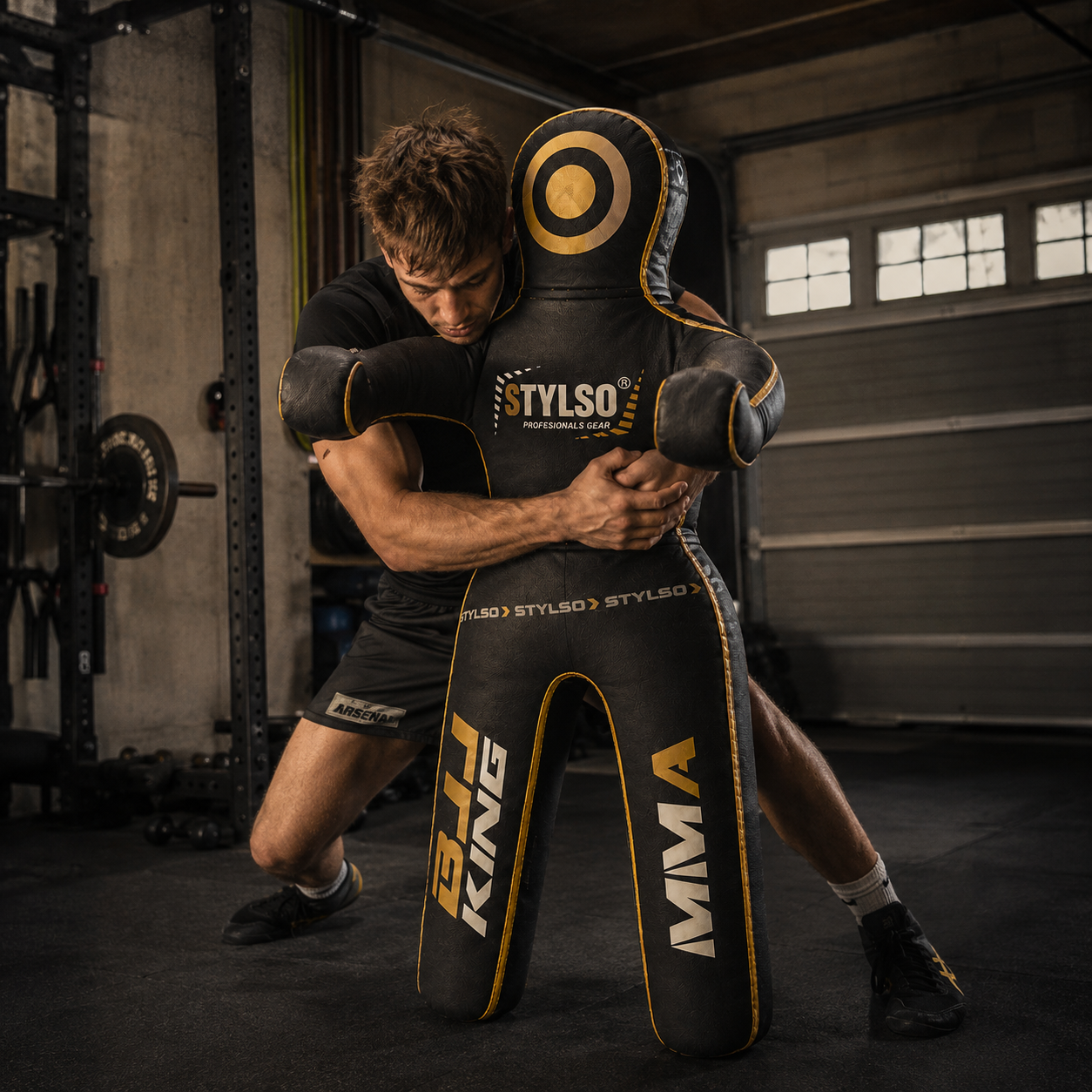
The Stylso sit-position grappling dummy holds the right guard angle, stays stable, and doesn’t tip mid-pass. It’s built for exactly this kind of solo guard work — and it works for guard retention drills too (your arms in its collar and sleeve, working frame-and-shrimp against a fixed opponent). Check the current price on Amazon before you decide.
Shop on Amazon — Stylso Sit Grappling Dummy
Pair it with a solid gi for home sessions — you’ll want the real collar and sleeves to drill grip entries from drill 6. Check out the best BJJ gi for beginners if you’re still picking your first one.
Free: BJJ Solo Drill Checklist
A one-page printable — the Stylso Solo 7 Circuit with rep counts, timing, and a weekly schedule. Plus a care tip for washing your gi after heavy sweat sessions. Get it instantly.
Keep Going
Solo drilling builds the foundation. Pair it with smart training habits — here’s the fastest path to getting better at BJJ and a deep cut on collar grip drilling you can add to your solo sessions.
Questions About BJJ Solo Drilling at Home
How often should I do solo BJJ drills at home?
Three to five times a week is solid. Solo drilling isn’t hard on your body, so it doesn’t need the same recovery time as hard sparring. Even 15 minutes before bed three nights a week will sharpen your movement.
Can solo drilling replace mat time?
No — and it shouldn’t try to. A sparring partner gives you resistance, timing, and unpredictability that you can’t solo-drill. But solo drilling fills the gaps between classes and builds the motor patterns that make your mat time stick faster.
Do I need a grappling dummy for solo BJJ training?
Six of the seven drills here need nothing. The dummy only matters for guard passing and grip drilling — two specific patterns that don’t transfer from shadow work. It’s a good investment if you train a few times a week and want to work guard passing at home.
What’s the best solo drill for beginners?
Hip escape (shrimping). It shows up in every position — guard recovery, escapes, frames. If you only do one thing, do two lengths of the room shrimping every day. It’s what separates beginners who improve fast from those who stay stuck.
How long does a solo BJJ circuit take?
The Stylso Solo 7 Circuit runs about 20 minutes per round. Most people do two rounds — 40 minutes total. One round is still useful if you’re short on time.
Can I do BJJ solo drills if I’m injured?
Depends on the injury. A tweaked shoulder might still let you shrimp and stand-up drill. A bad knee means you skip rolls and guard work but can still drill arm drag shadows. Always check with a physio first for anything that doesn’t resolve in a few days.