Here’s the thing about showing up to your first BJJ class in a wrestling singlet: it doesn’t work. The instructor will be kind about it. But you’ll realize pretty fast that the gear isn’t just a uniform — it shapes how the whole sport runs. And that split matters before you spend a single dollar on gear.
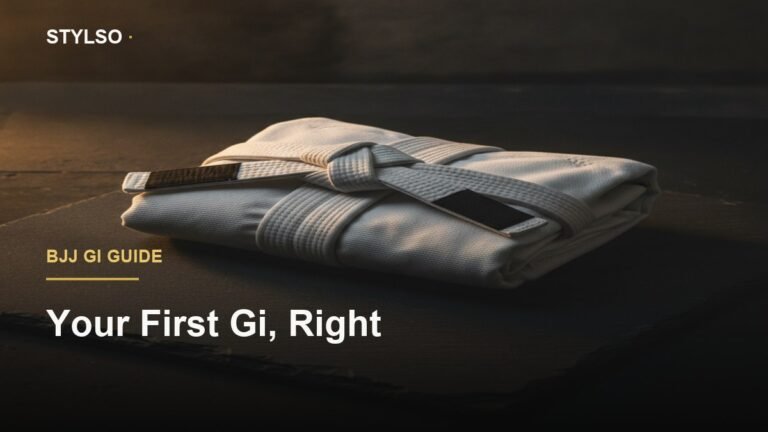
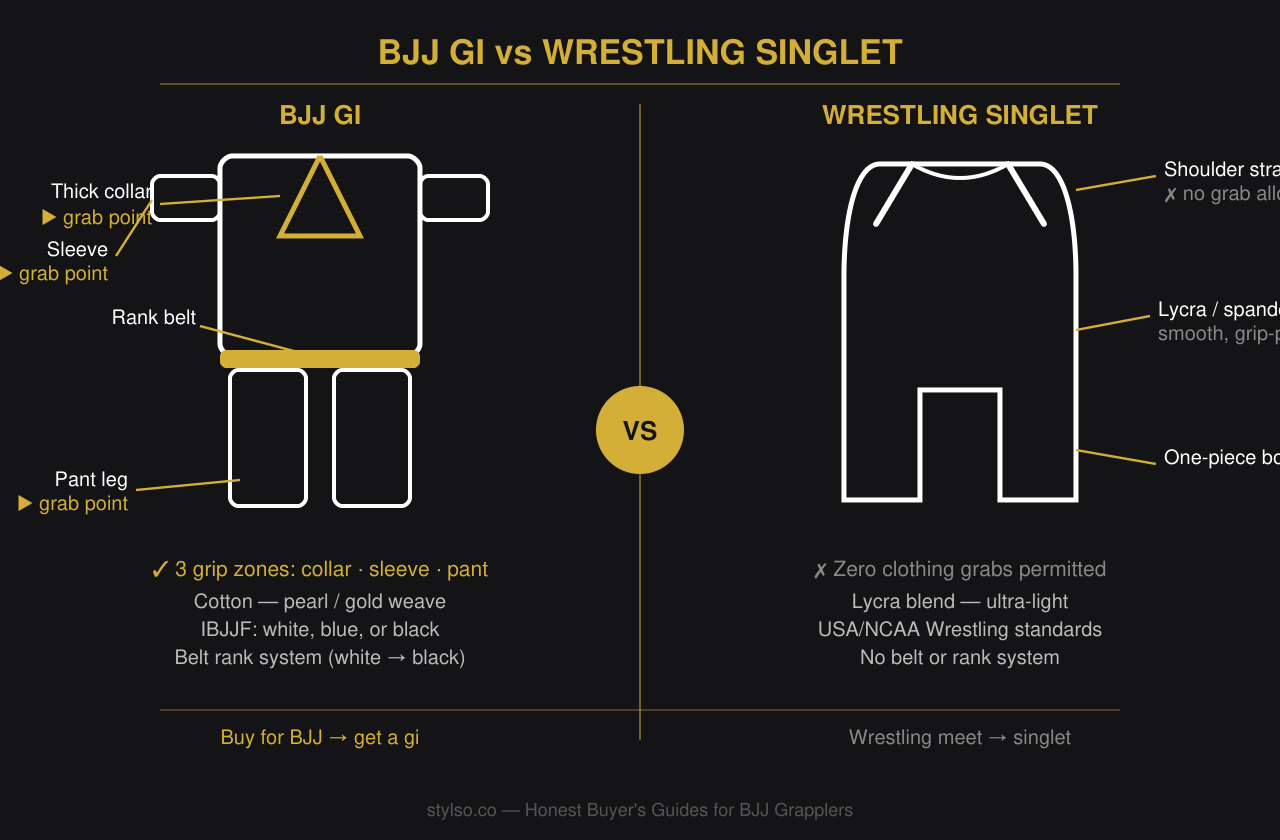
A BJJ gi is a full cotton uniform — jacket, pants, and belt — built so your opponent can grab the fabric and use it against you. A wrestling singlet is a tight, one-piece suit designed to be ungrabbable. Same sport family, totally different equipment. They don’t swap for competition or class.
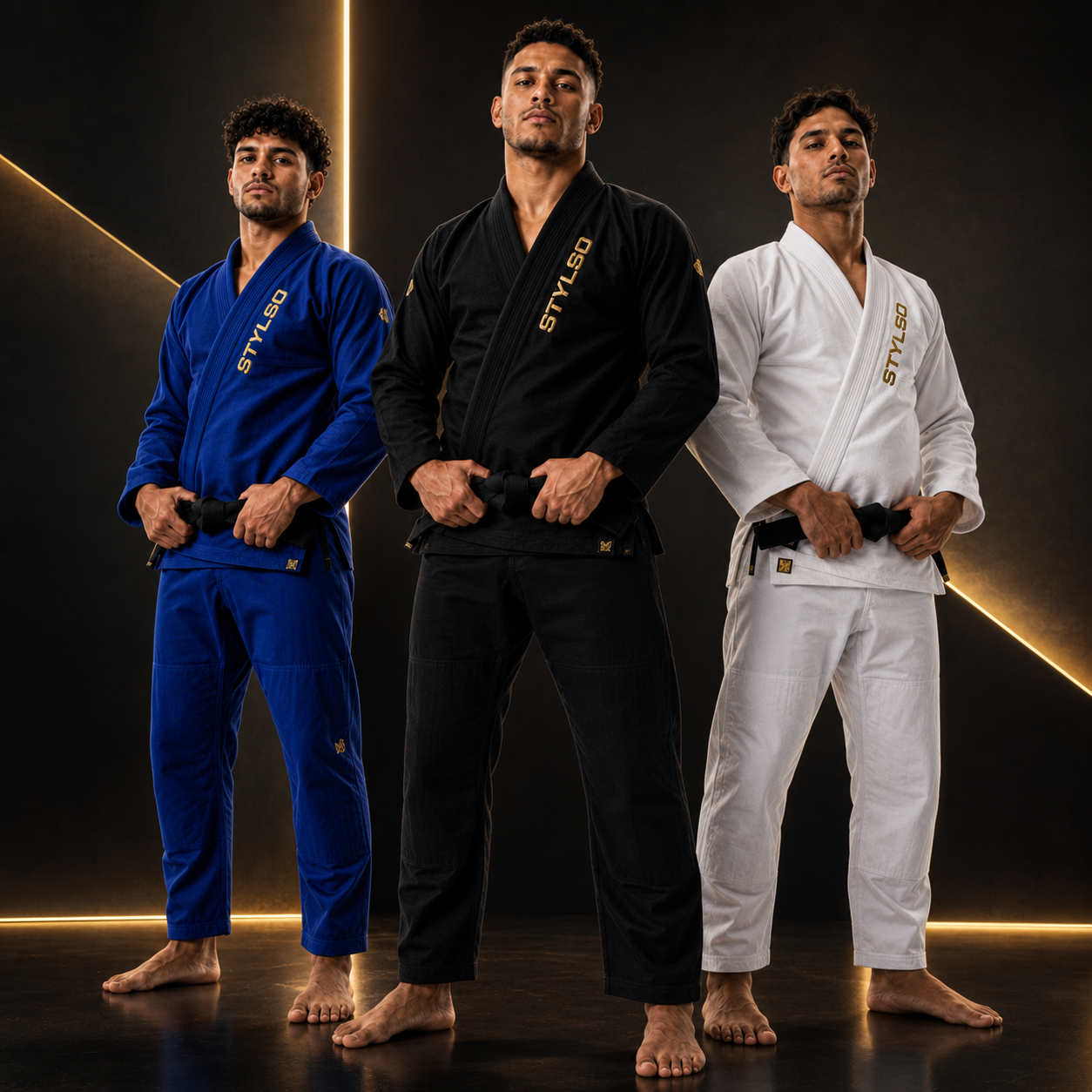
- A BJJ gi has three parts: jacket, pants, and belt. The fabric is part of the sport.
- A wrestling singlet is one piece — tight, smooth, and designed so nothing can be grabbed.
- You can’t swap them for competition or most gym sessions.
- Starting BJJ? You need a gi. Check the size chart before you order.
What Makes a BJJ Gi Different
The jacket collar is the key. It’s thick, stiff cotton — on purpose.
In BJJ, your opponent grabs your collar to control your posture, set up a choke, or pull you into a sweep. Sleeve grabs break your balance. Pant legs become handles for foot sweeps and guard passes. The gi isn’t just what you’re wearing. It’s what you’re fighting with — and against.
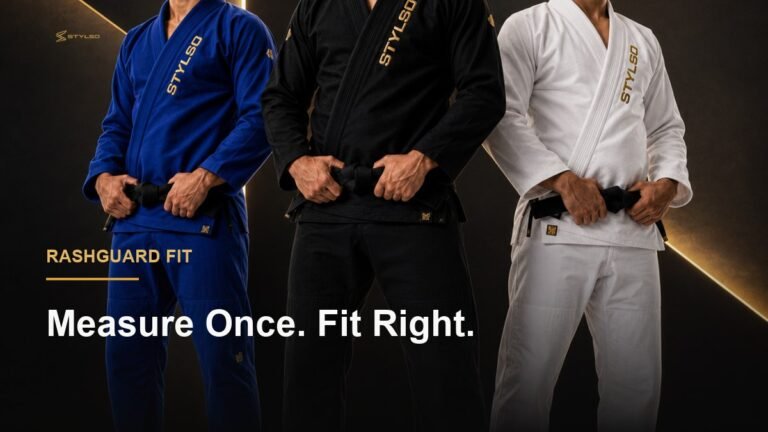
A regulation gi has three pieces: the jacket (kimono), the pants, and a belt that marks your rank. The fabric is most often pearl weave or gold weave cotton. Pearl weave is the standard — lighter than double weave, tougher than single. The Stylso gi uses pearl weave for exactly that balance of durability and breathability.
IBJJF competition rules require white, blue, or black. Your gym might be more relaxed for daily training, but most want a proper gi on the mat. Don’t show up in something else.
Shop the Stylso Men’s Gi on Amazon
What a Wrestling Singlet Is Built For
Completely opposite design philosophy.
A singlet is a one-piece lycra or spandex bodysuit — skin-tight, smooth, and effectively grip-proof. That’s intentional. Wrestling rules don’t let you grab your opponent’s clothing at all. You grab their body: underhooks, double legs, ankle picks, bear hugs. The fabric stays out of the way so the athleticism drives everything.
Wrestling is takedowns, pressure, and pins. No collar choke. No sleeve guard. No sweep off a pant cuff. The technique is all body-to-body.
You’ll see singlets at high school wrestling meets, USA Wrestling events, and the Olympics. At practice, though, most wrestlers train in compression shorts and a rashguard or T-shirt. That’s also the standard no-gi BJJ setup — so the crossover kit is closer than you’d think.
BJJ Gi vs Wrestling Singlet — Side by Side
| Feature | BJJ Gi | Wrestling Singlet |
|---|---|---|
| Style | Jacket + pants + belt (3 pieces) | One-piece bodysuit |
| Fabric | Cotton — pearl or gold weave | Lycra / spandex blend |
| Grip rules | Collar, sleeve + pant grabs legal | No clothing grabs allowed |
| Used in | BJJ, some judo | Freestyle + Greco-Roman wrestling |
| Competition rules | IBJJF (white, blue, or black) | USA/NCAA Wrestling standards |
| Rank system | Belt colours (white → black) | None |
| Price on Amazon | Check current price | Check Amazon for singlets |
Shop the Stylso BJJ Gi on Amazon
Why the Uniform Shapes the Whole Sport
Here’s the part most people miss. The gear isn’t just clothing — it’s the ruleset made physical.
BJJ’s grip game comes from judo, which developed it for exactly this reason: the gi creates a whole layer of technique that doesn’t exist without it. A collar drag, a cross-collar choke, a sleeve pull to break posture — none of those exist in a singlet sport. The fabric IS the method.
Wrestling’s grip-fighting runs body-to-body. Underhooks, wrist control, ties — all physical contact. No clothing involved. The singlet just stays out of the way.
For wrestlers starting BJJ — drill this in your first week: have your training partner take a basic collar grip on you from standing. Don’t try to escape. Just feel how much control that single grip gives them over your posture and head position. In gi BJJ, that collar is one of the most dangerous positions to be caught in. Learning to break grips and protect your collar is the first new language you’re learning. Your wrestling athleticism transfers beautifully — the grip game is the new vocabulary you need to build.
Worth knowing: judo players often cross over to BJJ with sharp collar control but a steep learning curve on guard work. Wrestlers flip that — dominant takedowns, new grip defense needed. Know your starting point and you’ll learn faster.
BJJ Gi Sizing — Measure First, Don’t Guess
Gis don’t fit like regular clothes. They’re sized by height and weight — A0 through A5 for adults, K000 through K4 for kids. Get it wrong and you’re either drowning in fabric or can’t get your arm past the sleeve.
| Size | Height | Weight |
|---|---|---|
| A0 | 162–168 cm / 5’4″–5’6″ | 64–70 kg / 141–154 lb |
| A1 | 168–170 cm / 5’6″–5’7″ | 70–77 kg / 154–170 lb |
| A2 | 170–178 cm / 5’7″–5’10” | 77–86 kg / 170–190 lb |
| A3 | 178–188 cm / 5’10″–6’2″ | 86–102 kg / 190–225 lb |
| A4 | 185–193 cm / 6’1″–6’4″ | 104–118 kg / 229–260 lb |
| A5 | 190–200 cm / 6’3″–6’7″ | 118–136 kg / 260–300 lb |
Between sizes? Size up. Gis settle a little after the first few washes — a snug new gi loosens up; a loose one just stays loose. For a full walkthrough, see our BJJ gi sizing guide.
Which One Should You Buy?
Simple rule: buy for your sport.
Doing BJJ? You need a gi — full stop. Every gym expects one and every IBJJF competition requires one. A wrestling singlet won’t get you on the mat.
Doing wrestling? A singlet for competition, compression shorts and rashguard for practice. No gi needed.
Starting no-gi BJJ or MMA training? Spats and a rashguard. No singlet, no gi required. You’re in the overlap zone between both sports — it’s a clean, versatile setup.
Doing both BJJ and wrestling? Keep the gear separate. Wrong uniform means the wrong sport. It’s not complicated — just two different kits for two different rulesets.
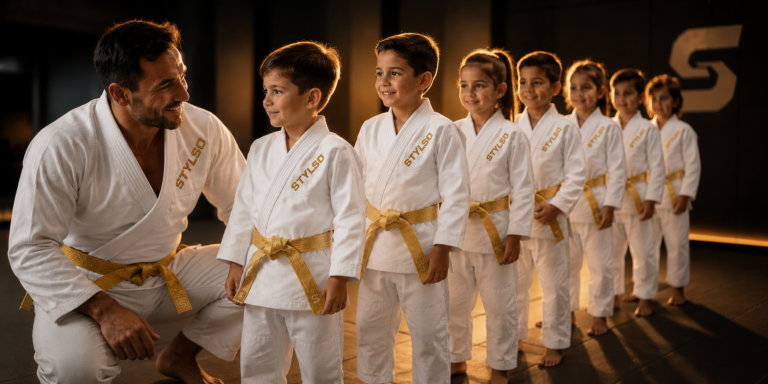
Kids doing BJJ? The Stylso kids’ gi covers sizes K000 through K4 and fits 114–160 cm height. Check the size chart before ordering — kids grow fast and half a size really does matter on the mat.
Shop the Stylso Men’s Gi on Amazon
Shop the Stylso Kids’ Gi on Amazon
Also see: Gi vs No-Gi BJJ — which should you start with? and What to wear under a BJJ gi.
Free: BJJ Starter Gear Guide
What to buy before your first class — gear chart, sizing table, and the one drill to try in week one. Get it instantly.
FAQ
Can I wear a wrestling singlet to a BJJ class?
No. BJJ classes require a proper gi — jacket, pants, and belt. A singlet doesn’t meet the dress code and won’t work with the techniques either.
Can I wear my BJJ gi to a wrestling meet?
No. Wrestling rules don’t allow jacket-style uniforms. A gi gives one athlete an unfair fabric-grabbing advantage, which is why they’re banned in wrestling.
What do wrestlers wear when they cross over to no-gi BJJ?
Compression shorts (spats) and a rashguard — no singlet, no gi. Just tight athletic gear that stays in place during scrambles.
Is gi or no-gi better for beginners?
Most coaches recommend starting with the gi. It slows things down, builds strong fundamentals (posture, base, grip defense), and those habits carry directly into no-gi training. Many elite no-gi competitors still train regularly in the gi.
What’s the difference between a BJJ gi and a judo gi?
They look similar but aren’t identical. BJJ gis tend to be slimmer-cut and lighter. Judo gis are wider-sleeved and heavier, built for judo’s specific gripping styles. Some BJJ competitions accept judo gis if they pass measurement requirements.
How do I size my first BJJ gi?
Measure your height barefoot and your weight in normal training condition. Match to the size chart above — A-series for adults, K-series for kids. Between sizes, go up. Check our full BJJ gi sizing guide for more detail.