Stylso — Brazilian Jiu-Jitsu gi and grappling gear designed for athletes who compete.
You’ve watched someone get pulled aside at check-in over a patch. Maybe it happened to you. The rulebook is out there, but most gyms don’t walk you through it — so grapplers find out the hard way. Here’s the straightforward version of what IBJJF actually says about patches on competition gis, and the one rule that trips up more people than any other.
- Patches must be sewn onto the gi — iron-on and velcro patches aren’t accepted at IBJJF events
- The collar is off-limits; the gi must stay a legal color even with patches added
- Academy logos, sponsor marks, and manufacturer emblems are generally allowed within placement and size limits
The rule most grapplers miss: sewn patches only
Walk into a tournament with iron-on patches and you’re asking for a pre-match headache. IBJJF and most major competition organizers require all patches to be permanently sewn onto the fabric. Iron-on, heat-press, velcro, and stick-on patches are not accepted.
It makes sense. A patch that peels off mid-roll is both a safety issue and an equipment violation. The sewn-on rule keeps things consistent. If you’ve bought patches for your gi, take them to a tailor or ask your academy — most have someone who handles team patches. It’s a ten-minute job and worth every second versus getting flagged at inspection.
The practical shortcut: start with a gi whose manufacturer’s logo is already embroidered in. That’s sewn by default. The Stylso gi ships with IBJJF-compliant embroidery built in — you can compete with zero extra patches if that’s what you want.
Shop the Stylso Men’s Gi on Amazon
Where patches can go (and where they can’t)
The collar is the hard no. That’s the one zone that catches people who thought they knew the rules. The collar is a regulated color area — anything that changes how it looks from the approved white, blue, or black is a problem at inspection. No patches, no wrapping, nothing.
Here’s the zone-by-zone breakdown for major competitions:
| Gi Zone | Patches Allowed? | Notes |
|---|---|---|
| Chest (both sides) | ✓ Yes | Academy logos, sponsor marks — within size limits |
| Sleeves | ✓ Yes | Brand emblems, sponsor patches are common here |
| Upper Back | ✓ Yes | Academy name and logo — the most common placement |
| Lower Back / Hip | ⚠ Check first | Varies by organizer — verify against current rules |
| Collar | ✗ Never | Changes the regulated collar color — always flagged |
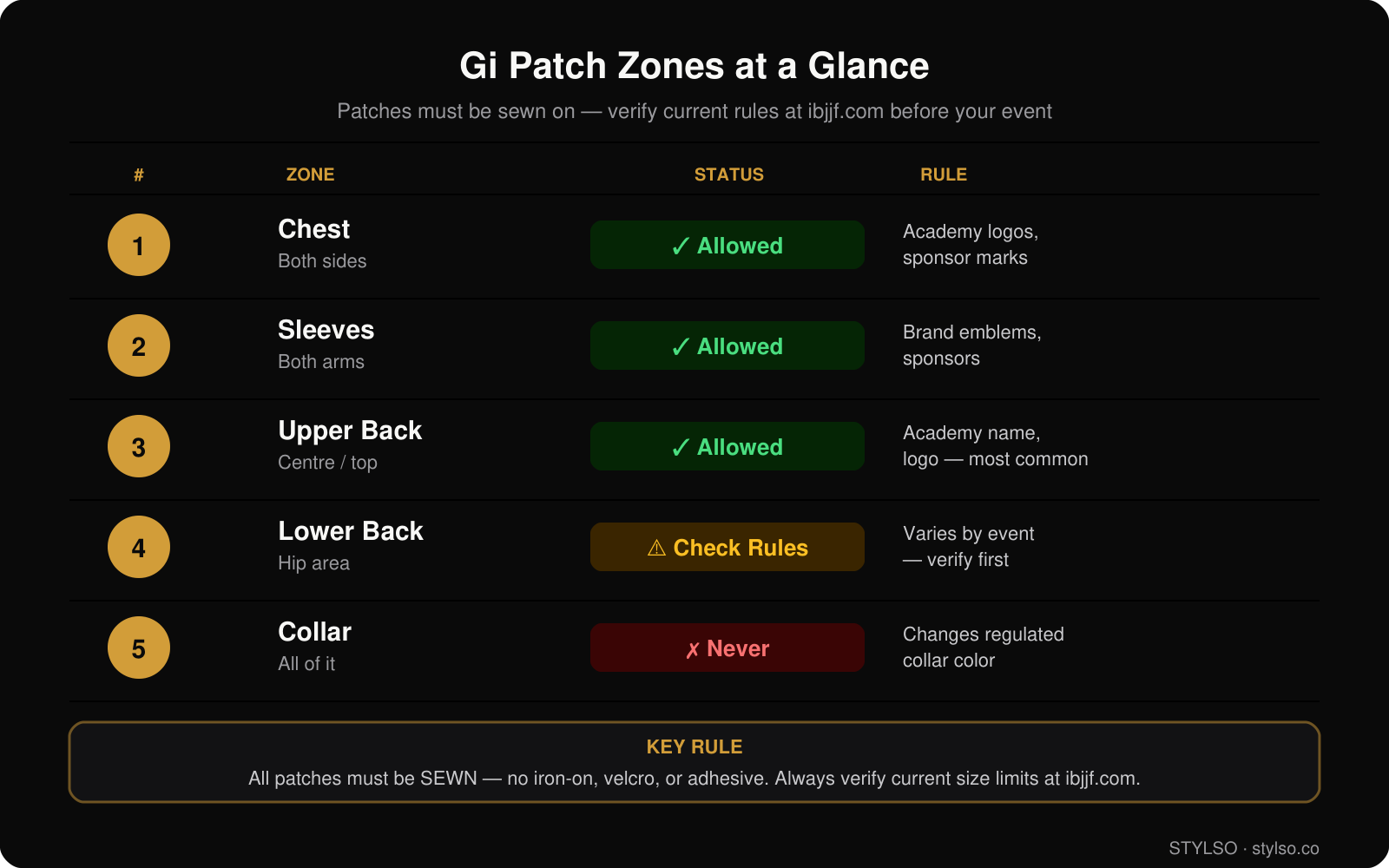
One thing to keep in mind: IBJJF updates its rulebook regularly, and local organizers sometimes run stricter interpretations. Always download the current rulebook from ibjjf.com before your event. Don’t rely on what your training partner told you two years ago.
Patch sizes: what’s generally accepted
Here’s where things get specific — and where quoting a single number can mislead you. Patch size limits change between IBJJF adults’ rules, kids’ rules, and different federations. Rather than cite a dimension that may have been updated, here’s the honest rule of thumb:
- Manufacturer brand mark: small and tasteful — if it came sewn with the gi, it’s almost certainly fine
- Sponsor patches: compact — think credit-card size, not poster size
- Academy logo on the back: larger is generally accepted, but check the current rulebook for exact max dimensions
- Total patch coverage: less is more — IBJJF limits overall patch area, not just individual pieces
The practical test: if your gi looks like a NASCAR car, it’s too much. If it’s a training gi with your academy name on the back and a small brand mark on the chest, you’re in safe territory at most events.
Academy, sponsor, and brand patches — the differences
Academy patches are the most straightforward. Your gym’s name and logo on the back or chest is exactly what the rules are designed to allow. Sewn in, placed correctly, you’re fine.
Brand or manufacturer emblems — the patch your gi came with from the factory — are almost universally accepted. They’re small, positioned on the chest or sleeve, and part of the gi’s original design. The Stylso gi’s embroidered branding falls into this category.
Sponsor patches are where grapplers run into trouble. If you’re competing at a higher level with sponsor logos, you need to be more careful about size, total count, and placement zone. Check the specific event rules, not just the general IBJJF guidelines — they can differ.
One cross-sport lesson that applies here: this is exactly how judo handles gi branding too. International Judo Federation events have similar patch placement rules, and judo competitors learn early that keeping a clean gi base is the easiest way to pass inspection. Same principle transfers directly to BJJ — less embellishment, faster check-in.
Your pre-competition patch checklist
Run through this the week before your event — not the morning of:
- Every patch is sewn on. Lift the edge. If there’s a plastic backing or it peels, it needs to be replaced or removed before you go.
- Nothing on the collar. That includes temporary patches, team name tape, and anything not part of the original gi construction.
- Gi color is still legal. Adding a large colored patch didn’t turn your white gi into a blue-and-white patchwork that fails the color check.
- No offensive content. An obvious rule, but double-check any custom-designed patches before competition day.
- Current rulebook downloaded. ibjjf.com → General Rules → the PDF for your specific event type. Five minutes now saves a lot of stress at the table.
Free: BJJ Competition Patch Rules Cheat Sheet
One-page printable covering the 5 patch zones, the sewn-only rule, and a pre-event checklist. Print it, fold it in your bag.
Does your gi need patches to compete?
Not at all. A clean gi with just the manufacturer’s emblem is perfectly legal — and that’s what most white and blue belts wear at their first tournament. Academy patches are common at team events, but they’re optional unless your gym makes them part of the uniform.
What you DO need: a gi that’s already regulation-compliant from the start. Right color, clean construction, no accidentally non-legal details. The Stylso gi is IBJJF-approved in white, blue, and black — pearl weave, solid build, and embroidery that passes inspection on day one. Start from there, then add your academy patch when you’re ready.
Shop the Stylso Men’s Gi on Amazon
Getting a gi for a young competitor? The kids’ gi rules follow the same basic logic — sewn patches, no collar patches, legal gi color. Check the IBJJF Kids’ Division guidelines for your child’s age bracket before their first tournament.
Shop the Stylso Kids’ Gi on Amazon
Frequently asked questions
Can I put iron-on patches on my BJJ gi for competition?
No. IBJJF and most major organizations require sewn patches only. Iron-on, heat-press, and velcro patches won’t pass inspection. A tailor or your academy can sew patches on properly — it’s worth the few minutes to avoid getting flagged at the table.
Where can’t you put patches on a BJJ gi?
The collar is the main prohibited zone. Patches on the collar change the color and appearance of a regulated area — it’s flagged every time. Also avoid anything that turns the gi’s base color from a legal shade (white, blue, or black) to something else.
How many patches can you have on a competition gi?
IBJJF limits both the size and total coverage of patches. The exact limits change with rulebook updates — download the current version at ibjjf.com before your event. A general rule: the less you have, the faster you clear inspection.
Can I wear my academy patch at IBJJF events?
Yes — academy logos are exactly what the patch rules are designed to allow. Sewn on, placed on the chest or upper back, within size limits, and you’re good. It’s the most common patch setup at any tournament.
Do kids’ gi patch rules differ from adults’?
The same core rules apply — patches must be sewn, collar is off-limits, gi color stays legal. The IBJJF Kids’ Division rulebook may specify different size limits, so check it separately for your child’s age group.
What happens if my gi fails the patch inspection?
Usually you’ll get a chance to fix it on the spot — remove the patch or change gis if you have a spare. In some cases, you may not be allowed to compete in that gi for that division. That’s why checking the week before matters: catch it before you’re at the table, not after.