Three sessions a week. That’s the sweet spot for most beginners — two fundamentals classes plus one drill or open mat between them. Enough mat time to build real muscle memory, enough rest to actually absorb what you learned. Here’s the exact schedule, what each session looks like, and the gear that makes it work.
Key Takeaways
- 2–3 sessions per week is the beginner sweet spot. Start with two; add a third only when you’re not sore on every off day.
- No sparring for the first four weeks — drilling and positional work only. Your joints and nervous system need time to adjust.
- One 15-minute shrimping drill at home between classes outperforms a fourth mat session. Your brain locks in the movement while you sleep on it.
How Often Should a BJJ Beginner Train?
Your first instinct is probably to go every day. Don’t.
BJJ is harder on your body than it looks. Your tendons, joints, and nervous system all take a hit in ways that running or lifting simply don’t. You’re learning movement patterns that fight your natural instincts — your brain needs sleep to sort them out. Going five days a week in month one doesn’t speed that up. It just means you’re exhausted and frustrated by week three, and done by month two.
Here’s what nobody says at sign-up: the bottleneck isn’t effort. It’s recovery. Most coaches — across affiliate academies, competitive gyms, and beginner programs — land at the same number: two to three sessions per week. Two is fine to start. Add a third once your body isn’t sore on every off day, usually around weeks 4–6.
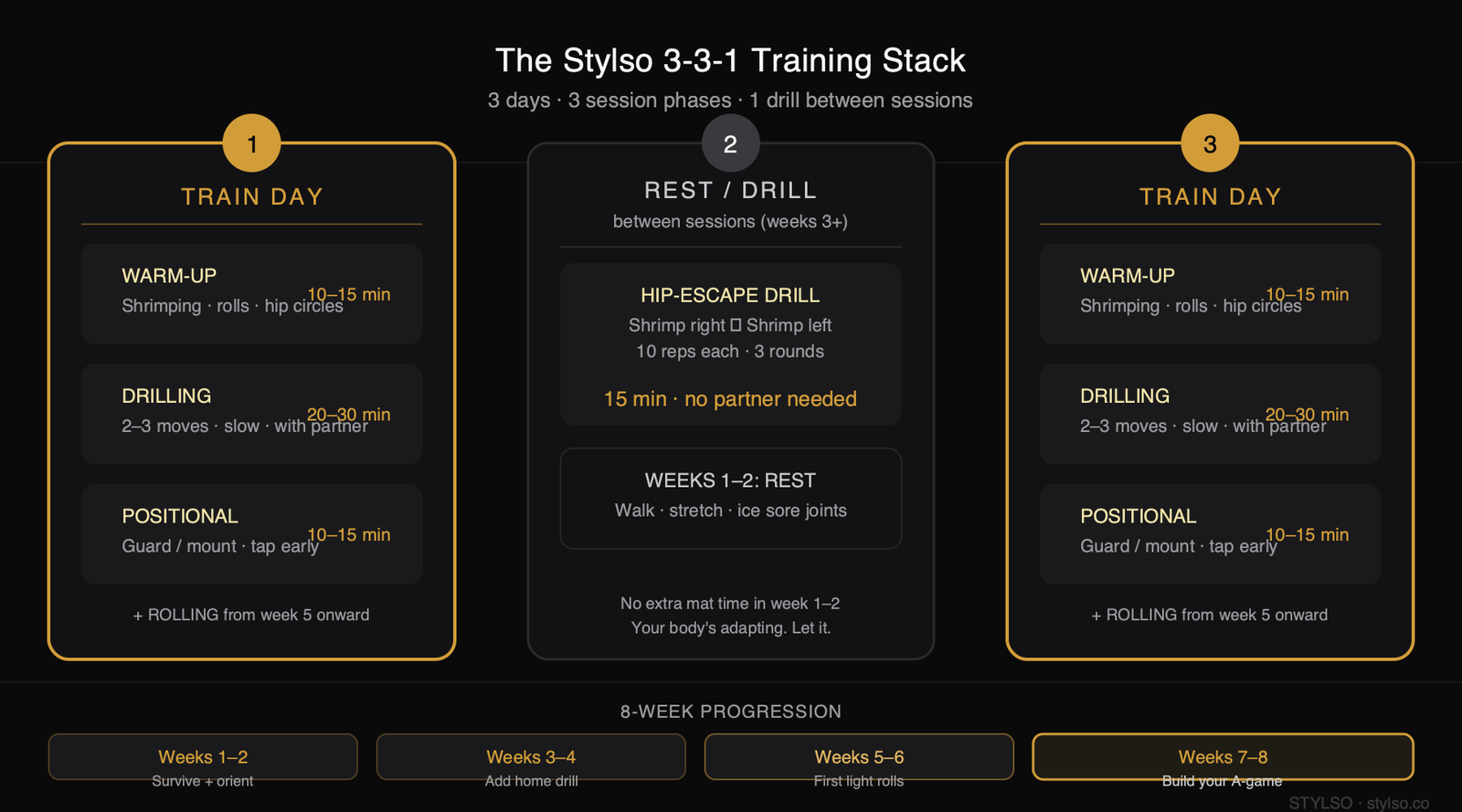
The Stylso 3-Day Beginner Training Schedule
This is an 8-week starter block. Run it as written, then adjust based on how your body’s actually responding — not how you think you should feel.
| Phase | Session 1 | Between Sessions | Session 2 | Focus |
|---|---|---|---|---|
| Weeks 1–2 | Fundamentals class | Rest — walk or light stretch only | Fundamentals class | Survive and orient yourself |
| Weeks 3–4 | Fundamentals class | 15-min shrimp drill at home | Fundamentals class | Build hip-escape muscle memory |
| Weeks 5–6 | Fundamentals class | Drill OR open mat (watch first) | Fundamentals + light roll (5 min) | First live reps without pressure |
| Weeks 7–8 | Regular or fundamentals class | Drill or open mat | Regular class + light roll | Start building your A-game |
Optional third session (weeks 5+): add an open mat if your body’s recovered and you’re sleeping well. Don’t force it. Training while run-down is one of the most common BJJ beginner mistakes — it leads to injury, not improvement.
What Each Session Should Look Like
Every BJJ class follows a similar structure. Knowing it ahead of time means you can actually focus on learning instead of wondering what’s coming next.
| Phase | Duration | What Happens | Your Focus |
|---|---|---|---|
| Warm-Up | 10–15 min | Shrimping, forward/back rolls, hip circles, breakfalls | Breathe normally. Don’t rush through it. |
| Drilling | 20–30 min | Instructor shows 2–3 techniques; you drill with a partner | Slow is smooth. Get the move right, not fast. |
| Positional Work | 10–15 min | Start from guard, mount, or side control — work escapes or passes | Tap early. You’re not supposed to win yet. |
| Live Rolling (week 5+) | 10–15 min | Light sparring from standing or guard position | Survive. Getting submitted is the learning. |
What to Bring to Every Class
You don’t need a bag full of equipment. But the wrong gi makes a hard class miserable — most academies require one for fundamentals. The material matters more than beginners expect.
A heavy or rough gi makes drilling exhausting. Pearl weave moves with you, holds its shape after washing, and doesn’t trap heat. It’s the right call for the first eight weeks when you’re drilling constantly.
| Item | Why It Matters | Get It |
|---|---|---|
| BJJ Gi (pearl weave) | Required for most fundamentals classes. Pearl weave is lighter and more durable than heavy cotton — won’t rip when a bigger training partner grabs your collar during drilling. | Shop on Amazon |
| Rashguard (under the gi) | Stops mat rash during drilling. Wicks sweat. Keeps bacteria off your skin in those first weeks when your immune system’s adjusting. | See guide |
| Slides / flip-flops | You wear shoes from the changing room to the mat edge — bare feet on the mat only. | Any pair works |
| Water bottle (1L+) | You’ll sweat more than you expect. Hydration keeps your brain sharp enough to actually learn in the final 20 minutes of class. | — |
| Gi bag (ventilated) | A wet gi stuffed in a regular gym bag smells by Thursday. Ventilation keeps it fresh between sessions. | See guide |
The Stylso gi is pearl weave, IBJJF-approved, and comes in white, black, and blue — the three colours every academy accepts. Not sure on sizing? Read the BJJ gi buyer’s guide before ordering.
Shop the Stylso Men’s Gi on Amazon
Training with a kid? The Stylso kids‘ gi runs the same 3-day schedule — pearl weave, same durability, sized for growing grapplers. Check the kids’ gi size guide to get the fit right.
Shop the Stylso Kids’ Gi on Amazon
The One Drill That Changes Everything Between Sessions
Most beginners go to class, feel sore for two days, and do nothing in between. Here’s the move that separates people who improve fast from the ones who plateau.
It’s called shrimping — or a hip escape. Wrestling coaches call it “stand-up in base.” It’s the same motion. It’s the foundation of every guard escape, every frame, every scramble out of a bad position. And you can drill it in your living room with no partner in 15 minutes.
How to shrimp at home:
- Lie on your back on a yoga mat or carpet. Pull your right knee to your chest; plant that foot firmly.
- Push off the planted foot and swing your hips sharply to the left, while extending your left leg long.
- Land on your left side — both hips off the floor. That’s one rep.
- Reset. Repeat the other direction.
- 10 reps each way, 30-second rest, three rounds. Done — 15 minutes total.
The cross-discipline lesson: judo players use this hip-switch to escape throw grips. Wrestlers use it for stand-ups under pressure. BJJ uses it for guard recovery. It’s the universal survival movement in every grappling sport. Do it daily in weeks 3–6 and it’ll click automatically in class without anyone needing to show you again.
Gear tip: cold-wash your gi after every class, turn it inside out, and air dry. The collar and sleeves trap the most sweat and bacteria. Hot dryers shrink pearl weave — cold water keeps the fabric tight session after session. See the full gi cleaning guide for the exact routine.
The Recovery Rules Nobody Talks About
Recovery is training. Not recovery from training — recovery is part of the training itself.
- Sleep 7–8 hours. Technique consolidation happens during sleep — specifically REM cycles. Cutting sleep short means your nervous system can’t lock in the movement patterns you drilled. You wake up slightly less skilled than you were.
- Eat before class (carbs, not just protein). Carbohydrates 60–90 minutes before class give you energy to drill for 30 minutes without mentally fading. Training empty is miserable and makes the hardest part of the learning curve worse.
- Tap early. Tap often. The fastest learners tap the most. You can’t build a game while injured. Tap before it hurts, not when it already does.
- Ice your elbows and knees after your first few sessions. Almost every new BJJ practitioner wakes up stiff in those joints. Ten minutes of ice after the first few classes keeps swelling from becoming a real problem.
- Wash your gi after every session. Not just hygiene — BJJ mats carry bacteria that cause skin infections. A clean gi is injury prevention.
For solo training on your off days, the BJJ solo drills at home guide has seven full circuits you can run in 20 minutes with no partner and no equipment.
Free: 8-Week BJJ Beginner Training Calendar
A printable week-by-week starter plan with session breakdowns, the shrimp-drill steps, a gear checklist, and recovery reminders. Download instantly.
Frequently Asked Questions
How many days a week should a BJJ beginner train?
Two to three sessions per week is the right starting point. Start with two, enough to build muscle memory while your body adjusts. Add a third only when you’re no longer sore on every off day — typically weeks 4–6.
Can a beginner train BJJ 4 or 5 times a week?
Not recommended in month one. Training that frequently as a total beginner usually causes overuse injuries before the technique sticks. Tendons and your nervous system need time to adapt. Build up gradually over 6–8 weeks before adding sessions.
What do I need to bring to my first BJJ class?
A BJJ gi (or rashguard and shorts for no-gi), slides for the walk from the changing room to the mat, and a water bottle. Most academies loan gear for a first-ever session — call ahead to check. See the full white belt BJJ gear list for everything you’ll eventually need.
When can a beginner start sparring in BJJ?
Most instructors introduce light sparring around weeks 4–6, once fundamental movements have been drilled enough to work under pressure. Don’t spar before your instructor signals you’re ready. The first four weeks of drilling are where real BJJ actually starts.
Is 2 days a week enough to progress in BJJ?
Yes — especially in the first three months. Two consistent sessions per week plus 15-minute solo drills between classes builds a real foundation. Six months of consistency always beats two weeks of intensity followed by quitting.
What should I focus on in my first month of BJJ?
Survival. Don’t worry about submissions or winning. Focus on staying calm under pressure, recognising basic positions (guard, mount, side control), and drilling the hip escape until it’s automatic. Everything else builds from those three things.
Ready to train? Get the sizing right before you buy your first gi — the wrong size makes drilling harder than it should be. Check the BJJ gi buyer’s guide, then check your size on Amazon before ordering.