Your first class, you tapped from exhaustion — not a submission. That’s not a fitness problem. That’s a breathing problem.
BJJ breathing techniques are controlled breathing patterns you use on the mat to stop gassing out. The three core methods: exhale on every effort, reset your breath in bad positions, and use box breathing between rounds. Get these right and your cardio improves — even before your fitness does.
Key Takeaways
- The #1 cause of gassing out is holding your breath — not poor fitness.
- Exhale every time you push, pull, or scramble. No exceptions.
- Box breathing (4-4-4-4) between rounds resets your heart rate fast.
Why You Gas Out (It’s Not What You Think)
Here’s what nobody tells you in week one: the moment someone mounts you, most people hold their breath. It feels instinctive. You tense up, push hard, and forget to breathe entirely. Then your body panics. Your heart rate spikes. Sixty seconds later, you’re tapping — and you don’t know why.
Holding your breath during exertion is the single biggest gas-out trigger in BJJ. More than cardio. More than technique. When you stop breathing, your oxygen debt climbs instantly — and there’s no quick way back.
The fix isn’t six months of conditioning. It’s a breathing pattern you can start using tonight.
Stylso — BJJ apparel and training gear for grapplers who want to train smarter, not just harder.
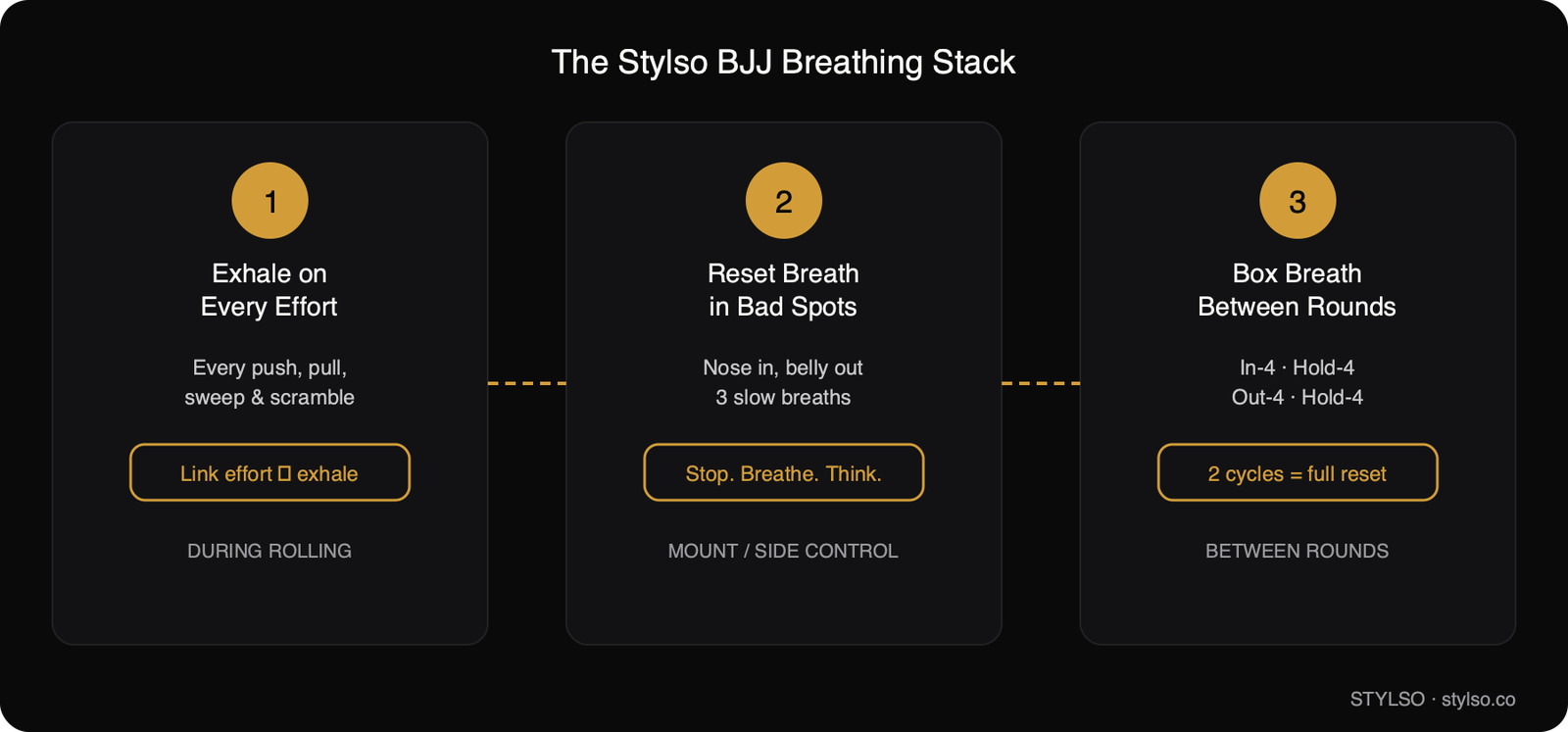
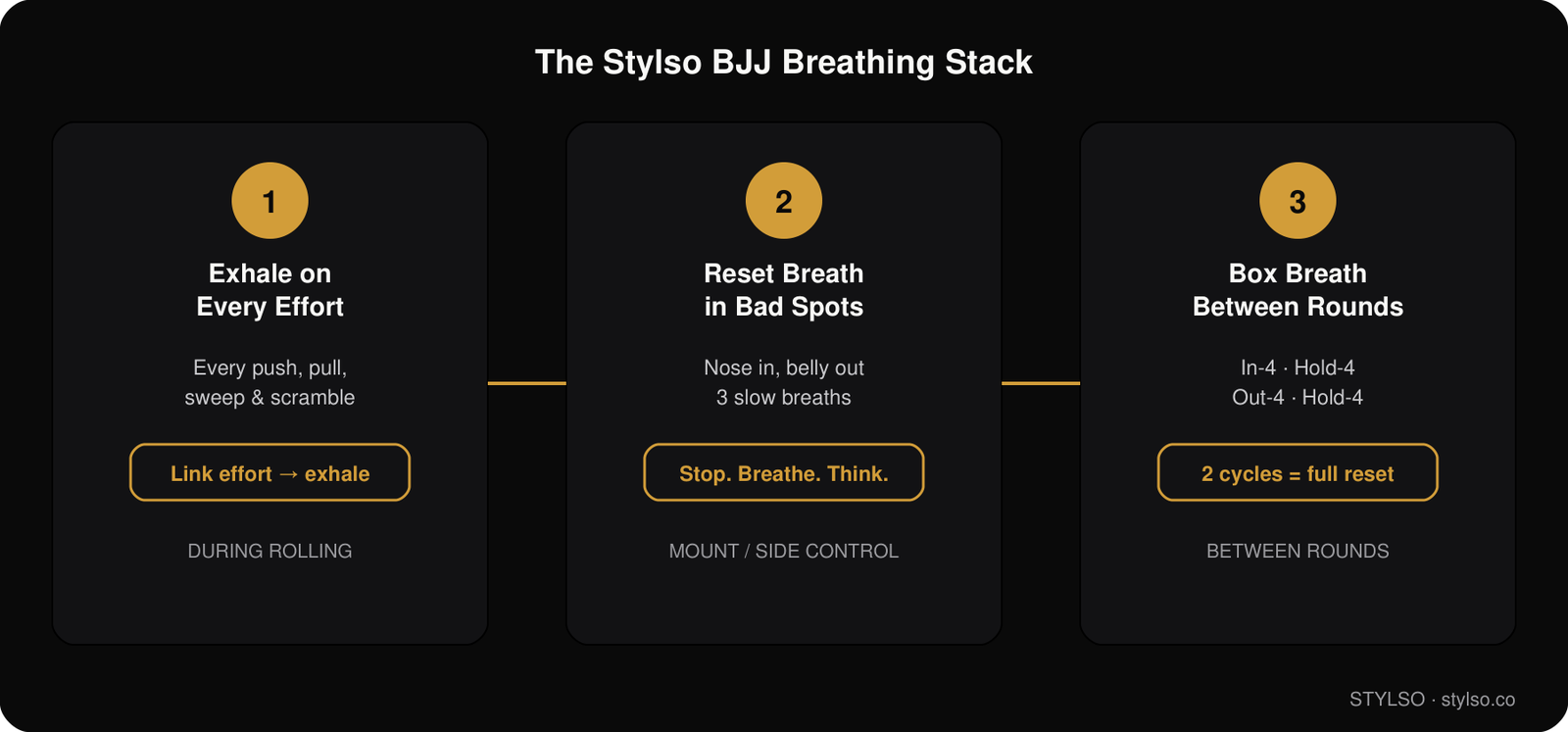
The Stylso BJJ Breathing Stack: 3 Methods That Work
There are three situations where breathing breaks down for beginners. Each one has a fix.
Method 1: Exhale on Every Effort
Every push, pull, bridge, sweep, or scramble — exhale. Breathe out on exertion. It’s how powerlifters brace, how boxers punch, how judoka throw. BJJ is no different.
Don’t wait for a big moment to breathe. Exhale on every single movement — short rolls, mini-exhales, constant. You’ll feel the difference in round one.
The cue: link every effort to a sound. Some grapplers hiss through the nose. Some grunt. Some breathe sharp and quiet. Pick one and make it automatic. Your body learns to breathe through the work instead of against it.
Method 2: The Reset Breath (In a Bad Spot)
You’re under mount. You can’t escape yet. Most beginners thrash and hold their breath. That’s how you gas out in 20 seconds flat.
Instead: stop. Breathe low and slow. Nose in, belly out — three breaths. This is diaphragmatic breathing (belly breathing, not chest breathing), and it tells your nervous system to stop panicking.
Shallow chest breathing speeds your heart up. Deep belly breathing slows it down. In a bad position, a slow breath buys you time to think — and time to find the escape.
Rickson Gracie uses a variation called percussive breathing — short rapid exhales (shh-shh-shh) to clear stale air and reset. Try it in side control when you can’t move yet. It feels awkward the first time. It doesn’t after week three.
Method 3: Box Breathing Between Rounds
Between rounds, most beginners pant. Understandable — but panting doesn’t reset you. It keeps you in the panic zone.
Box breathing does reset you. Four counts in, four counts hold, four counts out, four counts hold. 4-4-4-4. One full cycle takes 16 seconds. Two cycles and your heart rate drops enough to start the next round thinking instead of surviving.
This is what military operators use under stress. It’s what elite grapplers use at competitions. It’s free, it takes 32 seconds, and it works.
What Yoga and Combat Sports Teach Grapplers About Breathing
Yoga practitioners have spent decades studying breathing under physical stress. The one thing they’d tell a white belt: your breath leads your body.
When you slow your exhale, you slow your whole system. Long exhales activate the parasympathetic nervous system — your rest mode. Short rapid exhales activate fight-or-flight. On the mat, you want to dial between these deliberately, not just react.
One drill that transfers directly: the 2:1 exhale. Inhale for 4 counts, exhale for 8. Do it for 5 rounds before class. Your resting heart rate at the start of rolling will be noticeably lower. That’s a real edge.
Wrestling and judo coaches use the same concept during conditioning — exhale on the shot, the throw, the scramble. Same principle, different mat. If it works for takedowns, it works for your guard pass too.
BJJ Breathing Methods at a Glance
| Method | When | How | What It Fixes |
|---|---|---|---|
| Exhale on Effort | Every push, pull, sweep, scramble | Short exhale with every movement | Stops oxygen debt from building |
| Reset Breath | Bad positions (mount, side control) | Nose in, belly out, 3 slow breaths | Drops heart rate, buys thinking time |
| Box Breathing | Between rounds (30–60 sec breaks) | In-4, hold-4, out-4, hold-4 | Full reset before the next round |
3 Drills to Practice Before Class
You don’t need a training partner for these. Five minutes before you bow in is enough.
Drill 1: The shrimp-and-exhale. Hip escape across the mat. Exhale on every shrimp. Three lengths. Your body links the movement to the exhale automatically. After two weeks it’s muscle memory you don’t think about.
Drill 2: The 2:1 breath. Sit on the mat. Inhale 4 counts, exhale 8. Ten rounds. This lowers your resting heart rate before the session starts — you begin rolling from a calmer baseline.
Drill 3: The bad-position hold. Lie flat, arms framing, light bridge tension. Hold 60 seconds. Breathe low and slow the entire time. Don’t let your chest take over. This trains the reset breath under real discomfort without a partner dropping their weight on you.
Ten minutes total. Three times a week. Most white belts notice they’re gassing out much less within the first month.
Free: BJJ Breathing Drill Sheet
A printable one-pager — the 3 Stylso breathing methods, the 3 pre-class drills, and a 4-week practice tracker. Keep it in your gym bag.
Does Your Gear Affect Your Breathing?
More than most beginners expect.
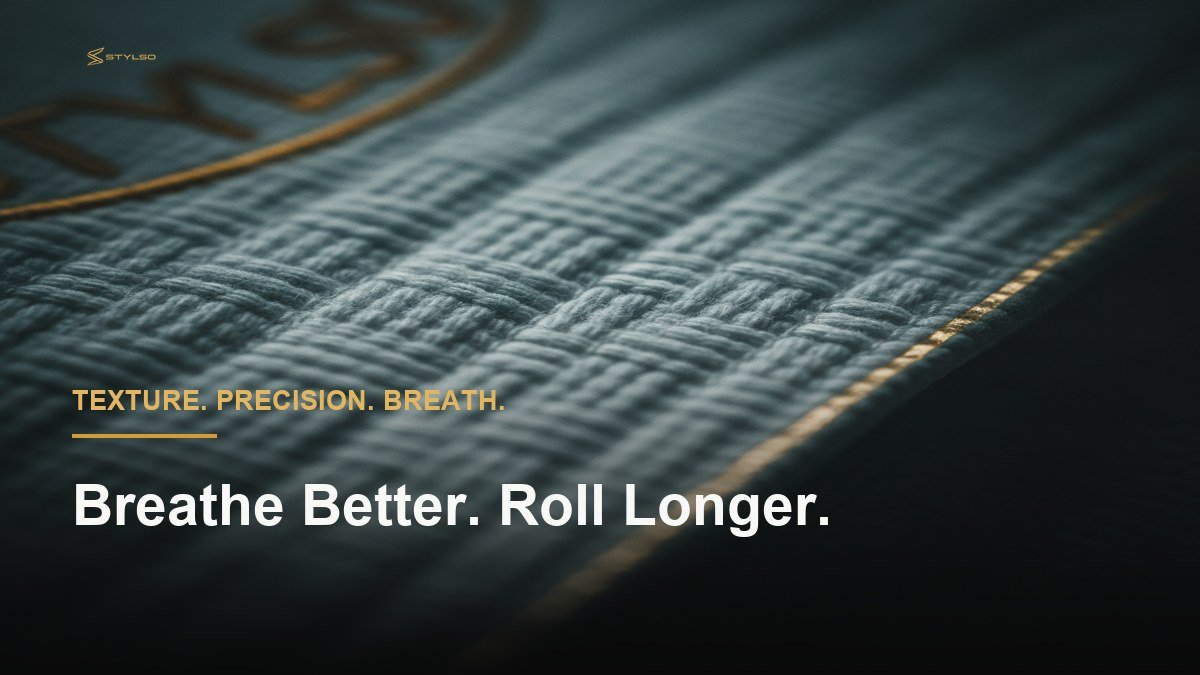
A heavy cotton-blend gi traps heat. Heat raises your heart rate. A raised heart rate means faster breathing, faster oxygen debt — and you’re gassing out in round two instead of round four.
A lightweight pearl-weave gi stays cooler and moves with you. Less restriction means less wasted effort on every scramble. Less wasted effort means your breath resets faster between positions.
The Stylso men’s gi is a pearl-weave build designed for active training — light enough to keep you cool, durable enough for the weekly grind. It won’t fix your breathing by itself. But it won’t work against it either.
For no-gi training — or as an under-gi layer on warm days — a fitted rashguard keeps fabric out of the way without adding bulk. See our best rashguard for BJJ guide for picks at every level.
FAQ: BJJ Breathing Techniques
Why do I gas out so fast in BJJ even when I’m fit?
You’re probably holding your breath without realizing it. Fitness helps, but if you’re not exhaling on every effort and resetting in bad positions, you’ll gas out fast regardless of your cardio base. Fix the breathing first — then build the engine.
Should I breathe through my nose or mouth during BJJ?
Nose breathing is the goal for steady-state rolls — it’s a natural intensity gauge. When you can breathe through your nose, you’re at a sustainable pace. When you’re scrambling hard, mouth breathing is fine. Don’t force nasal breathing at high intensity.
What is the Rickson Gracie breathing technique?
Rickson uses percussive breathing — short rapid exhales (shh-shh-shh) to clear stale air and reset the breath. It’s a way to force your diaphragm to engage under pressure. Try it in a pinned position. It resets your nervous system faster than standard breathing.
How do I stop panicking when I’m being mounted or choked?
Breathe low and slow. Three belly breaths the moment you feel the panic rising. Your brain reads a slow exhale as safe — even when the position isn’t. Practice it in training deliberately so it’s automatic when you need it in competition.
Can breathing techniques actually improve my BJJ cardio?
Yes — not by growing your lungs, but by using the oxygen you already have more efficiently. Less panic breathing means less wasted energy and better oxygen delivery. Most white belts notice they’re lasting 2–3 more rounds per session within the first month of using these methods.