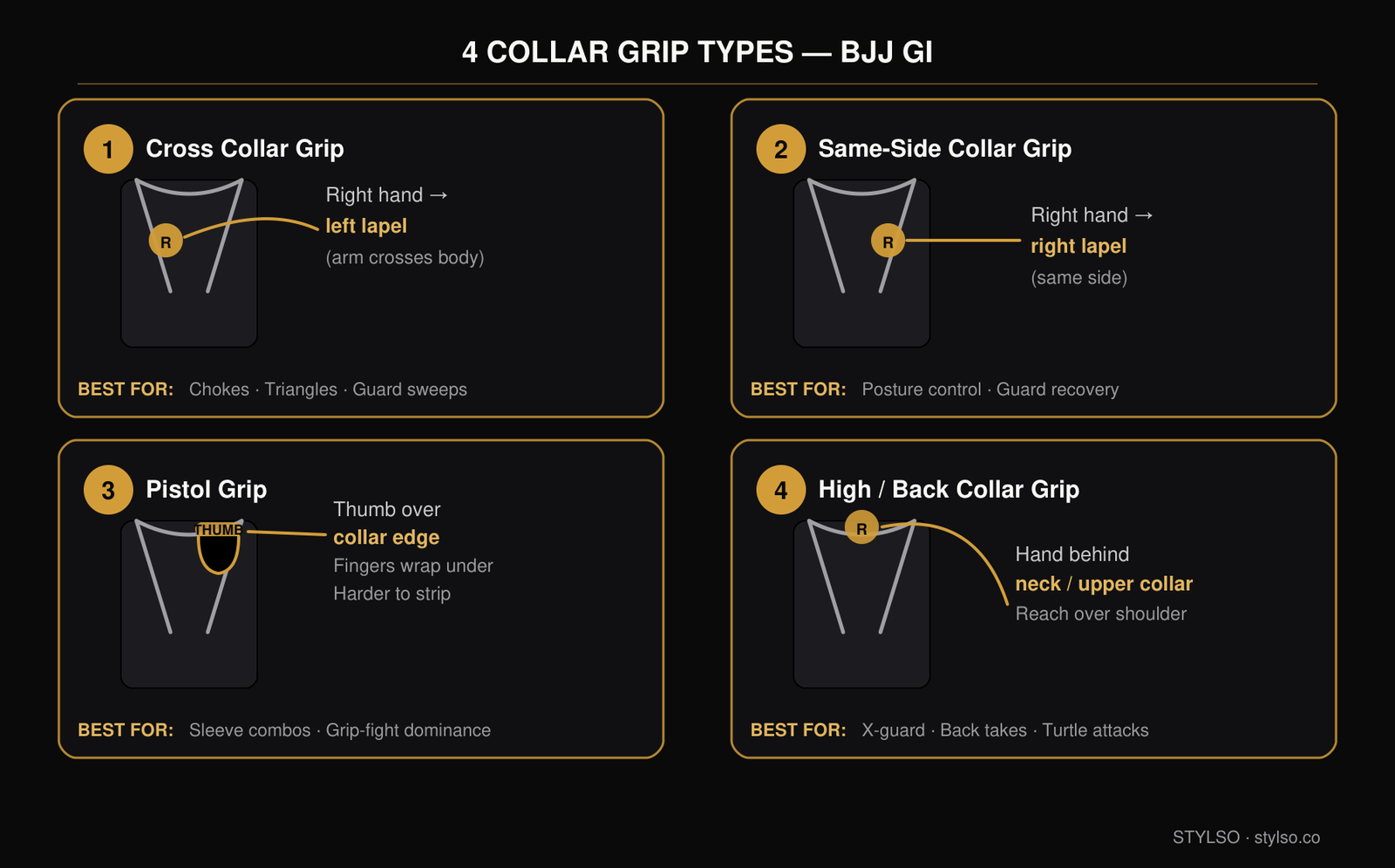
BJJ gi collar grips are holds on the lapel fabric of your opponent’s jacket — used to control, sweep, choke, or set up a submission. There are four main types: the cross collar grip, the same-side collar grip, the pistol grip, and the high collar grip. Each fits a different position and purpose in your game.
- The cross collar grip is the most versatile — great for chokes, triangle setups, and collar-sleeve combos from guard.
- Collar quality matters — a stiff, reinforced gi collar holds its shape under grab pressure; a floppy one loses control before you even start.
- Grip fighting is the fastest drill — 5 minutes every practice builds the collar-grip habits that win positions before any technique begins.
Stylso — BJJ gis & combat-sports apparel, designed for real training.
Why Collar Grips Are the Foundation of Guard Work
The first time a senior grappler grabbed your collar and pulled you forward, you probably thought they were just stronger. They weren’t. They’d done it ten thousand times and knew exactly where to place the hand.
Here’s the part most coaches don’t say early enough: the collar is always available. Closed guard, half guard, open guard, hunting a back take — that lapel is right there. Most beginners grab it by habit. Good grapplers grab it on purpose, and they know which of the four types they’re setting before their hand even reaches out.
Once you learn the four grip types and what each one enables, you stop reaching for fabric randomly and start reaching for a position. That’s the shift from white-belt to blue-belt collar awareness.
The 4 Main BJJ Gi Collar Grips
Each grip has a clear use. Use the wrong one and you telegraph your move, lose leverage, or set up a technique that can’t go anywhere from that angle.
| Grip Type | How to Set It | Best For | Shop |
|---|---|---|---|
| Cross Collar Grip | Right hand grabs the left lapel (arm crosses the body) | Collar chokes, triangle setups, guard sweeps | Shop on Amazon |
| Same-Side Collar Grip | Right hand grabs the right lapel (same side) | Guard recovery, breaking posture, head control | Shop on Amazon |
| Pistol Grip | Thumb over collar edge, fingers curl underneath | Collar-sleeve combos, grip-fight dominance | Shop on Amazon |
| High Collar / Back Collar | Hand reaches behind the neck to the upper collar | X-guard entries, back takes, turtle attacks | Shop on Amazon |
What Makes a Gi Collar Good for Gripping
Not all gi collars survive grip training equally. A floppy collar collapses the moment you grab it — you end up with a bunch of soft fabric but no real leverage. A stiff, reinforced collar holds its shape, so when you lock in that cross collar grip it stays put and does its job.
What to look for in a gi collar:
- Reinforced stitching at the collar seam — the collar takes hundreds of grip reps over its life; weak seams fray fast under repeated load.
- Firm collar fabric — it shouldn’t flatten under pressure from either the gripper or the defender.
- IBJJF-legal collar width — so the same gi works in training and competition without needing to switch.
The Stylso gi uses a pearl-weave build with a reinforced collar — designed to hold its shape through consistent grip drilling without going soft. Check the current price on Amazon to see if it fits your budget.
Shop the Stylso BJJ Gi on Amazon
The Grip-Fight Drill: Build Collar Control in 5 Minutes
This is the one drill that’ll move your collar game faster than anything else — and most gyms use it as a throwaway warm-up without realising it’s actually a training session of its own.
It’s called grip fighting. Done with intention, focused on the first collar grip, it builds the speed and accuracy your collar game is currently missing.
- Square up with a partner — no techniques, just gripping. Neither person tries to sweep, pass, or submit. The only goal in this round is the grip.
- Fight for the first cross collar grip (30 seconds per round). Whoever sets a clean cross collar grip first wins the round. Reset and go again.
- Switch roles — the defender now attacks. You’ll notice immediately that you favour one hand over the other. So does your partner. That habit is the thing you’re training to build — and to disrupt.
- Track your win rate for a week. You’ll see a pattern: one hand is consistently faster, one grip-break attempt works every time. Now you’ve found the weakness to drill next.
- Add a sleeve grip after two weeks. Fight for the cross collar AND a sleeve grip at the same time. This is full collar-sleeve grip fighting — the same thing judoka and elite BJJ players drill obsessively.
Five minutes of this every session beats 30 minutes of solo drills for building the muscle memory to set your grips before the other person does.
A health note: your forearms and grip tendons take a beating in high-rep collar drilling. At the end of practice, hang from a pull-up bar for 20–30 seconds (a dead-hang). It decompresses the elbow joint, stretches the forearm extensors, and builds the passive grip endurance that keeps you holding in round four. Add wrist circles after each session. Collar grip drilling is repetitive-stress work — the joints need the same attention as the muscles.
What Judo Teaches Us About Collar Grips
BJJ didn’t invent collar grips — judo did. And they’ve been refining collar control for well over a hundred years. Kodokan judo built its entire throwing system on the collar-and-sleeve hold (kumi kata): the collar hand breaks posture, the sleeve hand controls direction, the throw follows the structure. BJJ borrowed that framework and built the guard game on top of it.
The cross-training lesson: watch high-level judo grip-fighting footage. Elite judoka spend the first 20–30 seconds of a match fighting for the grip before any throw is attempted. They don’t rush the technique — they set the grip first and let the throw emerge from it. That same discipline is what separates good BJJ guard players from great ones. The grip is the technique.
The pistol grip specifically came from judo — it gives a mechanical advantage over a stiff collar and is harder to break than a standard four-finger lapel grab. Judoka use it to control collar angle; BJJ players use the same mechanic for collar-sleeve setups and collar choke entries. If your pistol grip feels weak, watch judo grip fighting for 20 minutes. It’ll change how you think about it.
Free: BJJ Grip Training Guide
A 4-week collar grip strength plan — daily drills, grip-fight progressions, and a printable tracking sheet so you can see your grip improve week by week.
Frequently Asked Questions
What is a cross collar grip in BJJ?
A cross collar grip is when you reach across your body to grab the opposite side of your opponent’s lapel — your right hand grabs their left collar, for example. It’s the most common grip for setting up collar chokes, triangles, and sweeps from closed guard. The arm crossing the body is what gives it the name.
What’s the difference between a pistol grip and a regular collar grip?
A standard collar grip wraps four fingers over the collar fabric. The pistol grip adds your thumb over the top edge of the collar, pinching it between your thumb and fingers. It gives more control and is significantly harder for your opponent to strip — it’s the grip judoka use for a reason.
Can you use collar grips in no-gi BJJ?
No — there’s no collar in no-gi. Collar grips are specific to gi grappling. In no-gi, you’d replace collar control with neck ties, underhooks, wrist control, or a head-and-arm clinch to get similar positional leverage.
How do I stop someone from breaking my collar grip?
Drive your gripping elbow down and in while keeping your wrist straight. Most grip-break attempts work by rotating your forearm outward — keeping the elbow tucked makes that rotation harder. Regular grip-fight drilling also builds the forearm endurance to hold the grip longer under real pressure.
Does gi collar quality affect grip training?
Yes — more than most beginners realize. A stiff, reinforced collar holds its shape every rep, so your grip mechanics stay consistent. A soft or worn collar moves unpredictably when grabbed, which builds imprecise habits. The difference shows up most during drilling, when you’re repeating the same grip 50–100 times in a session.
How long does it take to build strong collar grips?
With 5 minutes of deliberate grip fighting every session, most grapplers notice a real difference in 4–6 weeks. Grip strength builds fast with daily resistance. The bigger gain is muscle memory — knowing the right grip position by feel, without thinking.
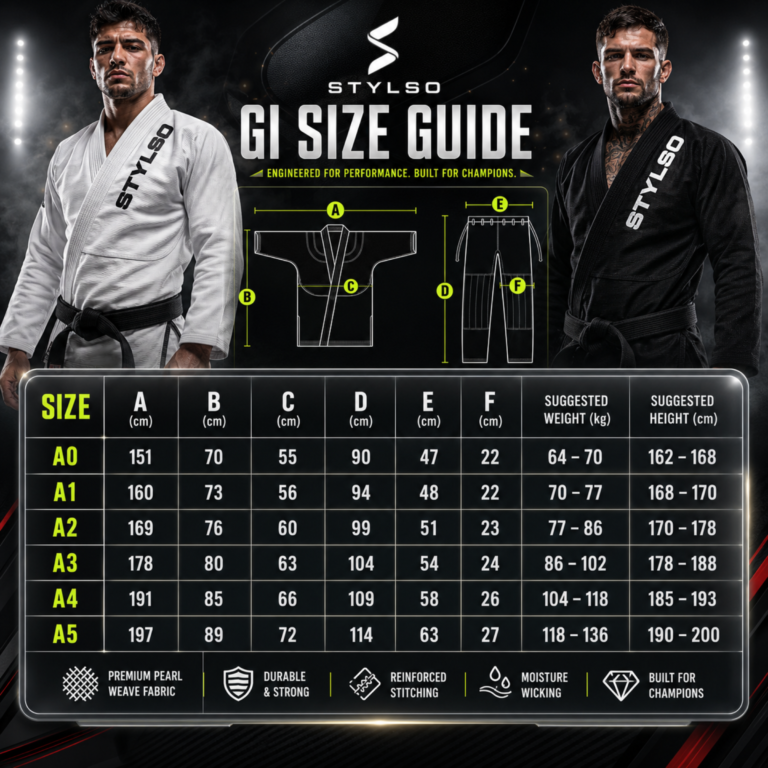
Want more on fitting and choosing a gi that holds up through collar grip training? Read our BJJ Gi Buying Guide and the Stylso Gi Size Guide. For competition, check the IBJJF Gi Requirements page — collar width and stiffness rules are enforced at every sanctioned event.