A BJJ recovery routine has five phases: cool down, rehydrate, stretch, refuel, and sleep. Do all five consistently after every hard session and you’ll cut soreness, come back sharper, and stay on the mat longer. Skip them and your training ceiling drops — no matter how many hours you log.
- Recovery is where adaptation happens — not on the mat.
- Five phases matter: cool-down, hydration, mobility, nutrition, sleep.
- The most skipped phase is mobility — 10 minutes at home that prevents chronic tightness.
Stylso — BJJ gis and combat-sports apparel — covers the full training journey: from choosing the right gear to getting the most out of every session you complete.
Why Recovery Is Actually Training
Here’s something most instructors don’t say out loud: the adaptation happens during rest, not during drilling.
When you roll hard for an hour, you’re breaking down muscle fibers, depleting glycogen, and stressing your nervous system. Your body repairs all of it during the 24–48 hours after class. Give it the right inputs and you come back stronger. Give it nothing and you come back sore — and slowly more sore each week.
Training is the signal. Recovery is the response.
The Stylso BJJ Recovery Stack (5 Phases)
| Phase | When | Duration | What to Do |
|---|---|---|---|
| 1. Cool Down | On the mat, after rolling | 5–10 min | Light shrimping, hip circles, deep breathing |
| 2. Rehydrate | First 15 min after class | 15 min | 500–750ml water + pinch of salt |
| 3. Mobility | At home, within 60 min | 10–15 min | Five BJJ-targeted holds — hips, spine, shoulders |
| 4. Refuel | Within 90 min of training | 5 min prep | 20–30g protein + complex carbs (real food wins) |
| 5. Sleep | That night | 7–9 hours | Non-negotiable. Peak repair window. |
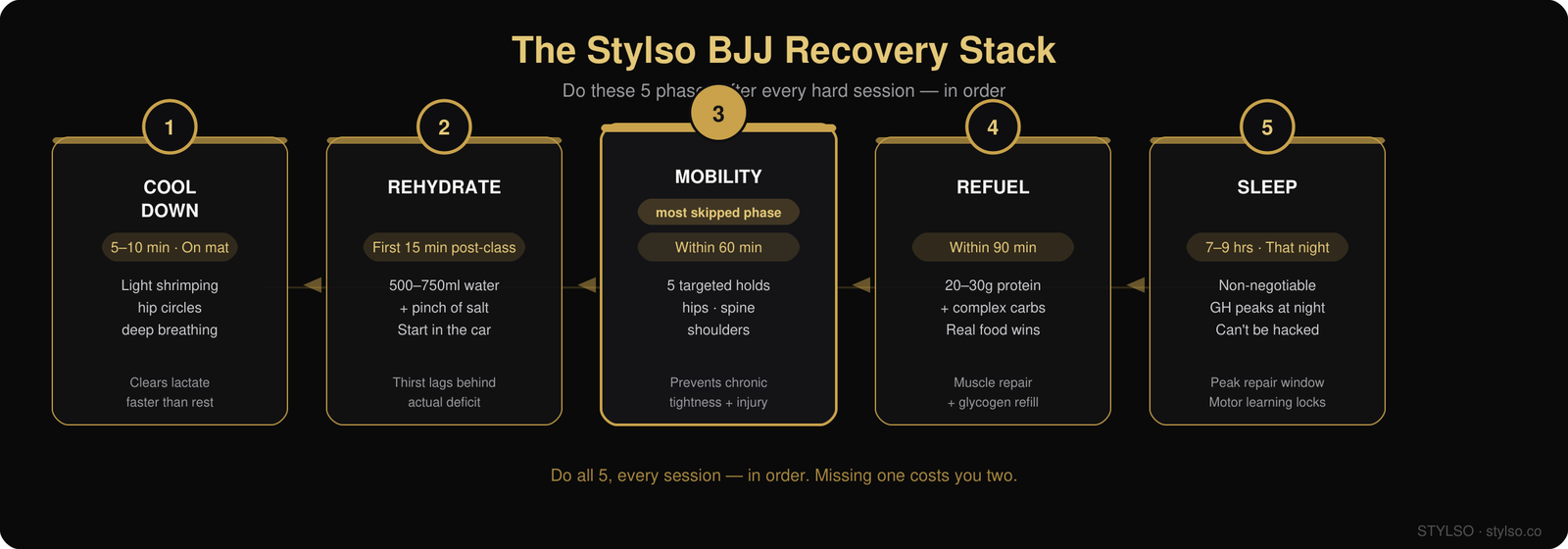
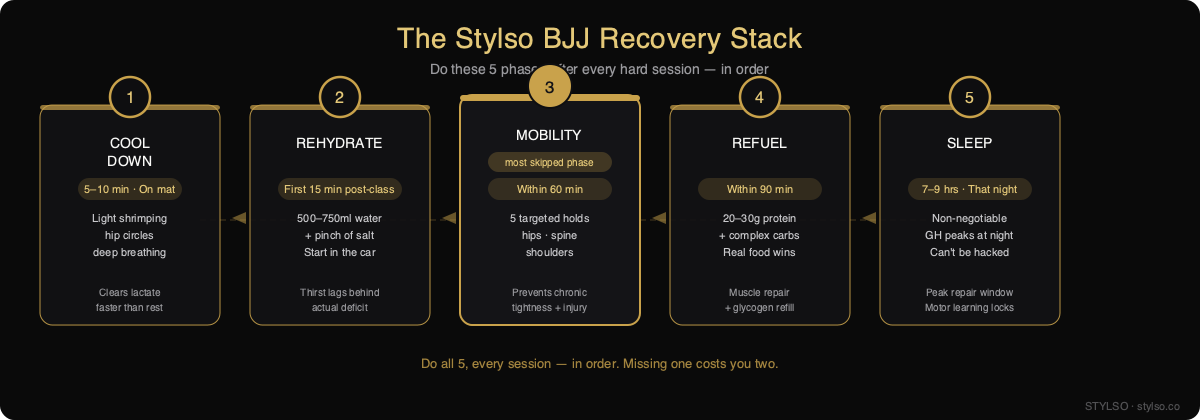
Work through these five in order. Every time.
Phase 1: Cool Down — Don’t Just Stop
Most people pack their bag the moment rolling ends. Don’t.
Spend 5–10 minutes doing light movement before you go cold. Slow shrimping (hip escapes) is perfect — it’s low-intensity, keeps blood flowing, and uses the same movement patterns you just trained. Add some hip circles and a minute of slow belly breathing.
Why bother? Light movement clears lactate from your muscles faster than sitting down. That’s the difference between waking up stiff and waking up mobile.
If you’ve only got 3 minutes: slow shrimping down the mat and back. Then breathe.
Phase 2: Rehydrate — Start on the Walk Out
You lost more than you think.
Even a moderate gi session can cost you 500ml–1.5L of sweat. Start drinking in the parking lot, not at home. Plain water is fine for sessions under 90 minutes. For longer or more intense sessions, add a pinch of sea salt — not a sugary sports drink.
Thirst is a lagging signal. By the time you feel thirsty, you’re already behind.
Phase 3: Mobility — The Part Most Skip
At home, within an hour of training, spend 10–15 minutes on the five areas BJJ hammers hardest: hip flexors, hip external rotators, thoracic spine, shoulders, and hamstrings.
You don’t need a yoga class. You need five targeted holds, 60–90 seconds each:
- Low lunge — hip flexor and quad
- Figure-4 seated stretch — hip external rotation (this is what your guard recovery needs)
- Thread the needle — thoracic rotation (spine from all that guard-passing pressure)
- Doorframe chest stretch — shoulders
- Standing forward fold, soft knees — hamstrings and lower back
These five address exactly what guard work, passing, and scrambles compress and tighten. For a complete routine, see our guide on how to improve BJJ flexibility.
Phase 4: Refuel — The Window Matters
Training on empty is bad. Recovering on empty is worse.
Muscles need protein to rebuild and carbohydrates to refill glycogen stores. You don’t need a complex formula. A simple post-training meal works: chicken and rice, eggs on toast, oats and peanut butter, or a protein shake with milk. Aim for 20–30g of protein and some complex carbs.
Eat within 90 minutes. After that window, uptake slows. Real food beats supplements almost every time — the shake is convenient, not magic.
Phase 5: Sleep — The One You Can’t Hack
This is the phase you can’t shortcut.
Sleep is when growth hormone peaks, muscle fibers rebuild, and your nervous system consolidates what you drilled. Skip it and the previous four phases lose half their value.
Target 7–9 hours. Not “six but deep” — at least seven. BJJ is a demanding sport and your body needs the full window to clear inflammation and lay down the motor patterns you practiced.
If you’re still sore after rest days, check your sleep first. A lot of what grapplers blame on training volume is actually sleep debt.
The Wrestling Lesson: Active Recovery Over Total Rest
Here’s something top wrestling programs figured out decades ago that most BJJ practitioners still miss.
Elite wrestling coaches — especially those behind Eastern European programs with decades of international results — built active recovery days into the training block. Not rest days. Active recovery days: 20–30 minutes of low-intensity movement (light drilling, gymnastics, movement flow) rather than total rest.
Why it works: light movement drives blood flow to sore muscles, delivering oxygen and flushing waste products. Total rest doesn’t do this efficiently. Researchers call it “active recovery.” The wrestlers just called it not getting stiff.
Apply it to BJJ: on your off day, do 20 minutes of solo drills. Slow shrimping, rolls, sit-outs, side-to-side hip escapes. Don’t drill hard positions. Just move. You’ll feel looser and more mobile than after a full rest day — and you’ll sharpen your movement patterns at the same time.
For a complete no-partner drill library, see BJJ solo drills at home.
Take Care of Your Gi Too
Recovery isn’t just about your body — it’s your gear.
A damp gi left in a bag is a bacteria problem. After every session, hang it to air immediately. Wash it within 24–48 hours on cold. Skin health and mat hygiene matter as much as muscle soreness — especially when you’re training 3–4 times a week.
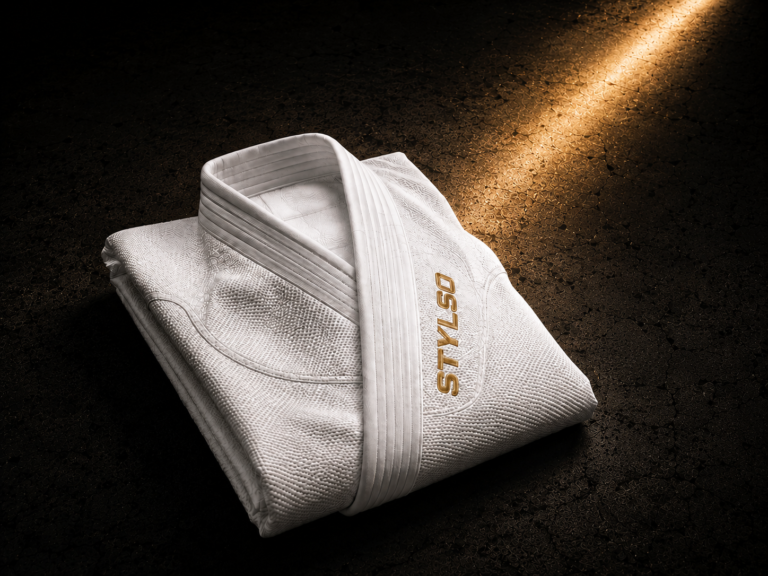
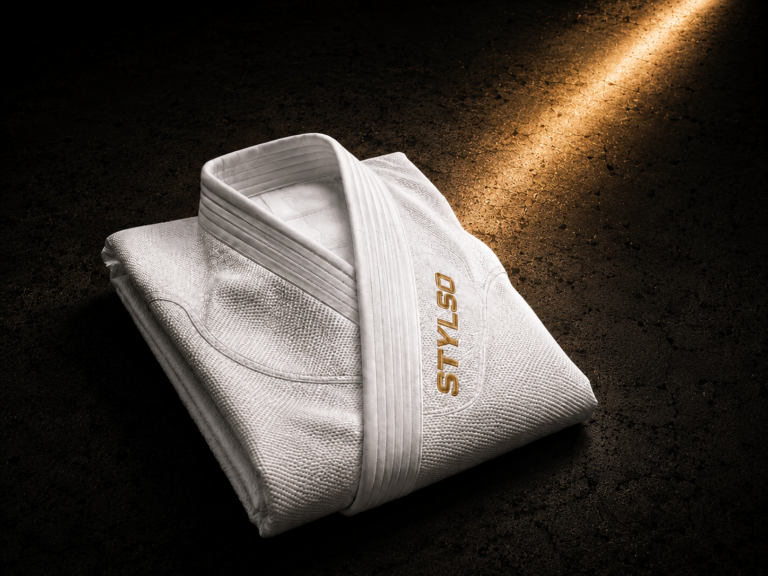
A clean, well-maintained gi is part of a consistent recovery routine. Consistent recovery is what keeps you on the mat.
Shop the Stylso Men’s Gi on Amazon
Recovery Stack Summary
| Phase | Done When | Why It Matters |
|---|---|---|
| Cool Down | On mat, after rolling | Clears lactate; reduces next-day stiffness |
| Rehydrate | First 15 min post-class | Replaces sweat loss; delays fatigue |
| Mobility | Within 60 min at home | Prevents chronic tightness; protects joints |
| Refuel | Within 90 min of training | Kick-starts muscle repair; refills glycogen |
| Sleep | That night | Peak recovery window; motor learning consolidates |
Free: The Stylso BJJ Recovery Stack Printable
7-day post-training tracker, the 5 mobility holds, and a printable checklist — everything in one page for your gym bag.
FAQ
How long does a BJJ recovery routine take?
The five phases take about 20–25 minutes of active effort outside of class — cool-down, hydration start, and mobility work. Sleep and eating are things you’re doing anyway. Build the routine around those and recovery adds almost nothing to your day.
Should I do recovery on rest days too?
Yes. Rest days still benefit from light active recovery: a 20-minute walk, gentle mobility work, or easy solo drills. Total inactivity slows blood flow and stiffens you faster than light movement.
Does foam rolling help after BJJ?
It helps, but it ranks below sleep, protein, and mobility in terms of impact. Get those three right first. Foam rolling as a bonus after mobility is fine — just don’t skip sleep to do it.
Why am I still sore even on rest days?
Usually one of three culprits: not enough protein, short or broken sleep, or training volume that outpaces your recovery capacity. Fix sleep first, then protein. If needed, reduce from 4 to 3 sessions per week temporarily and build back up.
What is the best food to eat after BJJ training?
Something with 20–30g of protein and complex carbohydrates within 90 minutes. Chicken and rice, eggs and toast, Greek yogurt and fruit, or a protein shake with milk. Check current prices on Amazon for protein supplements if getting real food in quickly is a challenge.
How do I know if I’m not recovering enough from BJJ?
Signs: soreness that doesn’t clear in 48 hours, technique declining under fresh conditions, dropping motivation, disrupted sleep, irritability. If you see three or more, cut training volume for a week and focus on sleep and nutrition first.
Related guides: BJJ Injury Prevention · BJJ Warm-Up Routine · How to Improve BJJ Flexibility · BJJ Solo Drills at Home