Your grip gives out before your body does. Every BJJ player figures this out eventually — usually mid-round, when a collar grip you’ve held for two minutes suddenly slides off. That’s not a fitness problem. It’s a grip-specific strength problem, and the fix is targeted.
Quick Takeaways
- BJJ grip demands crush strength, pinch strength, and grip endurance — most gym training only hits one.
- The Stylso Grip Stack is a six-drill system that covers all three, using gear you probably already own.
- Three days a week, 15–20 minutes — you’ll notice the difference in four to six weeks.
Why BJJ Grip Is Different
Standard gym grip training builds crush strength — how hard you can close your hand. That matters in BJJ. But it’s only a third of the picture.
In grappling, you also need:
- Open-hand (pinch) strength — holding a lapel or sleeve without a full-fist grip
- Grip endurance — maintaining any grip for three to five minutes under constant load and movement
- Finger extension strength — re-opening your hand quickly after a grip strip
Most gym programs ignore the last two. That’s why big, strong people still get their grips stripped on the mat.
The Stylso Grip Stack — 6 Drills That Cover All Three
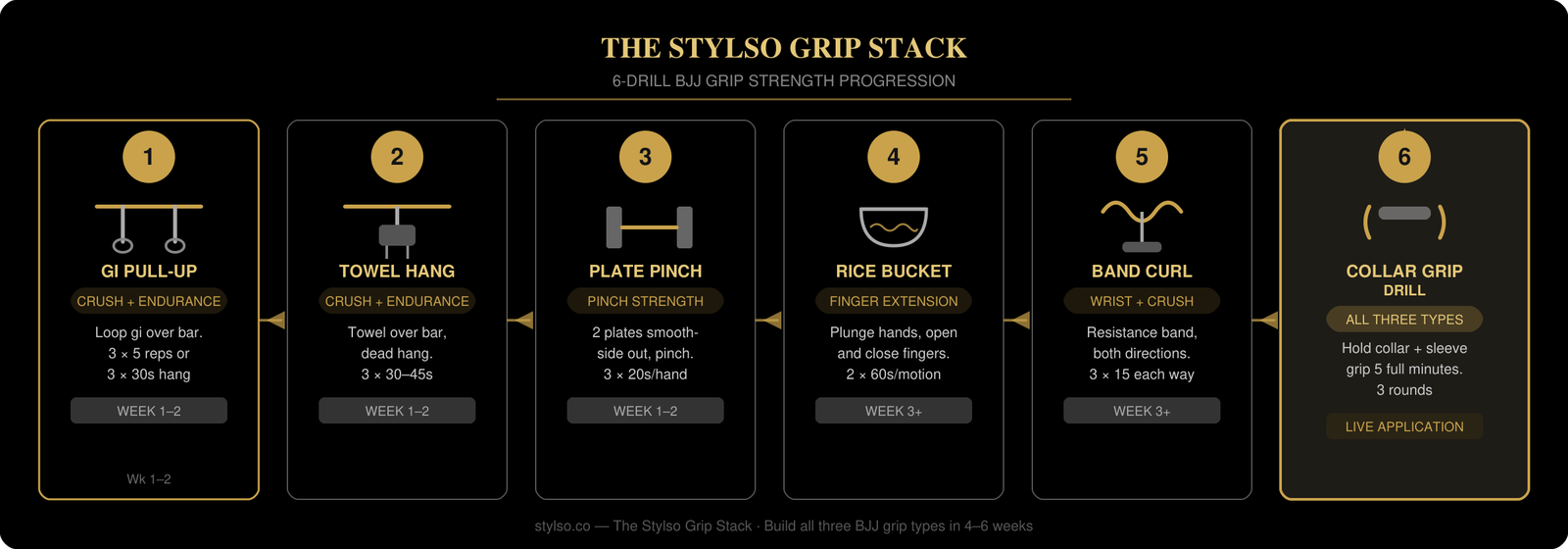
These six drills hit all three grip demands in about 15 minutes. Start with drills 1–3 in your first two weeks, then add 4–6 once those feel solid.
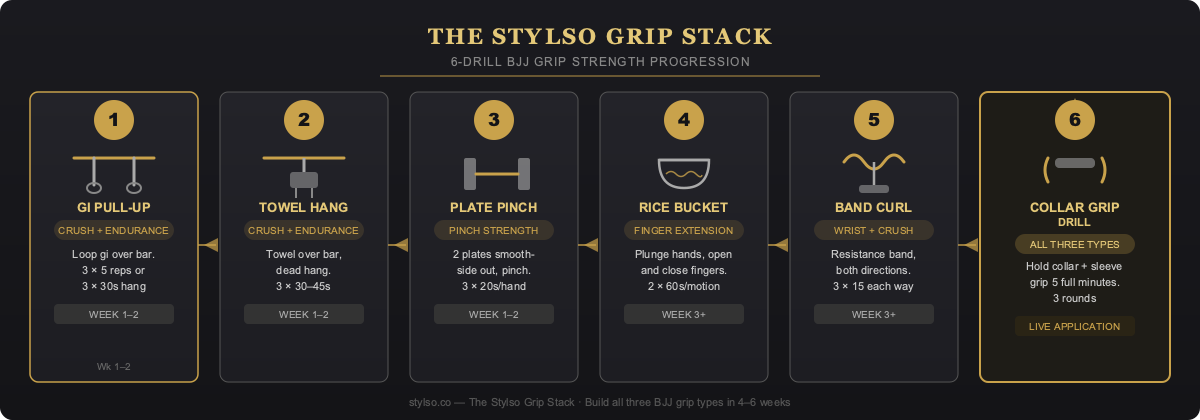
| # | Drill | Grip Type Trained | Sets & Reps | What You Need |
|---|---|---|---|---|
| 1 | Gi Pull-Up (or Gi Hang) | Crush + Endurance | 3 × 5 reps or 3 × 30s hang | Pull-up bar + an old gi or thick towel |
| 2 | Towel Dead Hang | Crush + Endurance | 3 × 30–45s | Towel over a bar; hang and breathe |
| 3 | Plate Pinch | Pinch Strength | 3 × 20s hold, each hand | Two 10-lb plates, smooth side out |
| 4 | Rice Bucket | Finger Extension | 2 × 60s each motion | A bucket of dry rice (~$3) |
| 5 | Band Wrist Curl | Crush + Wrist | 3 × 15, both directions | A light resistance band |
| 6 | Collar Grip Drill | All Three | 3 × 5-min rounds | Your gi + a grappling dummy or partner |
Drill 1 — Gi Pull-Up
Loop an old gi jacket or a doubled-up towel over a pull-up bar. Grab the fabric — not the bar — and pull. Can’t do a full pull-up yet? Just hang for 30 seconds. The fabric’s irregular surface forces your hand to work harder than a smooth bar. This is the closest gym drill to actual collar gripping.
Drill 2 — Towel Dead Hang
Loop a hand towel over a bar, hold both ends, and hang. Start at 30 seconds. Work to 45. Don’t grip the bar — grip the towel. This builds the grip endurance that stops your collar grip from sliding in a long scramble. It’s the drill most grapplers skip, and it’s the one that makes round four feel different.
Drill 3 — Plate Pinch
Two weight plates, smooth sides out. Pinch them together between your fingers — no grip assist, no mixed grip. Hold 20 seconds per hand, then switch. This trains the exact pinch pattern you use for a sleeve or pant grip. Wrestling coaches call this “fingertip strength.” It’s what keeps your sleeve grip from opening under pressure.
Drill 4 — Rice Bucket
Fill a bucket with dry rice and plunge your hands in. Open and close your fingers wide, dig in circles, spread and squeeze. Two minutes per session, two or three different motions. Your forearms will burn. That burn is your finger extensors — the muscles that re-open your hand after a grip strip. This is the one most people skip and then wonder why their grip strips keep working on them.
Drill 5 — Resistance Band Wrist Curl
Stand on a light band. Bend forward at the waist. Curl your wrists up (flexion), then flip your hands and curl the other way (extension). Three sets, 15 reps each direction. This covers the full wrist range your grip moves through in every roll — and it protects the joint while building strength.
Shop Resistance Bands on Amazon
Drill 6 — Collar Grip Drill (on dummy or partner)
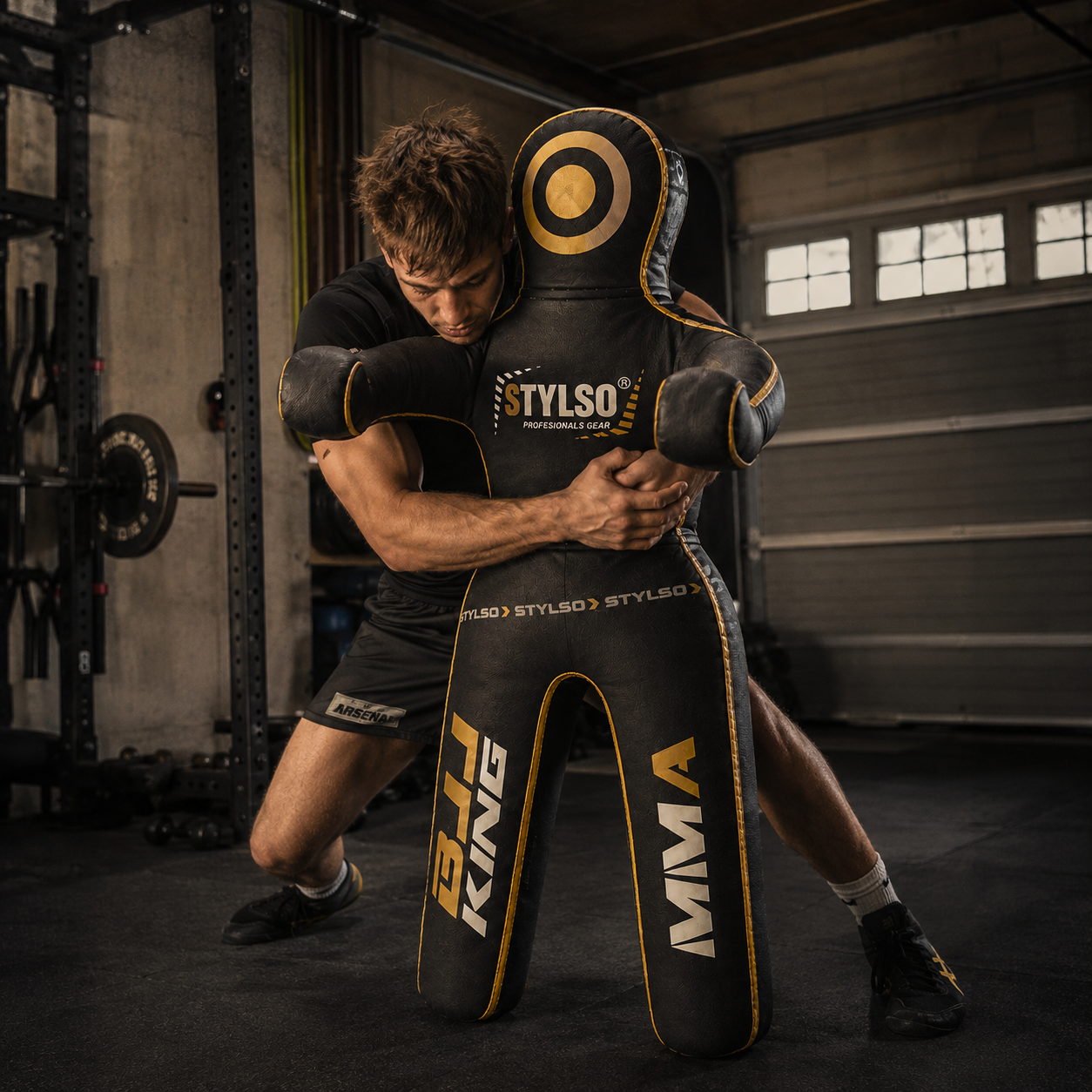
This is where it all comes together. Grab a high collar grip and a sleeve grip on your grappling dummy — or ask a training partner. Apply steady downward pressure for five full minutes. Don’t break grip. You’re not pulling hard; you’re training your nervous system to maintain grip quality under sustained load. This is the most direct transfer to live rolling of anything on this list.
The Judo Gripping Lesson That Changes How You Train
Here’s something most BJJ players don’t know: judo coaches teach grip as a tactical tool, not just a physical one. In judo, the sleeve grip isn’t just about holding — it’s about kuzushi, breaking your opponent’s balance. A judo player grips to redirect force, not just to hang on.
That changes how you drill. Instead of passively gripping a dummy and holding, practice pulling slightly down and across — the way you’d break someone’s posture from guard. Even on a bag or dummy, this trains your hand to be active, not just clamped. Skill-based grip lasts longer than brute-force grip in a live roll.
Wrestling adds another layer. Cradle positions require crushing grip strength in both hands simultaneously, often while your body is fully extended. Add a double-handed plate pinch (one plate, both hands, smooth side in) to borrow that training pattern and carry it back to the mat.
Your 3-Day Grip Block
You don’t need a separate gym session for this. Bolt it onto the end of training or add it on off days. 15 to 20 minutes is enough.
| Day | Focus | Drills | Time |
|---|---|---|---|
| Day 1 | Crush + Endurance | Gi Pull-Up · Towel Dead Hang · Plate Pinch | ~15 min |
| Day 2 | Extension + Wrist | Rice Bucket · Band Wrist Curl | ~10 min |
| Day 3 | Live Application | Collar Grip Drill (gi + dummy or partner) | ~20 min |
Give it four to six weeks. You’ll know it’s working when your grip stops being the thing that gives out first — in round three, in a tournament, in a long top-position scramble. That’s the point.
Free: The Stylso Grip Stack PDF
The full 6-drill guide with a weekly progress checklist, the judo gripping lesson, and a printable 3-day training block. No email list spam — just the guide.
Common Grip Mistakes
Only training crush strength. Squeezing a rubber ball builds one grip pattern. BJJ needs three. Use the full Stack.
Skipping finger extension work. Your grip muscles pull fingers closed. Your extensors open them. Neglect extension and you’ll be slow to re-grip after a strip. The rice bucket is the fix.
Gripping at max effort from round one. A death-grip from minute one burns your forearms by minute four. In practice, train a lighter grip — this is a skill, not just strength. The collar grip drill builds the control to choose your effort level.
Training grip on back-to-back days. Grip muscles are small and recover slowly. Space your grip block across three non-consecutive days. If your forearms are still sore going into training, give them one more day. Pushing through forearm fatigue is how fingers get injured.
FAQ
How long does it take to see real improvement in BJJ grip strength?
Most grapplers notice a real difference in four to six weeks of consistent grip-specific training — faster if you’re adding targeted drills instead of just relying on rolling to build it.
Do I need special equipment for BJJ grip training?
Not really. A pull-up bar, a towel, two weight plates, a bucket of dry rice, and a resistance band cover most of the Grip Stack. Your gi is already the best grip trainer you own for the collar drill.
Is grip training hard on the joints?
Not when you progress sensibly. Start with hangs and shorter holds — build volume over weeks. Listen to your fingers: muscle burn is fine, sharp joint pain is not. If finger pain persists between sessions, rest and see a physio. Don’t ignore it.
What grip training is best for BJJ beginners?
Start with the towel dead hang (easier than gi pull-ups) and the rice bucket. Both are joint-friendly and low-skill. They address grip endurance and finger extension — the two biggest gaps for beginners. Add plate pinch in week three.
Does your gi affect grip training?
Yes — fabric weight and weave change how grips feel. A heavier weave (double weave, gold weave) gives a more textured surface and can build hand endurance faster in training. A lighter pearl weave is easier on the hands for longer sessions. Both work well. Check the current options on Amazon.