The rashguard you grab off Amazon “for the gym” will fail you on the mat. It rides up on your back the moment you bridge. The seam finds your shoulder blade exactly when your partner’s knee is pushing through it. By round three, you’re adjusting gear instead of rolling.
Most “best rashguard” lists don’t account for what actually happens in BJJ — especially for women, where fit differences in chest, waist, and hip proportion mean a straight “medium” can gap at the hem or pull tight across your back mid-scramble.
Here’s what to look for instead.
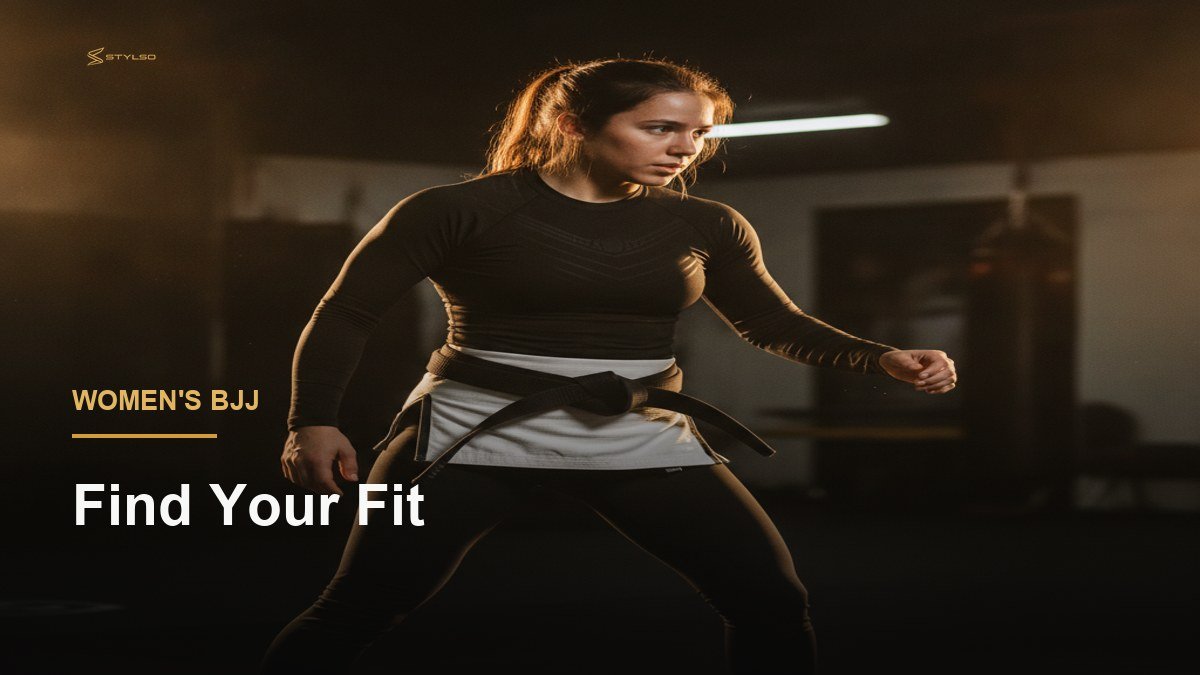
The short answer: The best women’s BJJ rashguard has four-way stretch, flatlock seams that sit flat against your skin during ground work, and enough compression to stay locked through a full roll. Long sleeve covers your arms and balances your temperature. Short sleeve runs cooler. Measure your chest — not your clothing size — before buying. Check current prices on Amazon.
- Flatlock seams are non-negotiable — raised stitching bruises against a partner’s knee during ground pressure
- Four-way stretch (lengthwise AND across) lets you reach for underhooks without the back pulling tight
- Long sleeve for most training; short sleeve for hot gyms or no-gi sessions
What BJJ Puts on a Rashguard (That Yoga Doesn’t)
A fitness top handles a spin class. BJJ is different.
Ground grappling asks your rashguard to do three things at once.
Stay in place. The back hem should stay tucked through bridges, shrimps, and roll-overs. If it creeps up, it’s costing focus. In competition under a gi, a bunched layer creates friction that adds up fast over a 6-minute match.
Protect your skin. Mat friction on bare forearms and shoulders leaves marks quickly. A well-fitted long sleeve takes those burns so you don’t. Wrestlers use compression layers for the same reason — same principle, same mat, same result.
Move with you. Four-way stretch means the fabric gives in every direction — lengthwise AND across. Reach for an overhook. Shoot a hip escape. The rashguard should follow, not fight.
The detail most people skip: flatlock seams. Regular stitching leaves a raised ridge on the inside of the fabric. In BJJ, that ridge sits exactly where a knee or elbow presses during top pressure. Flatlock seams lie flat against skin. It’s the difference between gear that works and gear that leaves a welt.
The 3 Best Women’s BJJ Rashguards: Honest Picks
No prices here — they change. Check current prices on Amazon and compare the feature lists. Here’s what each pick does well.
| # | Pick | Best For | Sleeve | Key Feature |
|---|---|---|---|---|
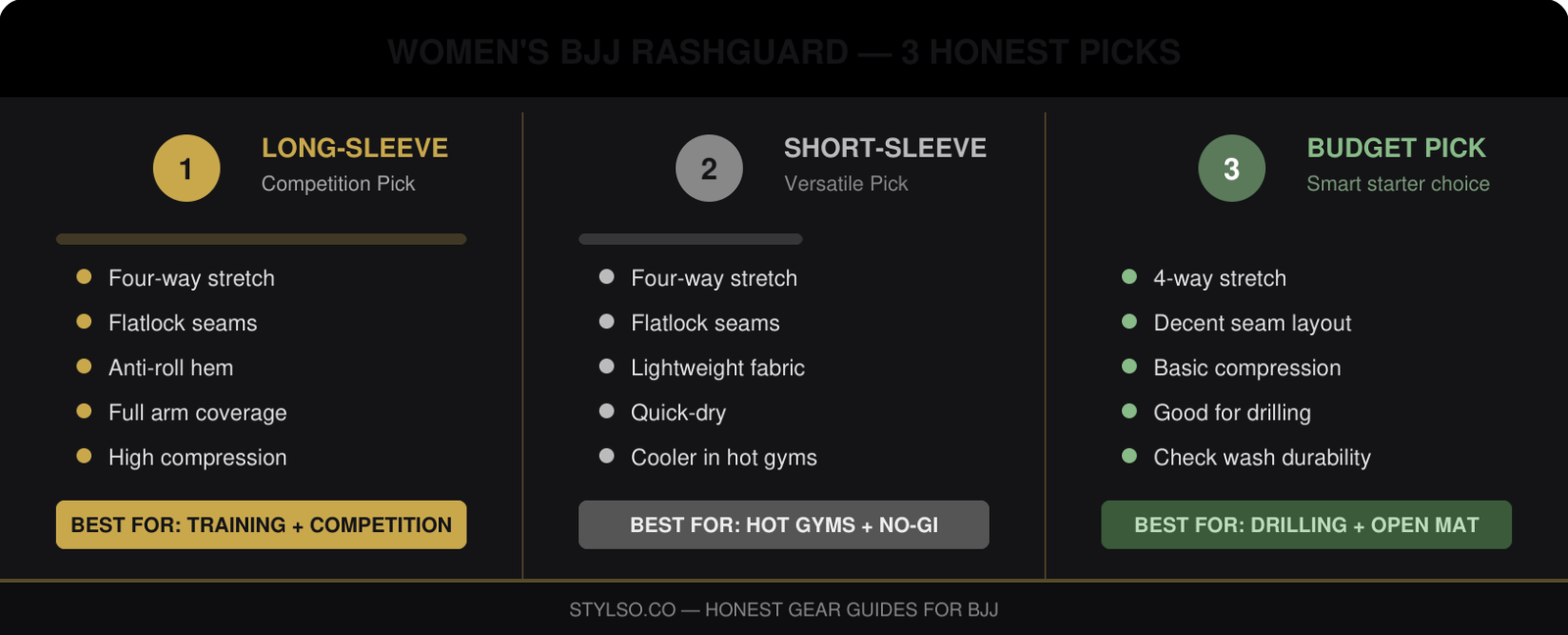
| 1 | Long-Sleeve Competition | Training + competition | Long | High compression, flatlock seams, anti-roll hem |
| 2 | Short-Sleeve Versatile | Hot gyms, no-gi | Short | Lightweight, quick-dry, cooler feel |
| 3 | Budget-Friendly | Drilling, open mat | Long or short | Basic 4-way stretch, decent seam layout |
1. Long-Sleeve Competition Pick
This is the workhorse. Long sleeve covers your arms from mat burns. High compression keeps everything locked — no riding, no resetting. Look for a four-way stretch nylon-spandex blend and flatlock seaming throughout.
The anti-roll hem — a tighter band at the bottom edge — is worth checking for. It keeps the back hem down through deep bridges and hip escapes. That one detail separates training rashguards from competition-grade ones.
This is the pick for regular drilling, hard sparring, and competition.
2. Short-Sleeve Versatile Pick
Hot gyms and no-gi sessions are where short sleeves earn their place. Less fabric means better heat management. In submission wrestling or intensive no-gi classes, that matters.
You trade arm coverage for comfort. Mat burns on the forearm are a fair cost in a warm gym. Look for the same core features: four-way stretch, flatlock seams, a snug fit that doesn’t slide.
Short sleeve is also common under a gi in summer competition.
3. Budget Pick
If you’re just starting, you don’t need to spend a lot. A basic four-way stretch rashguard with decent seams handles drilling and open mat fine.
What to check before buying: does it have actual compression (not just “stretch”)? Are the inside seams flat? What do recent reviews say about how it holds up after multiple cold washes? That last question is the most important one. Compression that dies after ten washes isn’t a deal.
How to Size a Women’s BJJ Rashguard
Rashguard sizing doesn’t match clothing sizing. Don’t go by the number in your jeans.
Measure your chest at the widest point — across the fullest part of your bust. That’s your primary measurement. Then match it to the brand’s chart.
General guide (measurements vary by brand — always verify the brand’s own chart before buying):
| Size | Chest (inches) | Chest (cm) |
|---|---|---|
| XS | 30–33″ | 76–84 cm |
| S | 33–35″ | 84–89 cm |
| M | 35–37″ | 89–94 cm |
| L | 37–39″ | 94–99 cm |
| XL | 39–42″ | 99–107 cm |
The Stylso 4-Point Women’s Rashguard Fit Formula:
- Chest first. Measure at the fullest point. Compression fit = at or close to your measurement. Size up only if you prefer lighter compression.
- Hem check. The bottom hem should reach at or below your hip bone — nothing gaps when you bridge or shrimp.
- Shoulder seams. They should sit at your shoulder joint, not drooping toward your arm or pulling toward your neck.
- Movement test. Raise both arms overhead, then reach forward. The rashguard should follow without pulling at the hem or tightening across the back.
If you’re between sizes and want a tighter competition fit, size down one. If long-session comfort matters more, take your measured size.
Wash It Right So It Lasts
Rashguards take a beating in training. The elastic degrades faster than you’d think if you skip the basics.
Cold water. Always. Hot water breaks down spandex. The compression fades after a handful of hot washes. Cold water on a delicate cycle keeps the fiber alive.
Air dry. This is non-negotiable. A dryer kills spandex — the heat warps the seams and destroys compression. Hang your rashguard or dry it flat. It’s done in under an hour at room temperature.
Turn it inside out before washing. Washing inside-out protects the outer surface from fabric abrasion.
Wash after every session. Don’t leave it damp in your gym bag — bacteria take hold fast in warm, wet fabric. The smell becomes permanent quicker than you think.
Same cold/air-dry principle applies to gis: How to Wash a BJJ Gi covers the full routine.
Free: Women’s BJJ Rashguard Size & Care Checklist
One-page PDF — sizing chart (XS to XL in inches and cm), the 4-Point Fit Formula, and a 5-step wash routine that keeps your rashguard lasting.
FAQ
Can I wear a fitness rashguard for BJJ?
You can, but it’ll fail during ground work. Fitness rashguards use standard stitching, lighter compression, and a looser hem. They work for light drilling. Rolling on the mat will expose every weak point — usually by the second or third round.
Long sleeve or short sleeve for BJJ?
Long sleeve for most training — it covers your arms from mat burns and helps regulate temperature. Short sleeve when your gym runs hot or during no-gi sessions where you want less fabric.
How tight should a BJJ rashguard be?
Close but not restricting. It should feel like compression, not a squeeze. You shouldn’t need to tug at it to move freely, but there shouldn’t be excess fabric bunching anywhere. If lifting your arms pulls at the waist, go up a size.
Do I need a rashguard if I only train gi?
It’s not required, but most training partners prefer it. It protects your skin, reduces friction, and keeps you warmer in cold gyms. Under a gi, a long-sleeve rashguard also protects your forearms during grip-intensive drilling.
How often should I wash it?
After every session. Don’t let it sit damp. Cold water, delicate cycle, air dry — that’s the routine. Follow it and your rashguard will last years.