Stylso — BJJ gis and combat-sports apparel, built for athletes who train.
You showed up to your first BJJ class in a karate gi. The instructor looked at you. Then looked at the gi. Then back at you. Nobody said anything — but the next time you rolled, your training partner grabbed your collar and pulled. The collar stretched. The seam at the back of the neck started to give. You heard something shift in the fabric that you really didn’t want to hear. That’s the moment the “a gi is a gi” myth dies.
A BJJ gi and a karate gi look almost identical hanging on a rack. But they’re built for completely different jobs. Here’s what nobody tells you: the difference shows up the second someone grabs your collar with real intention.
A BJJ gi has a reinforced collar, tighter sleeves, heavier weave, and a longer jacket skirt — all built to survive constant grip-fighting on the ground. A karate gi is lighter and looser, designed for striking speed and freedom of movement at distance. They’re not interchangeable, and using the wrong one in the wrong sport will cost you grips, seams, and in competition, a failed gear check.

They look alike. They’re not.
Stand both gis next to each other and you’d think they’re cousins. Same basic silhouette. But pick up the collar on each and you feel it immediately.
A BJJ gi collar is thick. Dense. Almost rope-like. It’s reinforced with layers of cotton folded and stitched under tension — built to be grabbed hundreds of times per session without tearing or collapsing. Here’s exactly what goes into BJJ gi construction if you want the full material breakdown.
A karate gi collar is thin and flat. It’s not designed to be grabbed. In karate, grabs are brief and controlled — you’re not spending three minutes fighting for collar control from guard. The collar doesn’t need reinforcement because gripping isn’t part of the game.
The rest of the gi follows the same logic. A karate gi is engineered like a power tool extension cord: fine for what it was designed for, not rated for loads it was never meant to carry. The moment you run BJJ grip-pressure through a karate gi, it fails. Not because it’s a bad gi — because it’s the wrong gi.
What makes a BJJ gi a BJJ gi
- Reinforced collar. The collar is the most-grabbed part. It’s thick — foam or rubber core, wrapped in multiple cotton layers, stitched hard. It has to survive twisting, stretching, and full grip-pressure without deforming.
- Tighter sleeves. BJJ gi sleeves are cut close to the arm. A loose sleeve is a handle — it gives opponents free grip surface. Tight sleeves make every sleeve grip something your training partner has to work for.
- Heavier weave. Pearl weave and gold weave fabrics are denser than plain karate-gi weave. The fabric adds structure — it doesn’t stretch or tear under the sustained pulling loads of ground fighting. More on what BJJ gi weaves actually mean.
- Longer jacket skirt. The BJJ jacket sits mid-thigh. You need enough fabric at the bottom to prevent the jacket riding up and exposing your back during guard work and scrambles.
- Double and triple stitching. Armpits, crotch seam, collar base — every stress point gets extra thread. A BJJ gi seam has to handle someone’s full body weight pulling against it.
What makes a karate gi different
Karate is a striking art. The fighting distance is longer. Athletes are on their feet, moving in and out, throwing punches, kicks, and blocks. The gear reflects that completely different game.
- Lightweight fabric. Karate gis are woven lighter — breathability and freedom of movement trump durability under grip pressure, because there isn’t any grip pressure.
- Thin, flat collar. It lays clean, looks sharp in kata. Under a grip-fighter’s fingers, it has nowhere near the structural integrity of a BJJ collar.
- Loose, flowing jacket. The looser cut gives karate athletes full range of arm motion for strikes and blocks. That same looseness becomes a problem in BJJ — more fabric means more gripping surface for your opponent.
- Lighter stitching. Appropriate for a striking art. Not rated for grappling loads.
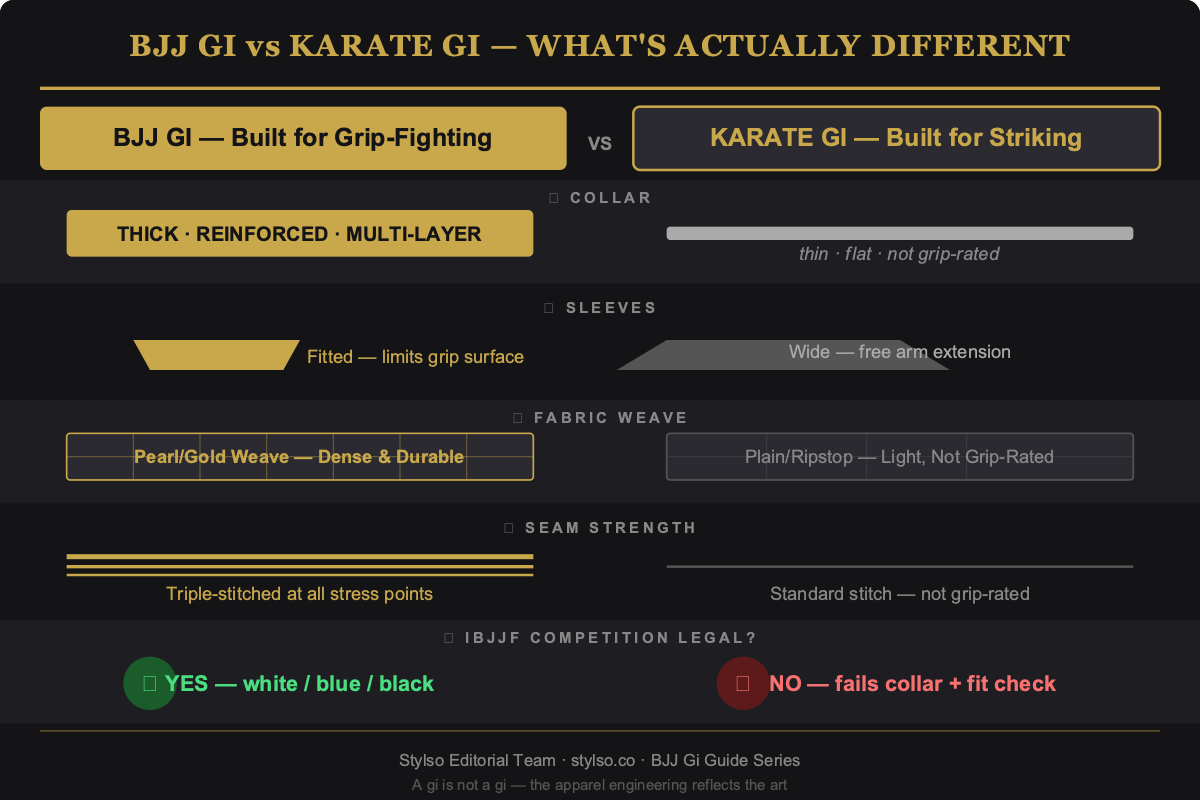
BJJ gi vs karate gi: side by side
| Feature | BJJ Gi | Karate Gi |
|---|---|---|
| Collar | Thick, reinforced — foam/rubber core, multi-layer cotton, heavy stitch. Built for grips. | Thin and flat. Looks sharp. Not built for grip pressure. |
| Sleeves | Fitted close to the arm — limits sleeve grips | Loose and flowing — full arm extension for strikes. Extra grip surface in BJJ. |
| Jacket cut | Shorter fitted skirt — stays in place during ground work | Longer, open cut — optimized for standup striking range |
| Fabric weave | Pearl or gold weave — heavy, tight, grip-resistant | Lightweight canvas or ripstop — breathable, fast-dry, not load-bearing under grips |
| Seam strength | Double and triple stitched at all stress points | Standard single stitching — fine for striking, not for grappling |
| IBJJF legal? | ✓ Yes (white, blue, black — if spec-compliant) | ✗ No — fails collar thickness and fit inspection |
| Price range | Higher (heavier build) | Similar or lower |
What karate actually teaches BJJ players
Here’s the cross-discipline insight most people miss. A karate player stepping onto the BJJ mat for the first time shouldn’t bring their karate gi — but they absolutely should bring their distance awareness.
Karate has a concept called ma-ai — the control of fighting distance. In karate, you manage the space between you and your opponent deliberately. You don’t drift into range accidentally. Every step means something.
BJJ players at the outside position — pushed off during a guard pass attempt, trying to re-engage — often rush straight back in with their head down. A karate player knows to circle first. Here’s a drill worth trying with a training partner:
- Your partner holds guard position. You get pushed to the outside — your normal reset spot.
- Instead of re-engaging straight forward, circle two steps laterally before closing distance.
- Your partner has to pivot to track you. This breaks their hip alignment before you re-engage.
That’s ma-ai applied to BJJ. The karate gi’s loose cut was designed for exactly those lateral, upright movement patterns. The BJJ gi’s tight cut is designed for what happens when you close that distance and grip up. Both gis make sense for their art. Understanding both makes you a better grappler.
See how the BJJ gi compares to another martial arts uniform in our BJJ gi vs judo gi breakdown.
Can you use a karate gi for BJJ?
Short answer: no. Don’t try it past week one.
The collar will fail. In a hard roll, when someone gets a cross-collar grip and applies real pressure, a karate gi collar folds, tears at the stitching, or collapses. It was never built for that load. The loose sleeves create grips you can’t control. And in any IBJJF-affiliated competition, you’ll be turned away at the door — karate gis don’t meet the construction standards.
You might get away with it for solo drilling or very gentle technical work. The moment you go live, the gi becomes a liability. Your training partner gets better grips on you than on themselves. That’s not a fair test of your technique.
If you’re coming from karate and starting BJJ, get a proper BJJ gi. Our guide to the best BJJ gi for beginners walks through exactly what to look for. And for a full breakdown of how to match the gi to your training, here’s how to choose a BJJ gi the smart way.
Can you use a BJJ gi for karate?
This one’s more nuanced. Often yes — at least for casual training and basics.
A BJJ gi is heavier and less crisp than a karate gi. You won’t get that satisfying snap on a technique. The cut is tighter around the arms and legs, which can feel restrictive. Some dojos have dress code requirements that specify a proper karate gi.
But for a casual cross-training session, kata practice at home, or a beginner class where you don’t own a karate gi yet? A BJJ gi usually works fine. It won’t fail. It’s overbuilt for karate — but overbuilt in the right direction.
The reverse isn’t true. BJJ will eat a karate gi alive.
Get the right gi for BJJ
The Stylso pearl-weave gi is built for BJJ training and competition — reinforced collar, fitted sleeves, triple-stitched stress points, IBJJF-approved colors. Check the current price on Amazon.
Shop Stylso Men’s BJJ Gi on Amazon
Training with a young grappler? The kids’ gi has the same reinforced collar and grip-resistant weave, sized for junior athletes.
Shop Stylso Kids’ BJJ Gi on Amazon
Free: BJJ Gi vs Karate Gi — The Comparison Cheat Sheet
One printable page — the full feature comparison, cross-use verdict, and the ma-ai drill to carry from karate into BJJ. No fluff.
Key takeaways
- A BJJ gi and a karate gi aren’t the same — different collar, weave, cut, and purpose.
- The collar is the biggest difference. A BJJ collar survives thousands of grips. A karate collar doesn’t.
- A karate gi will fail in a real BJJ roll. Don’t use it past week one.
- A BJJ gi usually works for casual karate basics. It’s overbuilt for it — but it won’t fail.
- Karate’s ma-ai principle transfers to BJJ’s standing game. Try the circling drill next training.
- For BJJ, always use a gi built for the sport — one that meets IBJJF construction standards.
Frequently asked questions
- What’s the main difference between a BJJ gi and a karate gi?
- The collar. A BJJ gi collar is thick, reinforced, and built to be grabbed hundreds of times under full grip pressure. A karate gi collar is thin and flat — designed for striking, not grabbing. Beyond that: heavier weave, tighter sleeves, and double-stitched seams throughout on the BJJ side.
- Can I wear a karate gi to my first BJJ class?
- Most instructors will let you try once. But the collar isn’t built for grip loads and may stretch or tear. You’ll give your training partner better grips than you have on yourself. Get a proper BJJ gi before you train in earnest.
- Will a karate gi pass IBJJF inspection?
- No. IBJJF checks collar thickness, jacket length, sleeve fit, and color. A karate gi fails on collar and fit. Even at informal club tournaments, most coaches will ask you to change.
- Is a BJJ gi heavier than a karate gi?
- Yes, by a meaningful margin. Pearl weave or gold weave fabric is denser than the plain or ripstop weave in most karate gis. That weight is the cost of durability under grip load — by design.
- Can I use my BJJ gi for karate class?
- Usually yes, for casual training and basics. The heavier fabric and fitted cut restrict striking range of motion slightly. For a crossover class or beginner session, it works. For dedicated karate training, get a proper karate gi.
- Do my kids need two gis if they do both karate and BJJ?
- Yes, if training both seriously. A karate gi won’t survive BJJ rolling. A BJJ gi restricts karate movement. Kids’ BJJ gis are built with the same collar reinforcement as adult gis. Check the current price on Amazon for the Stylso kids’ gi.
Shop Stylso Kids’ BJJ Gi on Amazon
Stylso Editorial Team | About Stylso