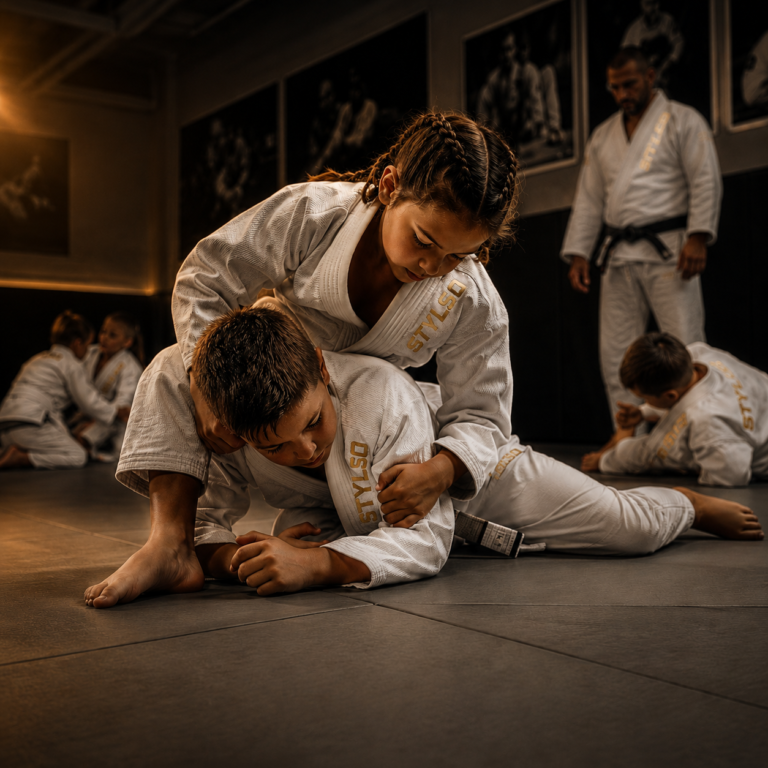
Your first live round on your feet probably felt like chaos. Collar grabs, scrambled footwork, then a fast pull to guard. That’s everyone’s first week. But here’s the thing nobody tells you: most high-level grapplers rely on two or three takedowns in competition. They just drill those moves until they’re automatic.
The goal isn’t to wrestle like a college champion in your first year. It’s to stop surviving the standup and start working it. Pick from this list. Learn one. Drill it until it feels natural. Then add the next.
Quick Takeaways
- Pick one takedown first and drill it 50 reps before you add a second.
- Wrestling shots (double/single leg) work in both gi and no-gi — learn them early.
- Even guard-pullers need one standing option — the threat alone changes how opponents grip and move.
Why Takedowns Matter (Even If You Pull Guard)
Maybe you’re thinking: I’ll just pull guard every match. That works. But here’s the thing — if an opponent thinks you can shoot a double leg, they hesitate. That hesitation opens your collar drag angle or your guard-pull timing. The threat of the takedown is a weapon even when you don’t use it.
Wrestlers learn this early. Judoka build their entire throwing system on the same idea — set up the attack so the opponent’s defense creates the opening. Even one reliable takedown changes how opponents engage you on your feet.
The 5 BJJ Takedowns Every Beginner Should Learn
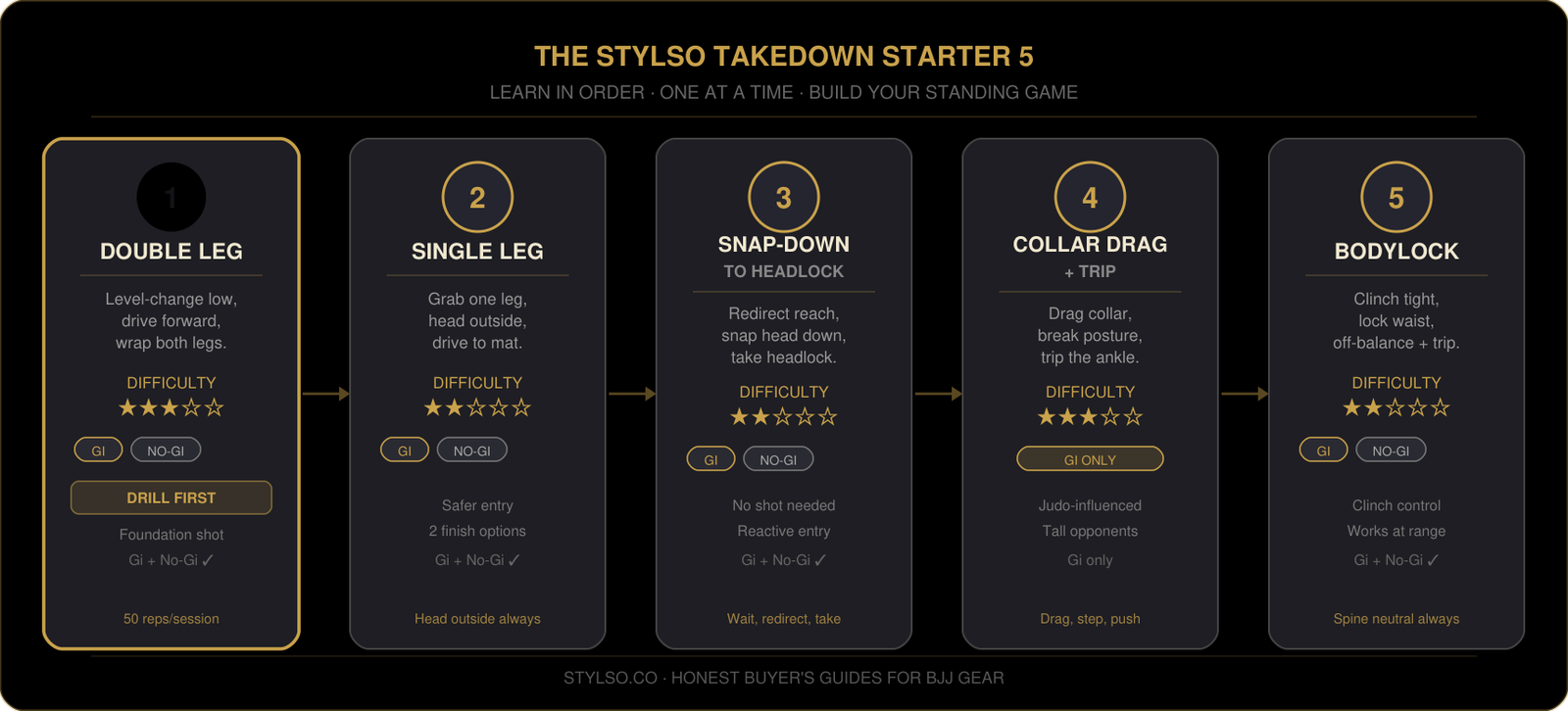
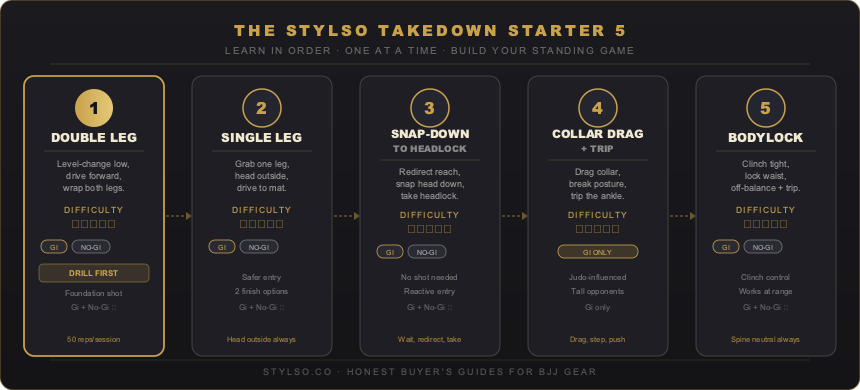
1. Double Leg (The Foundation Shot)
The double leg is BJJ’s most-drilled takedown — you’ll see it at every level. Level-change (drop your hips fast), drive forward, wrap both legs behind the knees, and complete the takedown. Works in gi and no-gi.
The part beginners skip: the level change itself. The shot is almost irrelevant if your entry is slow or upright. Drill the level change alone — 20 reps, eyes forward, low and fast — before you add the finish.
2. Single Leg (Versatile, Safer Entry)
The single leg is more forgiving than the double. You grab one leg, stay more upright, and use head position outside to avoid the guillotine. It’s one of the most common takedowns in BJJ competition at every level because it works even if the timing isn’t perfect.
Drill the entry: shoot, head outside (not inside — that’s a guillotine invitation), and drive. You can finish it standing or scoop-and-drive your opponent to the mat. Two finishing options from one entry.
3. Snap-Down to Front Headlock
No shot required. When your opponent reaches for a collar or sleeve grip, snap their head sharply down toward the mat. Take the front headlock immediately. From there you can drag them forward, attempt a choke, or work to the back.
Why it’s great early: it’s reactive. You don’t initiate — you redirect their movement. Works in gi and no-gi, and you can drill the snap-down motion alone or on a grappling dummy.
4. Collar Drag with a Trip (Gi-Specific)
Grab your opponent’s collar with one hand. Drag them forward to break their posture. Step your foot behind their ankle and push through. Smooth, low-risk, and effective against opponents who stand tall and grab at your collar first.
The judo connection: o-soto-gari and ko-uchi-gari use the exact same drag-and-trip mechanic. If you ever cross-train in judo, this muscle memory transfers directly. Judo footwork in BJJ is genuinely underrated — these moves share roots.
5. Bodylock (Bear Hug)
Clinch tight, lock your hands around their waist, and off-balance them sideways or trip a leg. Especially useful when you can’t get clean head position, or when your opponent is bigger and you need to control distance first.
Health note: keep your spine neutral in the bodylock — don’t hunch your lower back when you drive. Loading a takedown with a rounded back is how grappling back injuries happen. Train it right from day one and you’ll still be doing this move in year five.
How to Drill Takedowns Without a Partner
The most important part of any takedown — the setup — you can drill alone. Here’s a five-step solo session you can run anywhere:
- Level change × 20 — drop your hips sharp and low, stay on your toes, come back up. Repeat.
- Penetration step × 20 — one foot forward, drop to knee, drive your chest forward, reset.
- Snap-down motion × 20 — grab air, snap sharply down, immediately frame a front headlock.
- Collar drag pull × 20 — simulate the grip angle and the posture-breaking pull, step through the trip.
- Bodylock entry × 10 — clinch a post or grappling dummy, practice the lateral off-balance.
A grappling dummy turns this into finishing reps — snap-down to headlock, bodylock drive, single leg completion. The pattern builds fast when you’ve got something to work against.
Takedown Comparison Table
| # | Takedown | Difficulty | Gi | No-Gi | Best For |
|---|---|---|---|---|---|
| 1 | Double Leg | ★★★☆☆ | ✓ | ✓ | Foundation — drill every session |
| 2 | Single Leg | ★★☆☆☆ | ✓ | ✓ | Beginners, reactive play, safer entry |
| 3 | Snap-Down | ★★☆☆☆ | ✓ | ✓ | Reactive, grip-fighting, no-shot entry |
| 4 | Collar Drag + Trip | ★★★☆☆ | ✓ | — | Gi-only, tall opponents, judo roots |
| 5 | Bodylock | ★★☆☆☆ | ✓ | ✓ | Clinch fighters, bigger opponents |
The Gear You Actually Need
You don’t need much. But the right basics matter when you’re drilling takedowns daily:
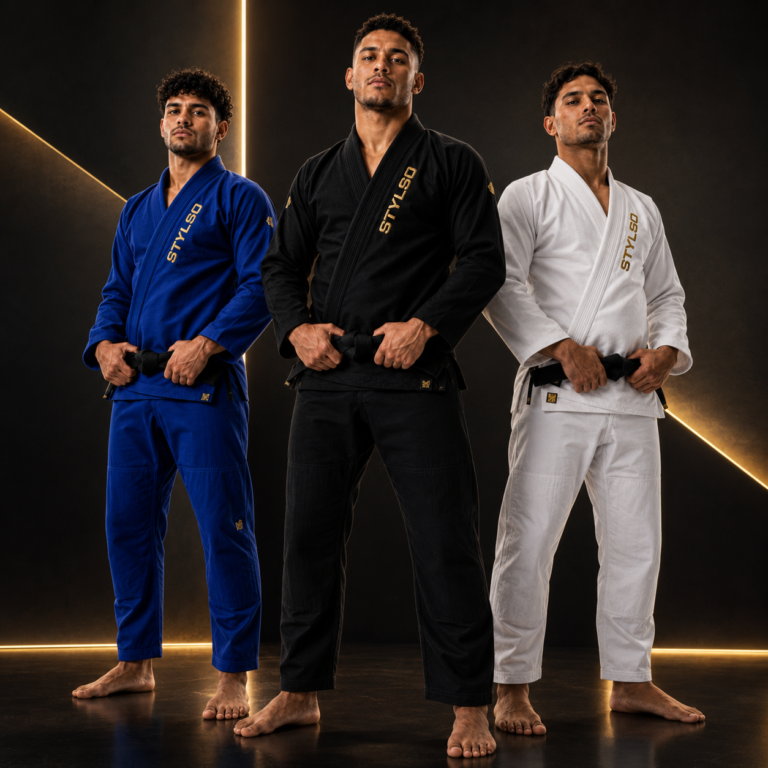
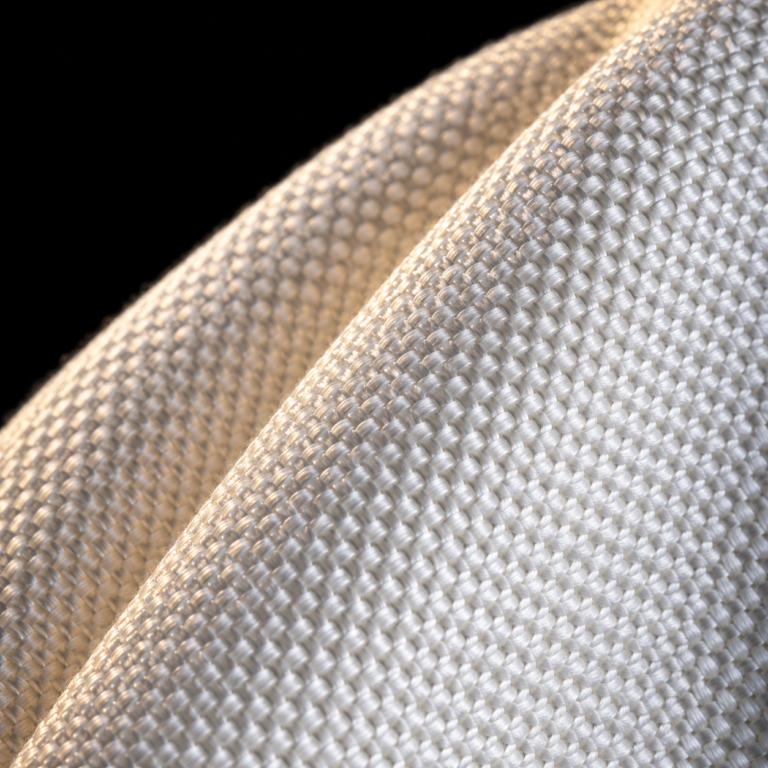
- A well-fitting gi: Loose enough to move freely in a shot. Tight enough that your own collar doesn’t get grabbed as you enter. A pearl weave gi is the standard — light enough for drilling, durable enough for daily training and collar grabs.
- A rashguard under the gi: Protects your skin in scrambles and mat contact. In no-gi, rashguard plus spats is the standard setup.
Free: BJJ Takedowns Drill Sheet
The full Stylso Takedown Starter 5 with a weekly rep tracker, drilling tips, and the key mistake for each move. One page. Keep it in your gym bag.
FAQ
What’s the easiest BJJ takedown for a complete beginner?
The single leg and snap-down are the most accessible. Both work in gi and no-gi, neither requires explosive athleticism, and both have clear entries you can drill from day one.
Should I learn takedowns if I plan to pull guard?
Yes. Even committed guard pullers benefit from one solid takedown. The threat alone changes how opponents approach you standing — which usually creates a cleaner guard-pull angle.
Can I practice BJJ takedowns at home without a partner?
Absolutely. The setup — level change, penetration step, snap-down motion — can all be drilled solo. A grappling dummy adds finishing reps and makes solo drilling genuinely useful.
Are wrestling takedowns legal in BJJ?
Most are. Double legs, single legs, and bodylock takedowns are legal in gi and no-gi BJJ competition. Slams are typically banned — check your specific ruleset before competing.
How long does it take to get a reliable takedown in BJJ?
With consistent drilling two to four times per week, most beginners have a working single leg or snap-down in eight to twelve weeks. It’s a motor pattern — reps are the entire answer.
Similar Posts
BJJ Gi vs Wrestling Singlet: What’s the Real Difference?
BJJ gi vs wrestling singlet — two sports, two completely different uniforms. Here’s what sets them apart and which one to shop on Amazon.
Best BJJ Gi for Teens — How to Pick the Right Size
Find the best BJJ gi for teens with our sizing guide. K-series for up to 160 cm, Adult A0 for taller teens. Shop on Amazon — no price guessing needed.
BJJ Gi Shrinkage by Weave: Which Fabric Holds Its Shape
Not all BJJ gi weaves shrink the same. Learn how single, double, pearl, and gold weaves handle heat — and which to buy if size matters.
The Best BJJ Shorts for Training (What to Look for Before You Buy)
Not all athletic shorts work on the BJJ mat. Find the best BJJ shorts for training — what holds up, stays on, and moves. Shop on Amazon.
Grappling Dummy vs Heavy Bag for BJJ: Which One Actually Builds Skill?
Grappling dummy vs heavy bag for BJJ: one trains your ground game, the other builds cardio. Here’s the honest pick. Shop on Amazon.
Best BJJ Rashguard for Women: Honest Picks from the Mat
The best women’s BJJ rashguard: honest picks for training, competition, and hot gyms. How to size, what seams matter, Shop on Amazon.