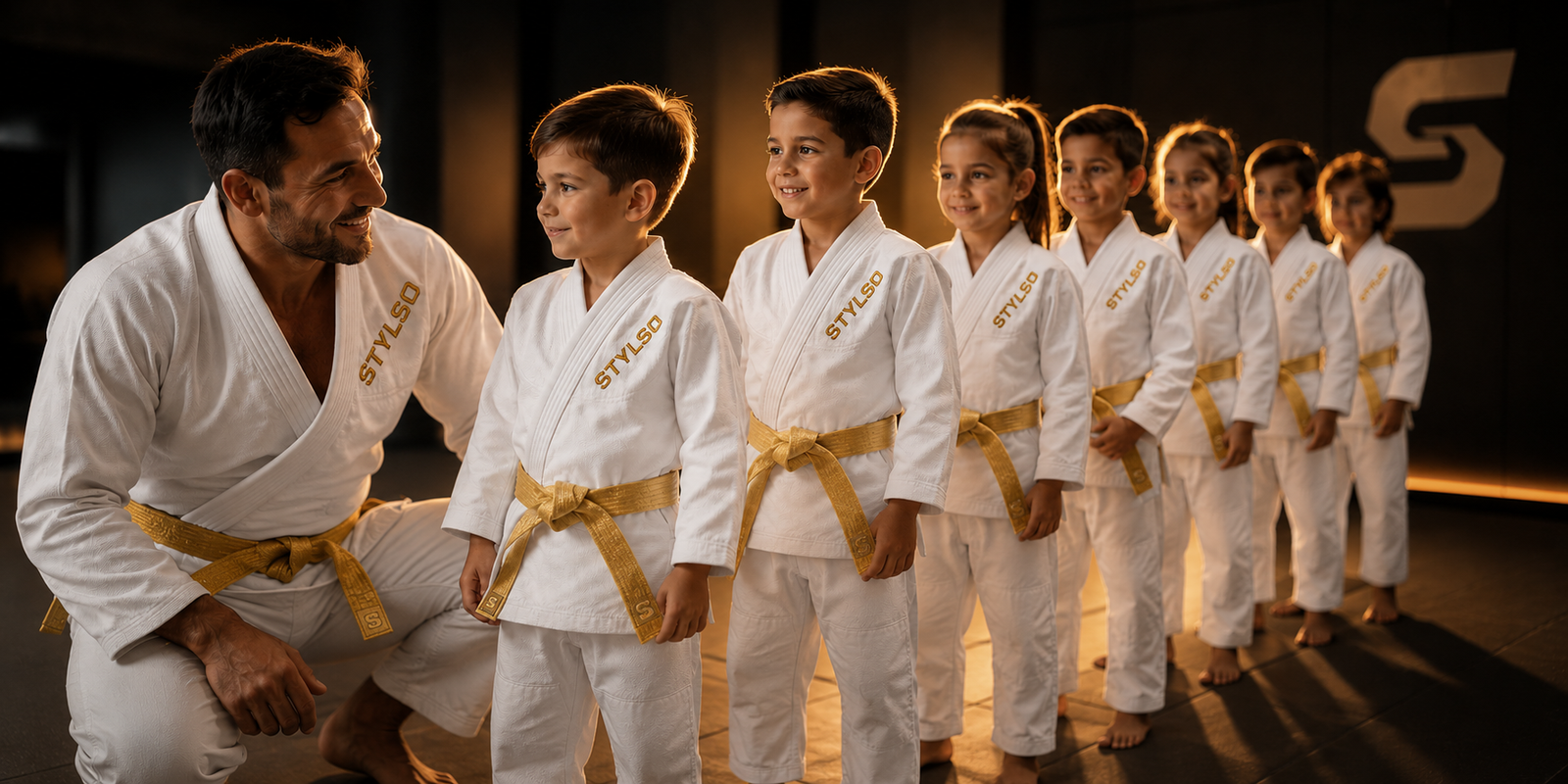
Most kids are ready for BJJ between ages 4 and 7. But the real question isn’t a number — it’s readiness. This guide breaks it down by stage: what to look for before you sign up, what your child will actually experience in that first class, and what gear they need. Adults, we’ve got you too. There’s no cutoff. Seriously.
Quick Takeaways
- Most academies welcome kids from age 3–4 in fundamentals programs; full BJJ typically starts around 6.
- Readiness — attention span, social comfort, ability to handle frustration — matters more than a birthday.
- Adults can start BJJ at any age. Many competitive black belts began training in their 30s or later.
Readiness Matters More Than Age
Two eight-year-olds can be in completely different places. One’s ready to drill guard passes and absorb coaching. The other needs another six months. Age is a rough guide, not a rule.
Before you book that first class, run through the Stylso Ready Check — five honest questions that tell you more than any birthday:
- Can they follow multi-step instructions? BJJ drills chain two or three moves. “Left foot, step across, sit” — if that gets a blank stare, give it a few months.
- Are they comfortable with contact? BJJ is a contact sport. Rolling means someone on top of you. Some kids love it immediately; others freeze. Know which yours is before class one, not during it.
- Can they handle frustration? They’ll get tapped, a lot, early on. Kids who laugh it off and try again are built for this. Kids who spiral into tears after every loss will struggle — and that’s okay. Try again in a few months.
- Can they focus for 45–60 minutes? A typical kids’ class runs about an hour. Constant distraction slows down the whole mat, and it’s not fair on the other kids.
- Do they actually want to go? This one matters most. A kid dragged to class every week doesn’t stick. One who’s already asking when the next session is? They’re ready.
Tick four or five of those boxes and stop waiting for the “right” birthday. Go try a class.
The Right Age to Start BJJ — By Stage
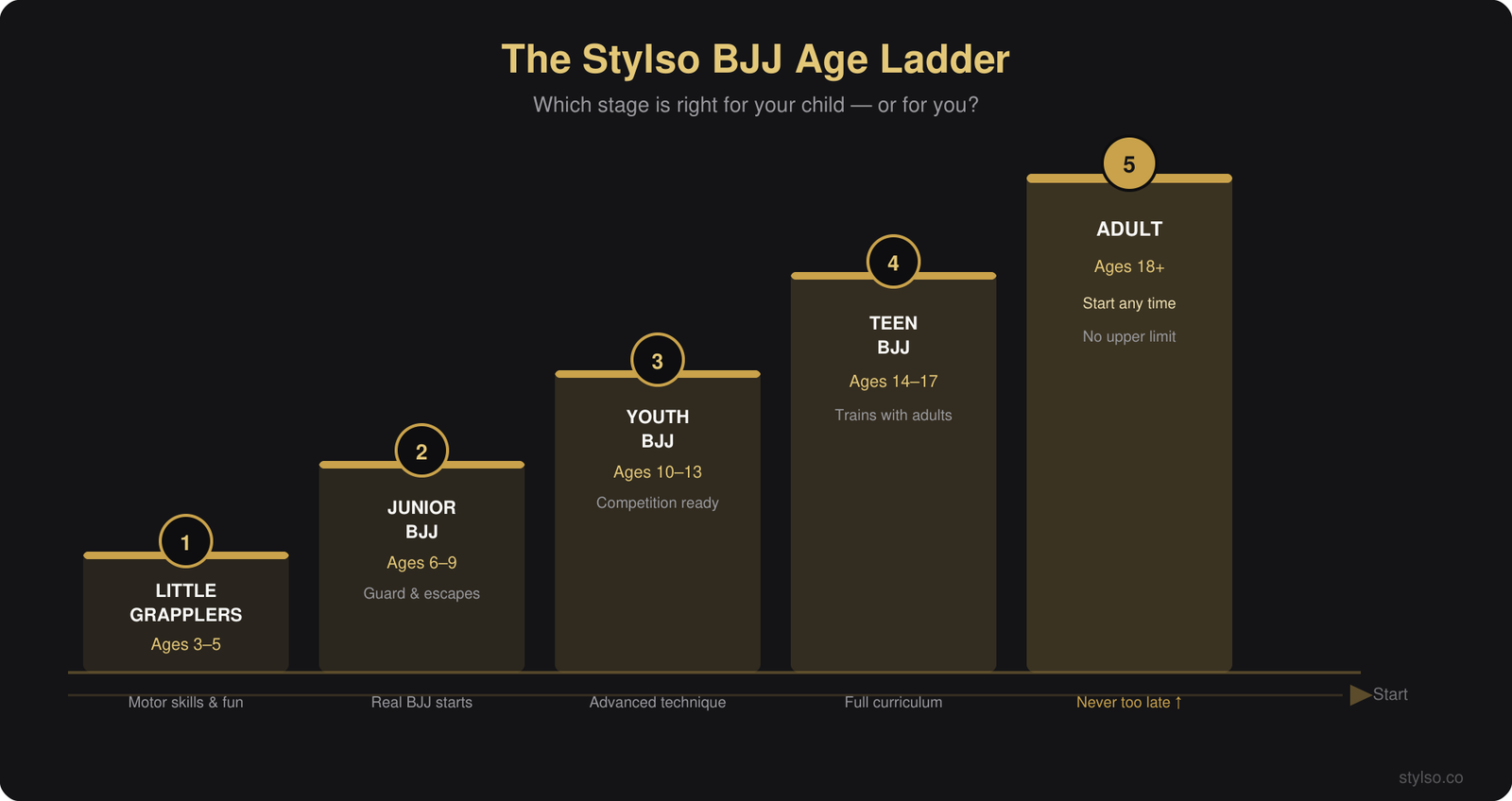
Most academies sort kids by development stage, not just age. Here’s an honest look at what each stage looks like on the mat — and what gear fits each one:
| Stage | Ages | What They Learn | Class Feel | Gear |
|---|---|---|---|---|
| Little Grapplers | 3–5 | Motor skills, tumbling, listening, body awareness | Game-based, short sessions — fun first, technique second | Kids’ Gi |
| Junior BJJ | 6–9 | Guard, mount, escapes, light submissions, mat etiquette | Structured drills + peer sparring — this is where real BJJ begins | Kids’ Gi |
| Youth BJJ | 10–13 | Advanced technique, strategy, competition prep | Closer to adult-level coaching; many compete at this stage | Kids’ Gi |
| Teen BJJ | 14–17 | Full BJJ curriculum, trains with adults, real self-defense | High intensity; teens often step into adult classes | Adult Gi |
| Adult | 18+ | Full curriculum from day one, no ceiling | Start at 25, 35, 45 — you’ll progress regardless | Men’s Gi |
Shop Stylso Kids' Gi on Amazon
Your Child’s First BJJ Class — What to Expect
The mat smells like rubber and effort. Everyone bows in. The warm-up starts — shrimping drills, forward rolls, backward rolls. It’s weird and unfamiliar and your kid is probably grinning by the second drill.
Most instructors have seen hundreds of first days. They’re patient. The partner drills are light — learning the shape of a move, not mastering it yet. Sparring, if it happens at all in session one, is with a trusted senior student who keeps it gentle.
The hardest part for most kids? The bow-in. Once that’s done, they’re usually fine. After the first roll, they’re hooked — or they’re not, and that’s okay too. You’ll know within the first couple of weeks whether it’s the right fit.
One practical note before you go: check whether the academy requires a gi for day one. Some let beginners wear loose shorts and a rash guard for the first week. Call ahead. Our white belt gear list covers exactly what to pack for that first session.
Starting BJJ as an Adult — It’s Not Too Late
Adults start BJJ at 25, 35, 45. Some at 55. The mat doesn’t check IDs.
If you’ve been putting it off because you think you’ve missed your window — you haven’t. Yes, kids absorb motor patterns faster. Their bodies are more pliable. But adults bring something most kids don’t: strategic thinking. You can understand why a technique works, not just mimic it. That understanding compounds quickly after the first few months.
Here’s a cross-discipline lesson worth keeping: in judo, there’s a long tradition of the sport as a lifelong practice — not just for competitive youth. Jigoro Kano, judo’s founder, framed the art as a path for physical and mental development across an entire life. Practitioners trained through their 70s. BJJ carries the same spirit. The question was never whether you’re the right age. It’s whether you want to start.
Get a gi that fits properly from the start. A loose gi gets caught in grips; a tight one restricts your movement and taps you before your partner does. Use the Stylso measuring guide to find your A-series size, then go from there.
Shop Stylso Men's Gi on Amazon
Sizing Your Child’s First Gi
Don’t buy an adult small and hope it fits — it won’t. Kids’ gi sizing is its own system. Stylso uses the K-series, sized by height and weight, not age. Measure your child’s height in centimetres (barefoot, standing straight) and match to the table below. These are real Stylso size chart numbers.
| Size | Height | Weight | Approx. Age | Shop |
|---|---|---|---|---|
| K000 | 114–120 cm | 18–23 kg | ~4–5 yrs | Shop |
| K00 | 120–127 cm | 23–27 kg | ~5–6 yrs | Shop |
| K0 | 127–135 cm | 27–32 kg | ~6–8 yrs | Shop |
| K1 | 135–142 cm | 32–36 kg | ~8–10 yrs | Shop |
| K2 | 142–147 cm | 36–41 kg | ~10–12 yrs | Shop |
| K3 | 147–155 cm | 41–45 kg | ~12–13 yrs | Shop |
| K4 | 155–160 cm | 45–50 kg | ~13–14 yrs | Shop |
Between sizes? Size up. Stylso gis are pre-shrunk pearl weave — they’ll settle slightly after the first couple of washes, and a little room in the sleeves means cleaner movement and grip room for your child’s growing frame. For a full measuring guide with visual cues, see our kids’ BJJ gi size guide.
Shop Stylso Kids' Gi on Amazon
One last thing: don’t overthink this. The best age to start BJJ is the age you start. For kids, that’s usually somewhere between 4 and 9. For adults, it’s now. The mat meets you where you are — as long as you show up. And for your child’s first competition-ready gi, our guide to the best BJJ gi for kids covers the picks worth knowing about.
Free: BJJ First Class Checklist
What to bring, what to wear, what to expect — plus the Stylso K-series kids’ gi sizing chart. One page, no fluff.
Frequently Asked Questions
What’s the youngest age to start BJJ?
Most academies accept kids from age 3–4 in fundamentals programs — sometimes called Little Grapplers or Tiny Ninjas. These classes are game-based with no submissions, just movement and listening. Full BJJ with guard, mount, escapes, and drilling typically starts around age 6.
Is BJJ safe for young kids?
Yes, in a well-run age-appropriate program. Kids’ classes use peer-matched sparring, controlled contact, and techniques suited to their development stage. Look for academies with dedicated kids’ programs — not just adult classes with small people in the corner. Watch a session before committing.
Can a 4-year-old do BJJ?
Some can. Run the Stylso Ready Check above — attention span and comfort with contact matter more than age at this stage. If your 4-year-old can follow a couple of chained instructions and isn’t bothered by physical contact, a fundamentals class is worth a try. Worst case: they need a few more months.
Can I start BJJ at 35? What about 40?
Absolutely. Adults start at every age, and plenty of serious competitors began training in their 30s or later. You’ll progress differently than a teenager — sharper conceptual understanding, slightly slower flexibility gains — but you’ll progress. The mat has no entry cutoff.
What gi should I buy for my child starting BJJ?
A kids’ gi sized by height and weight, not age. The Stylso K-series runs from K000 (roughly ages 4–5) to K4 (early teens). Measure their height in centimetres and use the table above. Don’t buy an adult small — the proportions are completely different and it won’t move right on the mat.
How do I know if my kid is ready for BJJ?
Run the Stylso Ready Check: can they follow multi-step instructions? Are they okay with physical contact? Can they handle frustration? Can they focus for about an hour? And — most importantly — do they actually want to go? Four or five yes answers and they’re ready. Don’t wait for a perfect score.