You’ve been shooting doubles for years. You live in the underhook. The first time someone pulls guard on you, every instinct you’ve trained fires — and none of it works the way it should.
BJJ doesn’t make your wrestling useless. It just adds a new layer on top of it — and for the first few months, that layer is confusing.
Here’s the honest bridge.
The short answer: If you wrestle, you’re already closer to BJJ than you think. Your base, your pressure, your sense of control — all of it transfers. What’s new: guard, submissions, the gi grip game. Start with a gi class. The first few weeks are humbling; the learning curve accelerates fast after that.
- Takedowns, top pressure, and base all carry over directly from wrestling into BJJ
- Guard passing and submissions are the genuinely new skills — they take a few months to click
- Start in gi class; the collar grips and jacket mechanics teach BJJ fundamentals faster than no-gi
What Transfers Directly from Wrestling
Wrestlers don’t start from zero in BJJ. The foundation is already there.
Base and balance. Wrestling builds the instinct to keep your weight low and maintain position. BJJ rewards the same instinct. Your base — hips back, knees bent, weight centered — is already trained.
Takedowns. Doubles, singles, and trips all work in BJJ with minor adjustments. Gi grabs change how you grip, but the shot mechanics and leg drive are identical.
Top pressure. The feeling of controlling someone from side control or mount is familiar if you’ve wrestled. You know how to use your weight and kill space. Those skills convert directly.
Explosive hip movement. Hip escapes, bridging, and scrambling — BJJ just has specific names for movements wrestlers already do.
Mental toughness. Wrestlers are used to being uncomfortable, tired, and close to failing. That tolerance matters enormously in your first months of BJJ.
What’s Different in BJJ
These are the things that will humble you — fast.
Guard. This is the biggest culture shock. In wrestling, being on your back is a loss. In BJJ, guard is an offensive weapon. Your opponent can be on their back and attacking you simultaneously. Your first instinct will be to stand up — and that’s exactly when you’ll get submitted.
Submissions. Chokes and joint locks are how BJJ ends fights. Wrestlers learn early that ignoring a submission in favour of a wrestling instinct is how you get tapped in front of everyone. Respect the tap.
The gi grip game. The jacket and collar create an entirely new grip universe. Sleeve grips, collar grips, lapel attacks — the gi adds options and defenses you’ve never felt before. It’s worth learning here first.
Guard passing. You’ll hit powerful takedowns on newer people and end up in a collar-drag situation you’ve never seen. Guard passing is a BJJ-specific skill with its own system. Give it time.
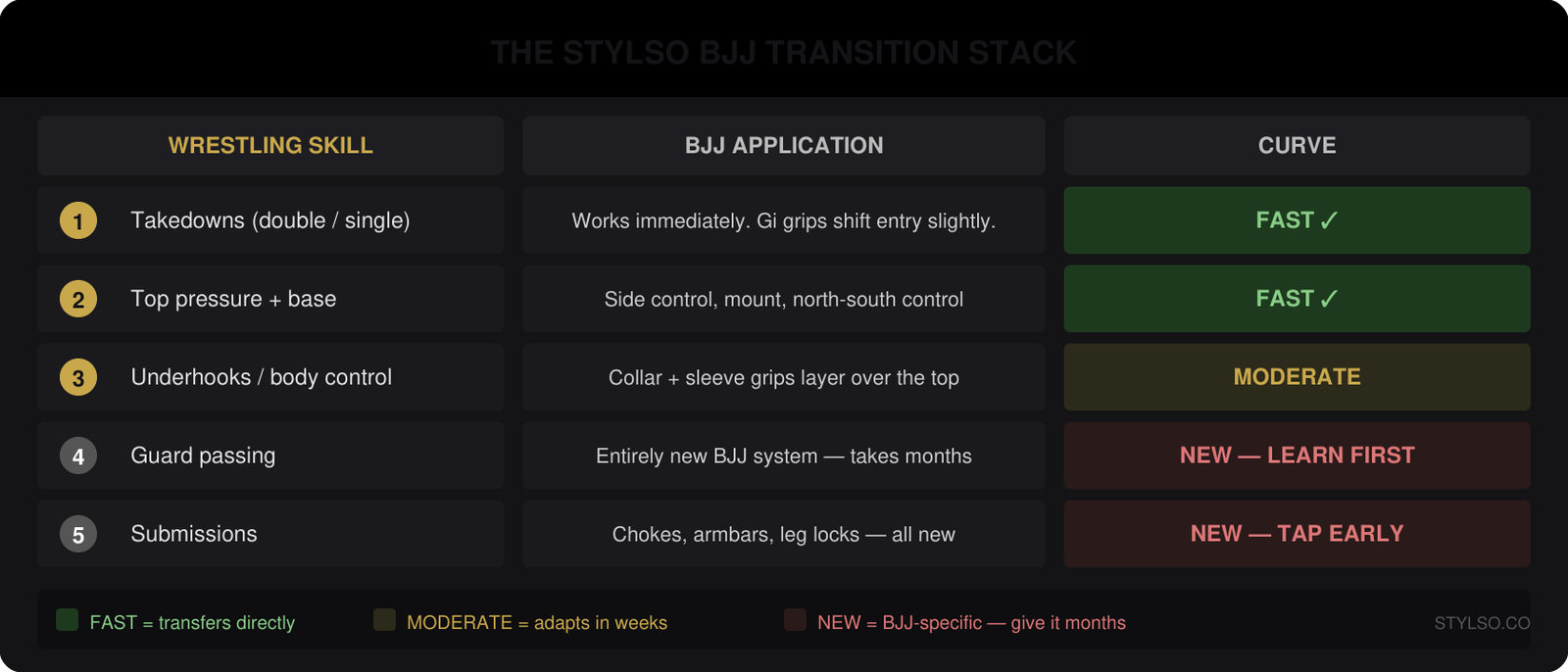
The Comparison: Wrestling Skills → BJJ Application
Here’s the honest map:
| Wrestling Skill | How It Translates in BJJ | Curve |
|---|---|---|
| Double-leg / single-leg | Works immediately. Gi grabs shift entry slightly. | Fast ✓ |
| Top pressure + base | Side control, mount, north-south control | Fast ✓ |
| Underhooks / body control | Collar + sleeve grips layer on top | Moderate |
| Hip escape / bridge | Guard retention, shrimping drills (same movement, new name) | Fast ✓ |
| Mental toughness | First months of being tapped — already there | Already done |
| Guard passing | Entirely new BJJ system — no wrestling equivalent | New — learn first |
| Submissions | Chokes, armbars, leg locks — all new | New — tap early |
What Gear You Need as a Wrestler Starting BJJ
You need a gi. That’s it.
If you’re coming from wrestling, you have the mentality and the fitness. The only missing piece is the uniform. Most BJJ gyms require a gi for fundamentals class.
Pick a gi that fits your frame. Wrestlers tend toward muscular, broader shoulders. A gi sized by height and weight works well; if you’re between sizes, size up for the jacket fit. A durable pearl-weave gi holds up through the grip-intensive training that comes with learning the jacket game. Look for reinforced seams at the collar and sleeve ends — those are the grip spots that wear out first.
Shop Stylso Men’s Gi on Amazon
If you want to compare options:
Browse BJJ Gis for Wrestlers on Amazon
For no-gi class — rash guard and shorts. You probably already own compression gear from wrestling. Check our BJJ gi vs submission wrestling guide if you’re deciding which to prioritize.
Tips for Your First Few Months
Tap early, tap often. Your ego from wrestling will fight this. Tap anyway. You’ll learn 10 submissions in the time it takes to escape one with brute force.
Learn guard first. Find a coach who’ll drill guard retention and basic guard attacks early. It’s your biggest gap and the position where wrestling instincts hurt most.
Drill the shrimp. The hip-escape drill (shrimping) is the foundation of guard retention. Wrestlers can already do the movement; the BJJ application is what takes reps. Do it every class.
Roll with blue and purple belts. They’ll expose your guard gaps without injuring you. Fresh white belts will just match your wrestling intensity — fun but not instructive.
Don’t just shoot every time. Yes, your takedown works. But drilling guard passing and grip-breaking is what makes you a BJJ practitioner vs. a wrestler who happens to train BJJ.
Looking at the full gear picture? The White Belt BJJ Gear List covers everything from gi to mouthguard. Also: Gi vs No-Gi: What to Buy First.
Free: Wrestler’s BJJ Transition Guide
One-page PDF — the Stylso BJJ Transition Stack (what transfers vs what’s new), first-months checklist, and gear guide. Free.
FAQ
Do I need to learn guard if I’m a wrestler?
Yes. It’s the biggest gap. In wrestling, guard is irrelevant. In BJJ, your opponents will pull guard specifically to neutralize your wrestling. You need to learn to pass it and to defend from the bottom.
Should I start in gi or no-gi BJJ as a wrestler?
Start in gi. The collar grips and jacket mechanics force you to learn real BJJ fundamentals. No-gi rewards your wrestling instincts more immediately — which feels good but delays your BJJ development.
Will my wrestling takedowns work in BJJ?
Yes, immediately and well. Doubles and singles work. Gi gripping changes your entry slightly (you can’t grab a knee the same way with a jacket in the way), but the mechanics and leg drive are the same.
How long until I’m competitive as a BJJ white belt?
If you have a strong wrestling background, 6–12 months of consistent training gets most wrestlers to the point where they’re competitive at white belt tournaments. Guard passing and submissions are the main gaps.
Do I need to be in wrestling shape to start BJJ?
No — you’re already ahead on conditioning. BJJ will feel different (more isometric, more grip demand) but your cardiovascular base from wrestling transfers well. The technical gaps matter more than fitness.