Your first six months of BJJ are going to feel like drowning with good music playing. That’s normal. What’s less normal — but just as common — is making the same five mistakes so consistently that they become part of your game. They don’t have to.
These aren’t secret mistakes. Every experienced grappler has made all five. Knowing them now doesn’t mean you won’t make them — it means you’ll catch them sooner, fix them faster, and spend less time building habits you’ll later have to unlearn.
Why Beginners Make the Same Mistakes
Most BJJ beginner mistakes come from one instinct: the survival brain. When someone bigger and better is putting pressure on you, your body defaults to strength, holding tight, and hoping for the best. The problem is that BJJ runs on almost the opposite logic. Position, not power. Breathing, not bracing. Moving, not freezing.
The good news is that all five mistakes below have clear, repeatable fixes — and knowing the fix is half the battle.
Mistake 1: Muscling Every Submission
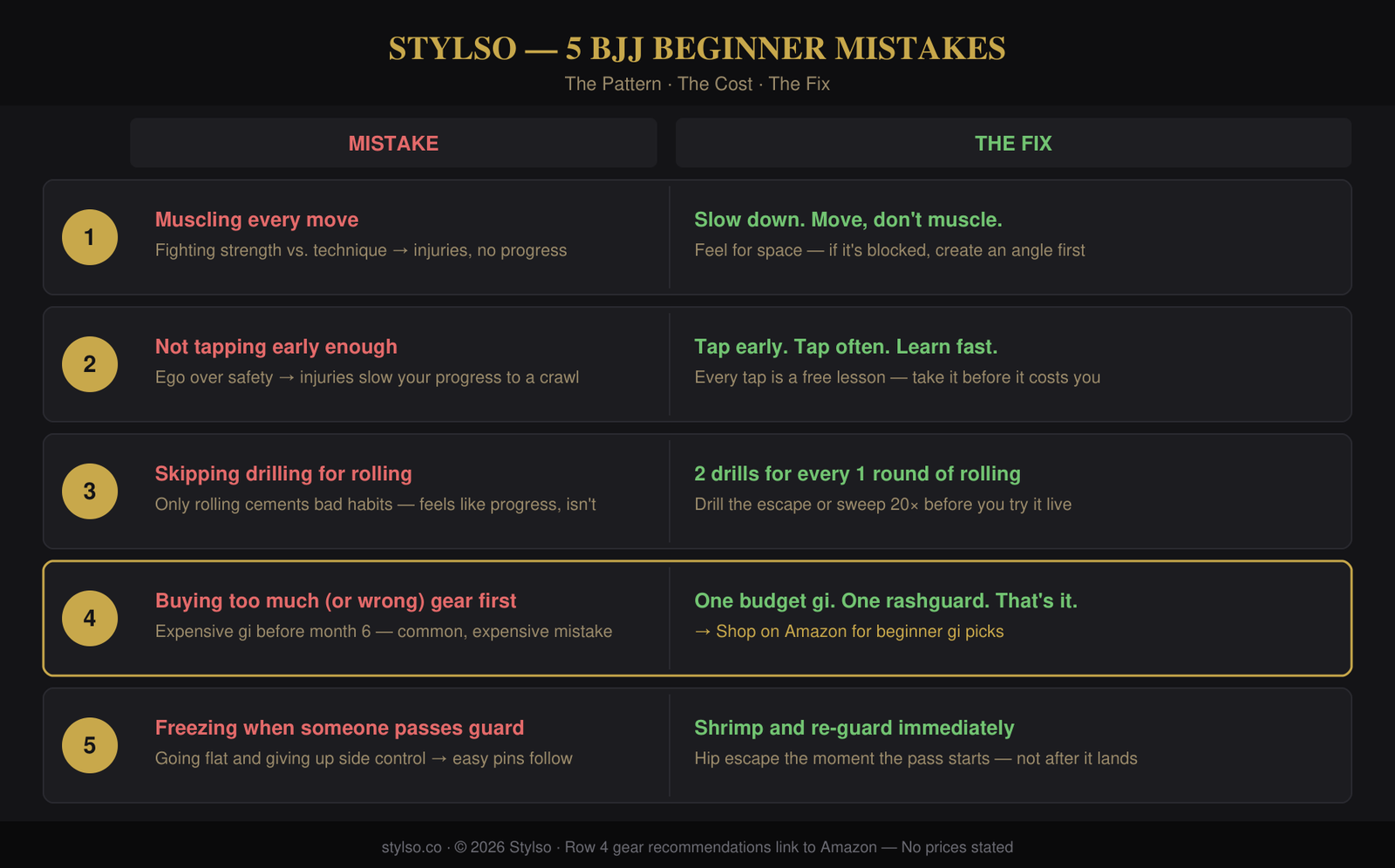
You see the armbar. You grab it and pull. Hard. Nothing happens — or worse, they reverse you. That’s muscling. You found the position, but you’re trying to force it rather than angle into it.
BJJ doesn’t reward strength so much as timing and geometry. The same armbar that stalls when you pull straight will work when you drop your elbow, turn your hip, and lever through their grip. Less force, more torque.
Here’s a cross-discipline lesson from wrestling that explains it better than most BJJ instruction: wrestlers call it “building the frame before you finish.” A wrestler doesn’t shoot for a takedown the moment they see a leg — they create head control, drive their hips, and then commit. The same principle applies on the mat. If a submission is blocked, you don’t push harder — you create an angle. Then you finish.
Drill this: when a submission stalls, stop, feel where the resistance is, and move your hips 10 degrees. Then try again. You’ll find the window.
Mistake 2: Not Tapping Early Enough
This one’s about ego, but it’s also about math. Every time you don’t tap and get hurt, you miss weeks of training. Every time you tap early, you get the lesson and keep training tomorrow. The grapplers who improve fastest tap the most — not because they’re getting dominated, but because they’re not afraid of learning.
Here’s the real cost: a strained elbow from not tapping a Kimura means 4–8 weeks of no rolling. That’s 8–16 training sessions. You don’t need that lesson twice.
Tap the moment you feel the lock. Not when it hurts — when it’s on. You can always drill that position more later. You can’t drill with a torn ligament.
Mistake 3: Skipping Drilling for Rolling
Rolling is fun. Drilling is work. The beginner brain chooses rolling every time it can, and then wonders why it keeps getting stuck in the same bad positions six months later.
Here’s what actually happens: rolling without drilling cements your instincts, good or bad. If your instinct is to turn your back when someone passes your guard, you’ll drill that bad habit every time you roll. You need to drill the correct response — the hip escape, the re-guard — before it becomes automatic.
A simple rule: for every round of rolling, do two drilling sets on a specific technique you worked in class. Drill the same escape or sweep 20 times before you try it live. It’ll feel mechanical at first. After two weeks, it’ll feel obvious.
Shop the Stylso BJJ Gi on Amazon
Mistake 4: Buying Too Much (or the Wrong) Gear First
You’re excited. The gear is part of it. A nice gi, matching rashguard, ear guards, spats, a rolling bag — it all feels like belonging. But spending on a premium gi in month one is one of the most common beginner gear mistakes, and one of the easiest to avoid.
Here’s the starter kit that actually makes sense for your first six months: one good budget pearl-weave gi, one rashguard. That’s it. You’ll wash the gi twice a week, and it’ll still outlast most beginners’ commitment to the sport — no disrespect, that’s just the reality of attrition.
Once you’ve trained consistently for six months and know you’re staying, that’s when it makes sense to upgrade. Check the beginner gi guide for what to look for and the budget gi picks — both have Shop-on-Amazon paths with no prices inflated by affiliate games.
One more gear note: once you have the gi, you need somewhere to put it. The gi bag guide covers the three types — most beginners do fine with a 45L duffle with a wet compartment.
Mistake 5: Freezing When Your Guard Gets Passed
This is the one nobody talks about in beginner resources. Someone passes your guard — maybe a scissor pass, maybe a leg drag — and you go flat and still. It feels like you lost. In BJJ terms, you just gave them the pin.
The fix is immediate and physical: the moment someone starts passing, your hips move. Not after the pass is complete — while it’s happening. The hip escape (shrimping) is the fundamental response. You turn your body away, create the frame with your forearm, and re-establish your guard before they can settle.
You won’t get it right every time. You’ll get it right sometimes. And “sometimes” is better than the flat, frozen version that gives them an easy transition to mount.
Drill it specifically: start in bottom side control with a partner, and practice hip-escaping to your knees 20 times in a row. Boring? Yes. Effective? Absolutely.
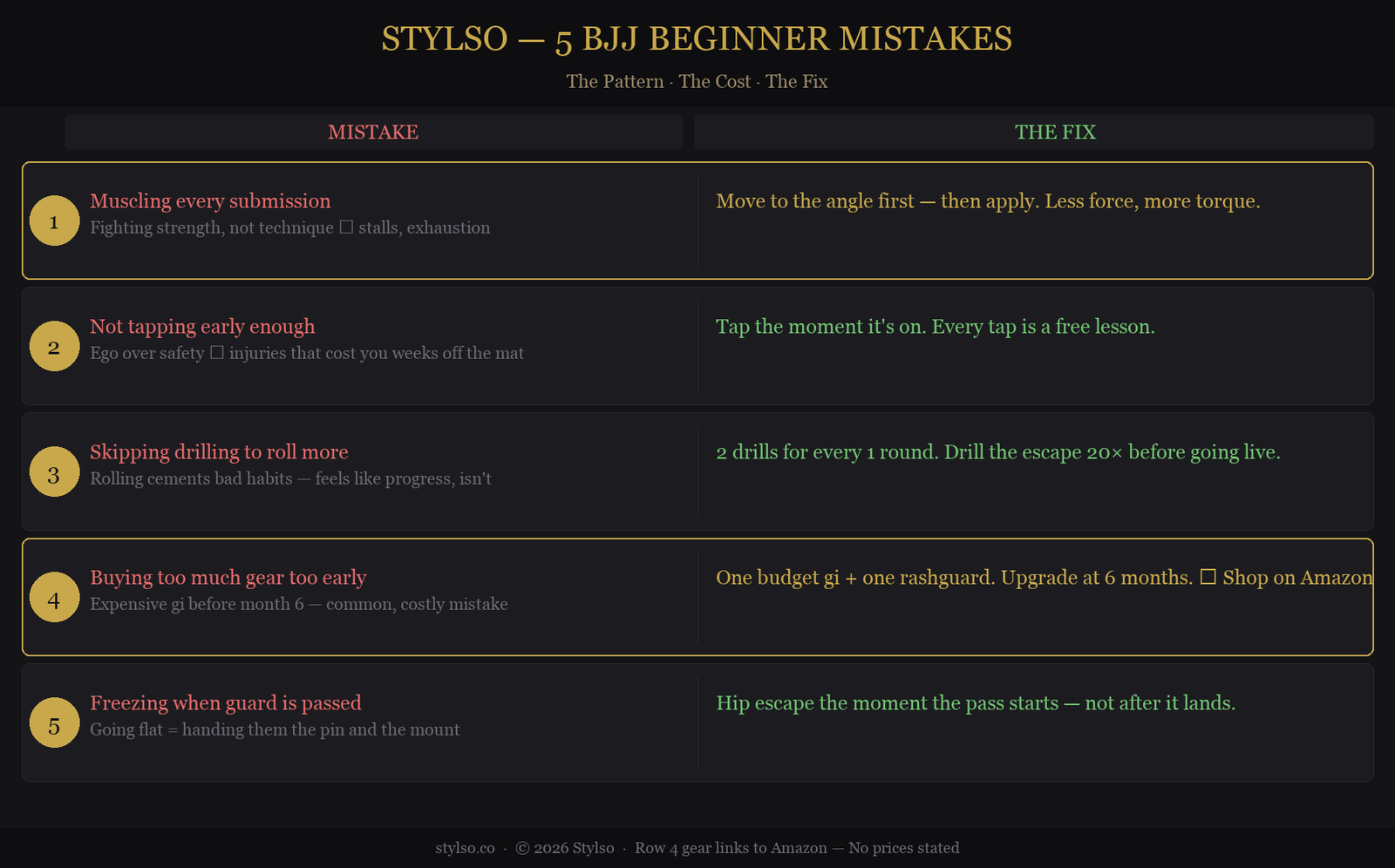
Free: 5 BJJ Beginner Mistakes Cheat Sheet
The full mistake-and-fix table plus a weekly training checklist — one printable page to track your progress. Yours free.
A Pattern All Five Share
Read the list again: all five mistakes involve the same impulse — doing what feels natural in the moment, not what’s correct. Muscling feels stronger. Holding out feels tougher. Rolling feels more productive than drilling. Buying the gi feels like progress. Going flat feels safe.
BJJ systematically punishes all of those instincts and rewards the opposite. The sooner you train against your own first reaction, the faster you move up the mat. That’s the whole game.
For more on building consistent training habits, the how to get better at BJJ faster guide covers the 7 habits that compound over months, not just sessions. And if you’re training solo or without gym access, the no-gym training guide has a 3-pillar system that builds the drilling habit at home.
Key Takeaways
- Muscling doesn’t work — create the angle first, then apply the technique with less force.
- Tap early. Every tap is a free lesson that doesn’t cost you 6 weeks on the sideline.
- 2 drills for every 1 round of rolling. Correct the instinct before it becomes a habit.
- First gear kit: one budget gi, one rashguard. Upgrade after 6 consistent months — not before.
- The moment someone starts passing your guard, your hips move. Not after. During.
Frequently Asked Questions
What’s the biggest BJJ beginner mistake?
Not tapping early enough, by a significant margin. It’s the one that causes the most missed training time and the slowest progression. You can fix a bad drilling habit or a muscling habit in weeks. A torn ligament costs you months.
How long does it take to stop making beginner mistakes in BJJ?
Realistically, 12–18 months of consistent training to see the major ones disappear from your game. Some (like muscling) resurface against stronger opponents even at blue belt level. The goal isn’t to eliminate mistakes — it’s to catch them faster and stop repeating the same ones.
Should I start with a gi or no-gi for BJJ?
Start with gi. The collar and sleeve grips slow everything down and force you to understand position before the speed of no-gi rolls obscures it. Most academies also teach gi-first. Once you have 6 months of gi, add no-gi — you’ll see the connection clearly. Check the gi vs no-gi guide for the full breakdown.
What gear do I actually need as a BJJ beginner?
One gi, one rashguard, a mouthguard, and flip-flops for off-mat walking. Everything else — ear guards, spats, knee pads — comes later when you know whether you need it. Spend on a good gi bag (wet compartment, 45L+) so your gi doesn’t wreck your clean clothes on the way home.
How often should a BJJ beginner train?
Two to three sessions per week is the right range for most beginners. More than that early on leads to exhaustion before you’ve built the base fitness. Consistency over intensity — three sessions a week for a year beats six sessions a week for two months and then a burnout break.
Is BJJ good for beginners with no martial arts background?
Yes, and it’s actually designed to work that way. BJJ levels the playing field through leverage and technique — a smaller person with good position beats a larger person with strength. No previous martial arts experience is required. Walk in, introduce yourself to the coach, and start from white belt. Everyone there was where you are.