The smell hits you before you even open the bag. That sour, locker-room staleness isn’t just embarrassing — it’s bacteria. And it spreads on the mat. Good news: three minutes after class can prevent it completely.
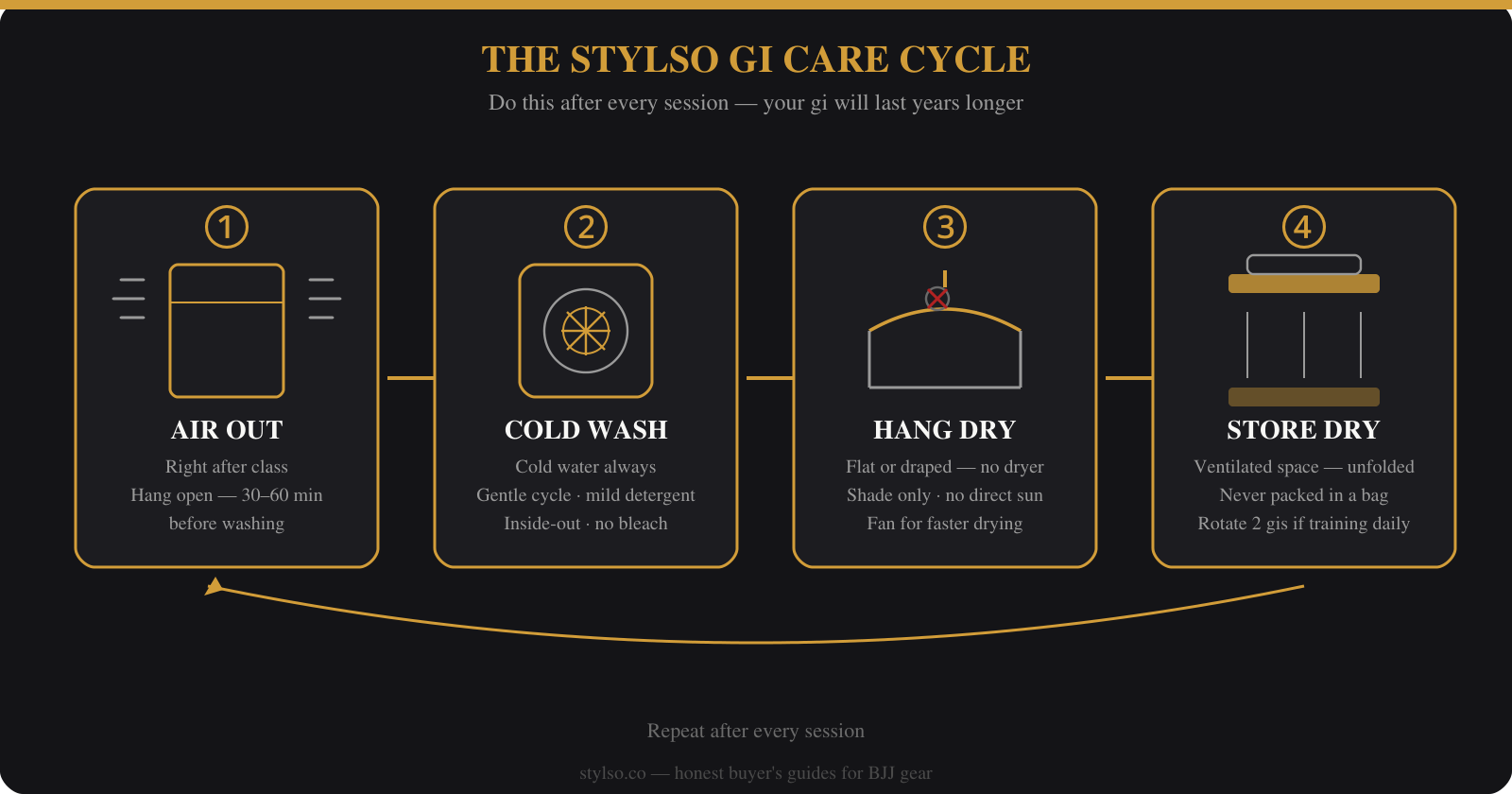
Cold water, gentle cycle, mild detergent — that’s it for washing. Hang it flat to dry; skip the dryer. Air your gi out within two hours of training and wash it within 24. Get that routine down and a quality pearl-weave gi can last you years of hard rolling.
- Cold water, gentle cycle, mild detergent — every single time
- Never machine-dry; hang flat or draped over a rack, out of direct sun
- Air out within 2 hours of training; wash within 24 — that’s how you stop bacteria before the smell starts
Why Your Gi Care Routine Actually Matters
Your gi absorbs sweat, mat grime, and whatever else your training partners bring into the room. Left damp, that’s a breeding ground for bacteria and fungal growth — the kind linked to skin infections that circulate in gyms. That’s not a scare tactic, it’s just biology. A clean gi is training hygiene, not vanity.
Beyond the health angle: a well-cared-for gi holds its weight longer, keeps its shape, and doesn’t fade or shrink out of fit. The two are connected — the habits that keep it clean are the same ones that make it last.
How to Wash a BJJ Gi (Step by Step)
- Air it out first. Right after class, unroll your gi and hang it open. Don’t stuff it damp into a bag for six hours — that’s how the smell gets embedded. Give it 30–60 minutes to breathe before it goes in the wash.
- Turn it inside-out. Protects patches, embroidery, and collar stitching from friction inside the drum. Takes five seconds.
- Wash cold, gentle cycle. Warm or hot water shrinks cotton gi fabric. Cold water plus a gentle cycle cleans it just as well — without the heat damage. Always cold.
- Use a small amount of mild detergent. A modest splash, not a full cap. Too much detergent leaves residue in the weave that traps bacteria over time and breaks down the fabric faster than washing itself does.
- Skip bleach and fabric softener. Bleach degrades the fibres and weakens the weave. Fabric softener leaves a coating that actually blocks the fabric from getting clean. Neither belongs near a gi — ever.
- Wash similar colours together. White gi plus blue gi in warm water equals a purple gi. It happens. Keep whites with whites.
For deep odour removal — that sour smell that survives regular washing — add half a cup of white vinegar to the fabric softener slot. It neutralises the bacteria causing the smell without damaging the weave. For a full fix, see our guide on how to remove gi smell.
Machine vs Hand Wash: Which Is Better for Your Gi?
| Method | Effort | Effectiveness | Impact on Gi Life | Best For |
|---|---|---|---|---|
| Machine — cold, gentle | Low | Very good | Minimal if done right | Everyday training gis |
| Hand wash — cold water | High | Excellent | Best — gentlest on fabric | Competition gis, embroidery |
| Machine — hot cycle | Low | Overdone | Shrinks fabric, weakens weave | Never |
| Dry cleaning | None | Overkill | Chemical solvents can damage fibres | Not recommended |
For your everyday training gi, cold machine wash is fine and sustainable. If your gi has heavy embroidery or silk patches, hand wash it occasionally to protect those areas. The key either way: cold water, gentle action, mild soap.
Drying — Where Most Grapplers Get It Wrong
The dryer is where gis go to die. Heat shrinks cotton, stiffens the weave, and causes repeated wear to the fibres with every tumble cycle. Even on “low heat,” a year of machine drying can cost you a full size or more.
Here’s how to air-dry it right:
- Hang flat over a rack — this is the ideal. No stretch from the gi’s own weight.
- Draped over a door or a bar — works too; flip it halfway through so both sides dry evenly.
- Out of direct sunlight. UV fades colour (especially blue and black) and degrades cotton fibres over time. A shaded spot with airflow is perfect.
- Room temp or a gentle fan speeds drying without heat damage. If you need it dry in two hours before another class, open window plus fan is the fastest safe method.
Most post-wash shrinkage happens in the first one or two washes — after that it stabilises. Don’t stress about air-drying shrinking it further. It’s the dryer that keeps shrinking it. For the full shrinkage picture, see how to stop a gi from shrinking.
Airing Out and Storage Between Sessions
The two-hour rule: the moment class ends, get your gi out of your bag and hang it open. Bacteria multiply fast in a warm, damp gym bag. A gi that breathes after training needs less washing — and smells better between sessions.
Between training days:
- Store it dry and unfolded in a ventilated space, not packed in a bag
- A hook on the back of a door or a rail in your room is ideal
- If you train every day, rotate two gis — one dries while you train in the other
That two-gi rotation is the single most effective habit for gi longevity. A gi that never fully dries between sessions will eventually smell no matter how well you wash it. Give it the time it needs.
Beating Gi Smell Before It Starts
If the sour smell is already there — the kind that survives a normal wash — the bacteria are embedded in the fibres. Regular detergent doesn’t fully reach them. Two fixes that work:
- White vinegar soak: Cold water basin, half a cup of white vinegar, soak for 30 minutes, then wash normally. Vinegar is mildly acidic and kills odour-causing bacteria without damaging the fabric.
- Baking soda wash: Add a quarter cup of baking soda to your normal cold wash alongside the detergent. It neutralises acid-based odours and freshens the weave.
Don’t mix bleach with either of these. Stick to one method at a time. For persistent odour that won’t quit, we go deeper in how to remove gi smell.

Free: BJJ Gi Care Checklist
A printable one-pager — the 5 wash rules, drying tips, storage checklist, and the Stylso size chart. Get it instantly.
When Your Gi Is Ready to Retire
Even a gi that’s been cared for well doesn’t last forever. Here’s what to look for:
- Thin patches at the knees or collar where the weave is becoming see-through
- Collar or cuffs stiffening and cracking — the cotton is breaking down
- Permanent discolouration that won’t wash out
- Seams fraying at stress points — armpits, crotch, collar — this is the critical one
A fraying seam can tear mid-roll. When you spot it, it’s time. A well-maintained gi that’s properly retired after two to four years of hard training served you well. Find the Stylso options below — check the current price on Amazon:
Stylso’s pearl-weave gis are pre-shrunk and IBJJF-approved — built for exactly the kind of care routine this guide covers. For how long a gi typically lasts with good care, see how long does a BJJ gi last.
Frequently Asked Questions
- Can you wash a BJJ gi after every training session?
- Yes — and you should if you train daily. A gi washed after every session consistently outlasts one washed twice a week and left damp in between. Washing correctly doesn’t shorten its life; washing hot or drying in a machine does.
- What temperature should you wash a BJJ gi on?
- Cold, every time. Warm or hot water causes cotton to shrink and weakens the pearl-weave structure over time. Cold water with mild detergent cleans just as effectively — without the damage.
- Can you put a BJJ gi in the dryer?
- Technically yes, but it’ll cost you. Heat shrinks the fabric and stresses the weave with every cycle. Air-dry flat after every wash — it’s the single biggest thing you can do to extend your gi’s life.
- How do I get the smell out of my BJJ gi?
- Soak in cold water with half a cup of white vinegar for 30 minutes, then cold wash normally. Or add a quarter cup of baking soda to your regular wash. Either neutralises the bacteria causing the smell. See the full guide on gi smell for persistent cases.
- How often should I wash my BJJ gi?
- After every session. No exceptions. A gi that sits unwashed after training — even just overnight — starts the bacterial cycle that causes odour and, eventually, degradation. Train, wash, dry, repeat.