You’re staring at two rashguards on Amazon. Same brand, same price range — one hits your wrist, one stops at your elbow. Twenty minutes later, you’re still not sure. Here’s what nobody actually tells you about sleeve length: it’s not about one being better. It’s about your gym, your game, and what you’re protecting.
Long sleeve rashguards cover your arms to the wrist — more skin protected from mat burns and bacteria. Short sleeves stop at the bicep — lighter, cooler, less fabric bunching under a gi jacket. Both are legal for competition. The right pick depends on three things: gym temperature, whether you train gi or no-gi, and how much you hate mat burn.
- Long sleeve = arm-to-wrist coverage, best for cold gyms and no-gi rolling
- Short sleeve = lighter and cooler, best for hot gyms and wearing under a gi
- Grip training tip: short sleeves under a gi keep the jacket sleeve cleaner for judo-style grips
What’s Actually Different Between Long and Short Sleeve Rashguards
The fabric is the same. The compression level and construction — identical. What changes is the coverage zone. A long sleeve runs elbow-to-wrist. A short sleeve stops just below the shoulder, leaving your forearms and most of your elbow exposed.
That sounds simple. But that gap in coverage changes how you feel rolling, what you protect, and — here’s the part most guides skip — how your training partner grips you in the gi game.
Long Sleeve: When It’s the Right Call
Go long sleeve when:
- Your gym is cold (under 65°F / 18°C)
- You train no-gi often and roll close to the mats
- You want maximum bacteria protection (think mat hygiene)
- You’re recovering from a mat burn on your forearms
Long sleeves give you a full arm compression layer. That means better warmth, less skin-on-mat friction, and one less way to pick up a mat rash. If you’re drilling guard passing and your forearms are grinding on the mat every rep, long sleeves take that punishment instead of your skin.
One fit note: if the sleeve bunches behind your elbow joint during armbars or triangles, size up. A sleeve that folds there cuts circulation and gets annoying fast.
Shop Long Sleeve Rashguards on Amazon
Short Sleeve: When It Makes More Sense
Go short sleeve when:
- Your gym runs hot (above 75°F / 24°C)
- You train gi more than no-gi
- You want less fabric between your elbow and your guard work
- You’re starting out and just want a clean training layer under your gi jacket
Short sleeves breathe better. In a hot gym at 80°F, a long sleeve rashguard will cook your arms by round two. The shorter sleeve also keeps the gi jacket sleeve fabric cleaner — less layering means your training partner’s grip on your sleeve sits on the gi fabric, not on two stacked layers of synthetic compression.
Shop Short Sleeve Rashguards on Amazon
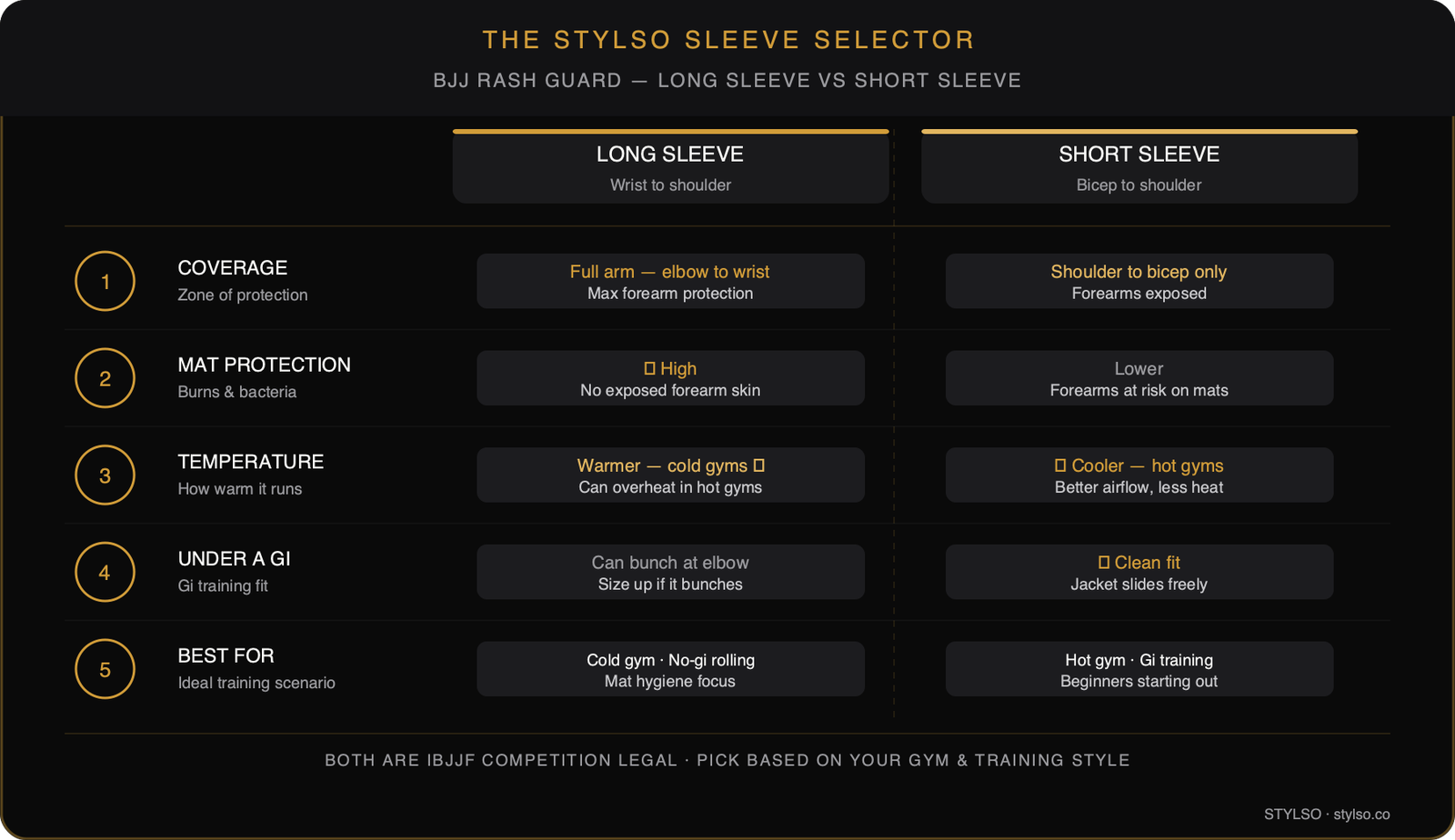
Long Sleeve vs Short Sleeve — Side by Side
| Feature | Long Sleeve | Short Sleeve |
|---|---|---|
| Arm coverage | Wrist to shoulder | Bicep to shoulder |
| Mat burn protection | High — full forearm covered | Lower — forearms exposed |
| Temperature feel | Warmer — best for cold gyms | Cooler — best for hot gyms |
| Elbow mobility | Slight restriction (size up if it bunches) | Unrestricted |
| Under a gi jacket | Can bunch at elbow in tight sleeves | Clean fit, jacket slides freely |
| No-gi training | Excellent — full skin protection | Fine — less coverage but cooler |
| Competition legal | Yes (IBJJF allows both) | Yes (IBJJF allows both) |
| Best for | Cold gym, no-gi grinders, mat hygiene focus | Hot gym, gi training, beginners |
| Shop | Shop on Amazon | Shop on Amazon |
The Judo Sleeve Grip Lesson (It Affects Your Choice More Than You’d Think)
Here’s something most rashguard guides skip: how your sleeve choice affects the grip-fighting game.
In judo — and increasingly in BJJ takedowns — the sleeve grip is a core technique. When your training partner shoots for an uchi-mata or a harai-goshi, they grab your gi sleeve just above the elbow. That grip feels different depending on what’s underneath the jacket.
Wearing a long sleeve rashguard under your gi? The gi sleeve stacks on top of the rashguard sleeve. Two layers of fabric create more bulk. Your training partner’s grip is thicker, harder to fully close, and can shift mid-throw.
Wearing a short sleeve rashguard? Your gi sleeve sits directly over bare forearm skin from the elbow down. The grab is clean. The grip closes faster. Some takedown-heavy grapplers specifically choose short sleeves under their gi for this reason.
Try this drill: grab five hip throws with a training partner, once with each sleeve length under your gi. You’ll feel the difference in the elbow grip immediately. It’s subtle — but it’s real. It’s one of those small variables that matters more the more you drill takedowns.
How to Choose Based on Your Specific Situation
The Stylso 3-Zone Sleeve Check
- Check your gym’s temperature. Cold gym (under 18°C / 65°F) → long sleeve wins. Hot gym (above 24°C / 75°F) → short sleeve wins. Temperate? Either works fine.
- Check your training split. Mostly gi → short sleeve keeps things cleaner. Mostly no-gi → long sleeve for better mat protection. Fifty-fifty? Keep one of each.
- Check your mat hygiene priorities. Worried about mat burns, skin rashes, or bacteria exposure? Long sleeve gives you more coverage. Healthy skin on clean mats? Short sleeve is fine.
If you’re just starting out, grab a short sleeve first. It’s lighter, cooler, and works under a gi without issues. Once you know your gym, your training style, and whether you run hot or cold, you can add the other length. Most serious grapplers end up owning both.
For help getting the sizing right, check our rashguard size guide — it covers how rashguards should fit and how to read brand-specific size charts. And if you’re still deciding whether a rashguard is even right for your training setup, see our breakdown of rashguard vs compression shirt.
Free: The Stylso Rashguard Sleeve Selector
One-page printable — when to pick long vs short, the 3-zone decision check, and care rules so your rashguard lasts. Get it free.
Ready to Shop?
Now you know which sleeve length fits your gym and your game. Check the current price on Amazon — both options are widely available and the price difference between sleeve lengths is usually minimal.
Shop Long Sleeve BJJ Rashguards on Amazon
Shop Short Sleeve BJJ Rashguards on Amazon
Looking for our full rashguard picks by type and use case? See our guide to the best BJJ rashguards. For what goes under (and over) your rashguard, check what to wear under a BJJ gi.
Frequently Asked Questions
Are long sleeve rashguards required for BJJ competition?
No. Most major organizations — including IBJJF — allow both long and short sleeve rashguards in no-gi divisions. Check your specific event’s rulebook to confirm, since rules can vary by bracket and federation. For gi divisions, the rashguard goes under your jacket and sleeve length typically doesn’t matter as long as it’s not visible past the gi sleeve.
Does sleeve length affect how tight a rashguard should fit?
No — fit rules are the same for both. A rashguard should be snug (compression-fit, no sagging fabric) but not so tight it restricts breathing or shoulder rotation. If a long sleeve bunches behind your elbow during an armbar, the sleeve is too long for your arm proportions — try sizing up rather than assuming it’s the wrong style.
Can I wear a short sleeve rashguard under a long sleeve gi jacket?
Yes, and many grapplers do. The gi sleeve covers your forearms anyway, so the rashguard’s sleeve length only matters between the shoulder and elbow — where the jacket sleeve doesn’t fully cover during guard work and scrambles. Short sleeve under a gi is clean and comfortable.
Does sleeve length matter more in no-gi or gi training?
It matters more in no-gi. In no-gi, there’s no jacket covering your arms — so whatever sleeve you pick is the full protection you’ve got. Long sleeve is the safer default for no-gi, especially on mats that see heavy drilling traffic. In gi training, the jacket covers most of your arm anyway, so short sleeve is often the cleaner choice.
How do I wash a rashguard to make it last?
Cold wash, gentle cycle, hang to dry. Heat is what kills compression fabric — hot dryers shorten the life of any rashguard significantly. Same rule applies for both long and short sleeve. Wash after every session; bacteria from the mat builds fast in synthetic fabric. Skip the fabric softener — it breaks down the compression fibers over time.
Should beginners start with long sleeve or short sleeve?
Start with short sleeve. It’s lighter, less restrictive, and works cleanly under a gi without issues. Once you know your gym’s temperature, your training style, and whether you run hot or cold on the mat, you can add the other length. Most grapplers who train regularly end up owning both.
Stylso Editorial Team — Stylso designs and sells BJJ gis (men’s and kids’) and grappling dummies on Amazon, with verified customer reviews. Our buyer’s guides help grapplers buy right the first time — no fake specs, no prices, no hype. About Stylso.