A BJJ rash guard is purpose-built for grappling — nylon-dominant fabric, flatlock seams that sit flush against your skin, and a long cut that won’t move when someone grabs you. A compression shirt works in a pinch, but it’s built for the gym, not the mat. If you’re rolling more than once a week, the difference starts to matter.
Key takeaways
- Rash guards use nylon/spandex — less skin friction, more stretch when you bridge or shrimp.
- Flatlock seams sit flush to the body, so they don’t dig in when someone’s pressing you down.
- Only a BJJ rash guard meets IBJJF no-gi competition rules — a compression shirt won’t qualify.
You’ve got a compression shirt that fits tight. Good enough for the mat, right? It is — until someone shoots and the whole thing bunches up around your armpits. That’s the real difference. Not how it looks in the mirror. How it behaves under pressure.
Here’s what separates the two — and how to know when you actually need to upgrade.
By the Stylso Editorial Team — about us. Stylso designs and sells its own BJJ gis and grappling gear on Amazon. We don’t fabricate specs or ratings — “check the current price on Amazon” is our rule.
What’s a Rash Guard, Exactly?
A rash guard is a fitted top built for close-contact sport. The name came from surfing — you wore one to stop the friction from a surfboard. In BJJ, you’re dealing with friction from the mat, a gi collar, and someone pressing your shoulder down for two minutes straight.
Good ones run about 70–90% nylon, the rest spandex. Nylon is smoother than polyester. It grabs less when your partner gets a grip on your torso, and it survives repeated washing better than cheaper blends.
A compression shirt? Typically the opposite — polyester-heavy, cut for gym performance and look. Nothing wrong with it for lifting or running. It just wasn’t made for what’s happening on a BJJ mat.
The 4 Differences That Actually Matter
1. Fabric
Rub your hand along a polyester compression shirt. Then along a nylon rash guard. The polyester catches. The nylon glides. That difference is small when you’re on a weight bench. On the mat, it adds up.
Polyester-heavy fabric creates more friction against gi sleeves, belt edges, and mat surfaces. Nylon moves with you instead of catching. During a fast shrimp or a scramble, your training partner’s grip doesn’t snag on your shirt.
There’s also a durability angle. After a month of 3×-a-week training, compression shirts start losing their stretch. Nylon-dominant blends handle the repeated tension better over a longer run.
Try this right now: if you have both, hold each one taut and rub your palm across. The snag you feel on the polyester one? That’s what your partner feels when they grab your torso. The less friction for them, the less distraction for you.
2. Seams
This is the detail most people skip — until they feel it under side control.
A regular shirt uses raised seams. The thread sits up slightly from the fabric. Fine for the gym, where nothing’s pressing on it. On the mat, when someone’s in mount or holding you in north-south for three minutes, those raised seams press into your arm or ribs.
A BJJ rash guard uses flatlock stitching. The thread runs flush — no ridge. No pressure point. You notice this most around the shoulders and anywhere a seam crosses a joint. It’s one of those things you don’t miss until you feel the difference.
3. Cut and Length
Compression shirts are cut for the gym mirror. They look good. They also ride up.
BJJ rash guards are cut long on purpose — longer torso, snug through the hips. When you pull guard, drop to your knees, or get taken down, the shirt doesn’t come untucked. Under a gi, it keeps the jacket collar from bunching. In no-gi, you’re not stopping to adjust it every round.
This crosses over directly from wrestling: staying tight is everything. Your gear should support that, not fight it. A rash guard that stays down is one less distraction in a roll — and distraction is the last thing you need when someone’s working for an arm lock.
4. Competition Rules
If you’re thinking about competing no-gi — even just a small local tournament — you’ll need a real rash guard. IBJJF no-gi rules require a rash guard top; a compression shirt doesn’t qualify.
You might not be thinking about competition yet. But buying right once means you don’t buy again when you do. And most people start thinking about a tournament somewhere between month three and month six.
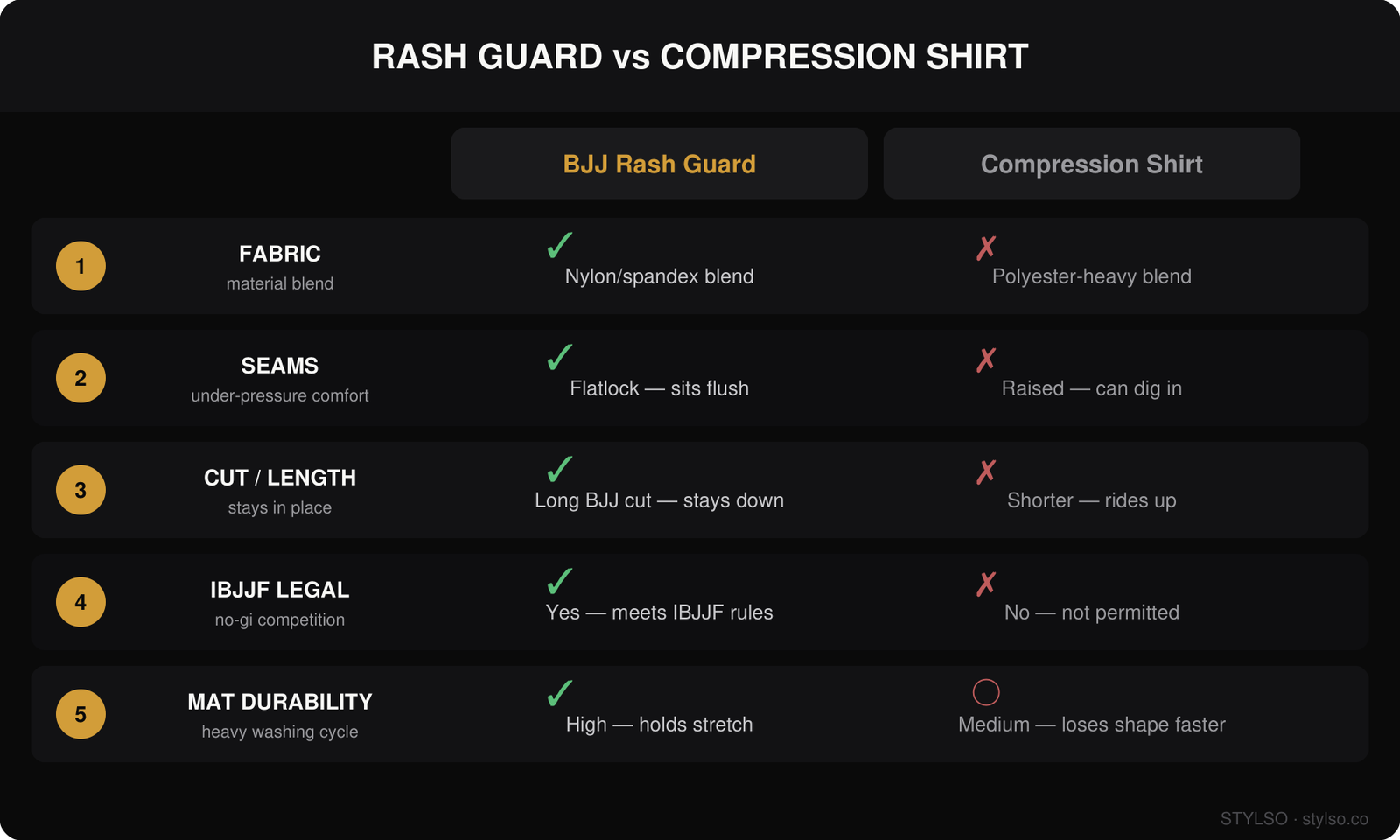
Rash Guard vs Compression Shirt at a Glance
The Stylso No-Gi Gear Check — five things that matter on the mat:
| Feature | BJJ Rash Guard | Compression Shirt |
|---|---|---|
| Fabric | ✅ Nylon/spandex blend — smoother, grabs less | ❌ Polyester-dominant — more friction |
| Seams | ✅ Flatlock — sits flush against skin | ❌ Standard raised seams — can dig in under pressure |
| Cut / Length | ✅ Long BJJ cut — stays tucked | ❌ Shorter gym cut — rides up during guard work |
| IBJJF Compliant | ✅ Yes — meets no-gi competition rules | ❌ No — not permitted at IBJJF events |
| Mat Durability | ✅ High — holds stretch through repeated washing | ⚠️ Medium — loses shape faster at high wash frequency |
The smart first buy: a long-sleeve BJJ rash guard. Check the current price on Amazon and look for a nylon-dominant blend with flatlock seams — those two details are worth checking in the product description before you buy.
Shop BJJ Rash Guards on Amazon
Also building your gi kit? Read our full guide on what to wear under a BJJ gi — it covers the complete under-gi layering system, from rash guard to spats to everything in between.
So When Can You Still Use a Compression Shirt?
Right now, if you want. If you’ve just signed up for your first two classes and you don’t want to spend money before you know you’ll stick with it — wear what you have. No one at your gym will judge week one gear choices.
But if you’re past the two-week mark and going twice a week, pick up a real rash guard. It’s not a luxury purchase; it’s just the right tool. It’s also one of the cheaper gear decisions you’ll make in BJJ — and it lasts longer than you’d expect if you wash and air-dry it properly.
Go long-sleeve for your first one. You’ll cover more skin, it works under a gi, and it fits better on rougher mat surfaces. Check the current price on Amazon.
Free: BJJ Gear Roadmap — White Belt to Blue Belt
A printable checklist + belt-level gear guide: what to buy in week one, what to upgrade at month one, and what to skip until you know you’re staying. Instant download.
FAQ
Can I wear a compression shirt under my gi?
Yes. A lot of beginners do, especially the first few weeks. It’ll ride up more than a purpose-cut rash guard, and the thicker polyester can run warm under a gi jacket. A rash guard fits cleaner and sits better — but it’s not a hard rule until you’re training regularly.
Do rash guards prevent mat burns?
They reduce them. The smooth nylon surface cuts friction on your arms and elbows during drilling — particularly on rougher mats. Not a complete solution, but it makes a noticeable difference on longer sessions or when you’re doing a lot of drilling on the ground.
Short sleeve or long sleeve — which one first?
Long sleeve if you’re not sure. More skin coverage, works for rolling and drilling, and fits better under a gi jacket. Short sleeve is cooler for warm gyms. Most regular training partners end up with one of each. Start long, buy short after your first month.
Does the material affect hygiene?
Yes. Nylon dries faster than polyester and generally holds odor less after repeated training sessions. Wash your rash guard after every single class — leaving it in a bag overnight is how bacterial infections start. Cold wash, air dry, and it’ll last a long time.
Can I compete in a compression shirt?
Not at IBJJF events. Their no-gi rules require a proper rash guard top. Smaller local tournaments vary — some are fine with any fitted top — but you can’t count on it. If you’re ever planning to compete, owning a real rash guard now just makes sense.
Are women’s rash guards different from unisex?
The cut is different around the chest and hips. A unisex rash guard won’t always give the right fit or coverage for women. Women-specific options exist across most brands — check the sizing guide before ordering and don’t assume unisex will work the same way.
The Bottom Line
A compression shirt won’t ruin your first class. But the mat teaches you fast that the details matter — fabric, seams, cut, and fit all add up to fewer distractions and better training. A rash guard is just the right tool for this job.
Check the current price on Amazon, grab a long-sleeve to start, and wash it after every session. That’s the whole system.
Shop BJJ Rash Guards on Amazon
Similar Posts
The Best BJJ Shorts for Training (What to Look for Before You Buy)
Not all athletic shorts work on the BJJ mat. Find the best BJJ shorts for training — what holds up, stays on, and moves. Shop on Amazon.
Best BJJ Gi for Judo: Honest Picks for Cross-Trainers
Best BJJ gi for judo? A quality gi handles casual judo training just fine. Here’s what to check — weave, collar, sizing — plus honest picks on Amazon. No fake specs.
BJJ Guard Passing Tips: 5 Techniques That Actually Work
Stuck in guard every round? These 5 BJJ guard passing tips explain what white belts miss — posture, frames, and three pass styles compared. Shop on Amazon.
BJJ Gi for Curvy Women: How to Find a Fit That Actually Works
Finding the right BJJ gi for curvy women starts with one measurement most charts ignore. Here’s how to get a fit that moves with you — Shop on Amazon.
BJJ for Seniors: The Honest Beginner’s Guide (Starting at 40, 50, or Beyond)
Starting BJJ as a senior? Here’s the honest first-month guide — gear, safety, what to expect, and what actually gets better with age. Shop on Amazon.
Kids BJJ Gi Size Guide: Measure Once, Buy Right (2026)
Not sure what size kids gi to order? This guide has the real K-series chart — 2-minute measure, right fit, first time. Shop on Amazon.