For most beginners, BJJ is the better first choice. It builds the ground game that MMA fighters depend on, in a safer and more structured setting. Whether your goal is self-defence, sport BJJ, or eventually MMA — learning BJJ first puts you further ahead, faster.
- BJJ is ground-focused, technically rich, and genuinely beginner-safe — it has a clear belt system and rolling doesn’t involve strikes.
- MMA is striking plus grappling. Most good MMA coaches want students to have a base in one before they start combining.
- The grappling in MMA is largely BJJ. Start there and you’re already ahead when you cross over.
The Mistake Most Beginners Make
Here’s the logic most people use: “MMA covers everything — striking, wrestling, submissions. Why not just start there and learn it all at once?”
Makes sense on paper. Doesn’t work in practice.
When you try to learn everything at once with no base, you end up with a shallow version of each skill. You’re a beginner at striking AND a beginner on the ground — you don’t have one area where you feel comfortable or confident. The result is a lot of frantic, messy sparring where you don’t actually build anything solid.
Here’s what almost every MMA coach will tell you if you ask them honestly: their best students came in with a foundation in one area. Some were wrestlers. Some boxers. A lot were BJJ practitioners. The base is what lets them progress fast in the rest.
BJJ is that base for most beginners — and here’s why.
What Is BJJ (Quickly)
BJJ — Brazilian Jiu-Jitsu — is a grappling art built around taking the fight to the ground and finishing it with joint locks or chokes. You wear a gi (your uniform) or train no-gi in a rashguard and shorts. No punching. No kicking. Just positions, transitions, and submissions.
It has a clear belt system — white, blue, purple, brown, black — with visible progress at each level. And it’s one of the safest combat sports for beginners because rolling (live sparring) doesn’t include strikes. You can tap out the moment something’s uncomfortable.
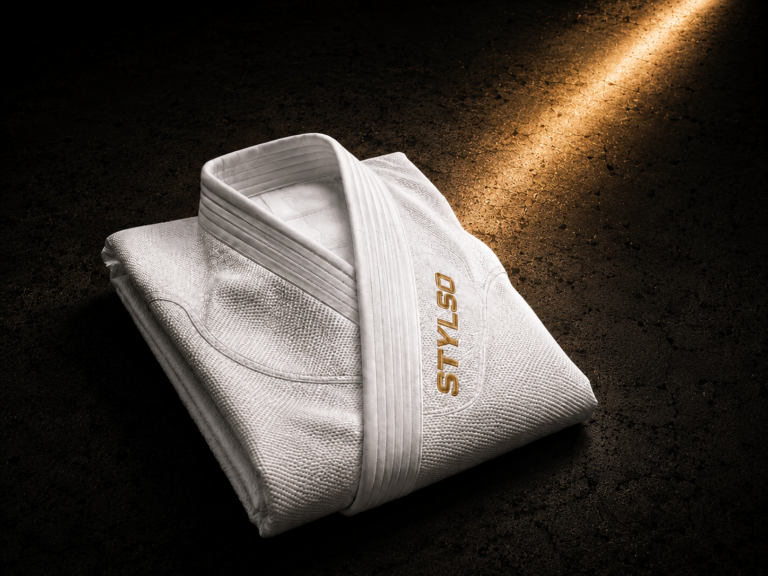
Stylso — BJJ gis & combat-sports apparel.
What Is MMA (Quickly)
MMA — Mixed Martial Arts — combines everything: boxing, kickboxing, Muay Thai for striking, and wrestling, BJJ, and judo for grappling. Think of it as the combination of several martial arts in one sport.
The point is that a fight can go anywhere — standing, in the clinch, on the ground — and you need tools for each. That versatility is what makes it exciting. It’s also what makes it harder to learn from scratch.
BJJ vs MMA: The Honest Comparison
| BJJ | MMA | |
|---|---|---|
| Focus | Ground game — positions, sweeps, submissions | Full combat — striking + grappling combined |
| Beginner safety | High — rolling has no strikes, tap any time | Moderate — sparring can include light striking early |
| Gear to start | A gi + belt (or rashguard + shorts for no-gi) | Gloves, rashguard, shorts, mouthguard, shin guards |
| Progression | Clear belt system — white to black | Varies by gym; often competition-based |
| Path to MMA | Direct — BJJ is the grappling in MMA | You’re already in MMA — but may lack a solid base |
| Best for beginners? | Yes — structured, safe, strong foundation | Better after you have one art solid |
| Shop | Shop Stylso Gi on Amazon | Shop Rashguards on Amazon |

Why BJJ First Makes You Better at MMA — Not Just Safer
Here’s the part nobody tells you when you’re standing at that sign-up desk.
The grappling in MMA is almost entirely BJJ. Every rear-naked choke. Every armbar. Every triangle, every guillotine, every back take — that’s BJJ. Even wrestlers who dominate the top position in MMA use BJJ submissions to finish fights. When an MMA fighter ends up on the ground, they’re fighting in BJJ’s world.
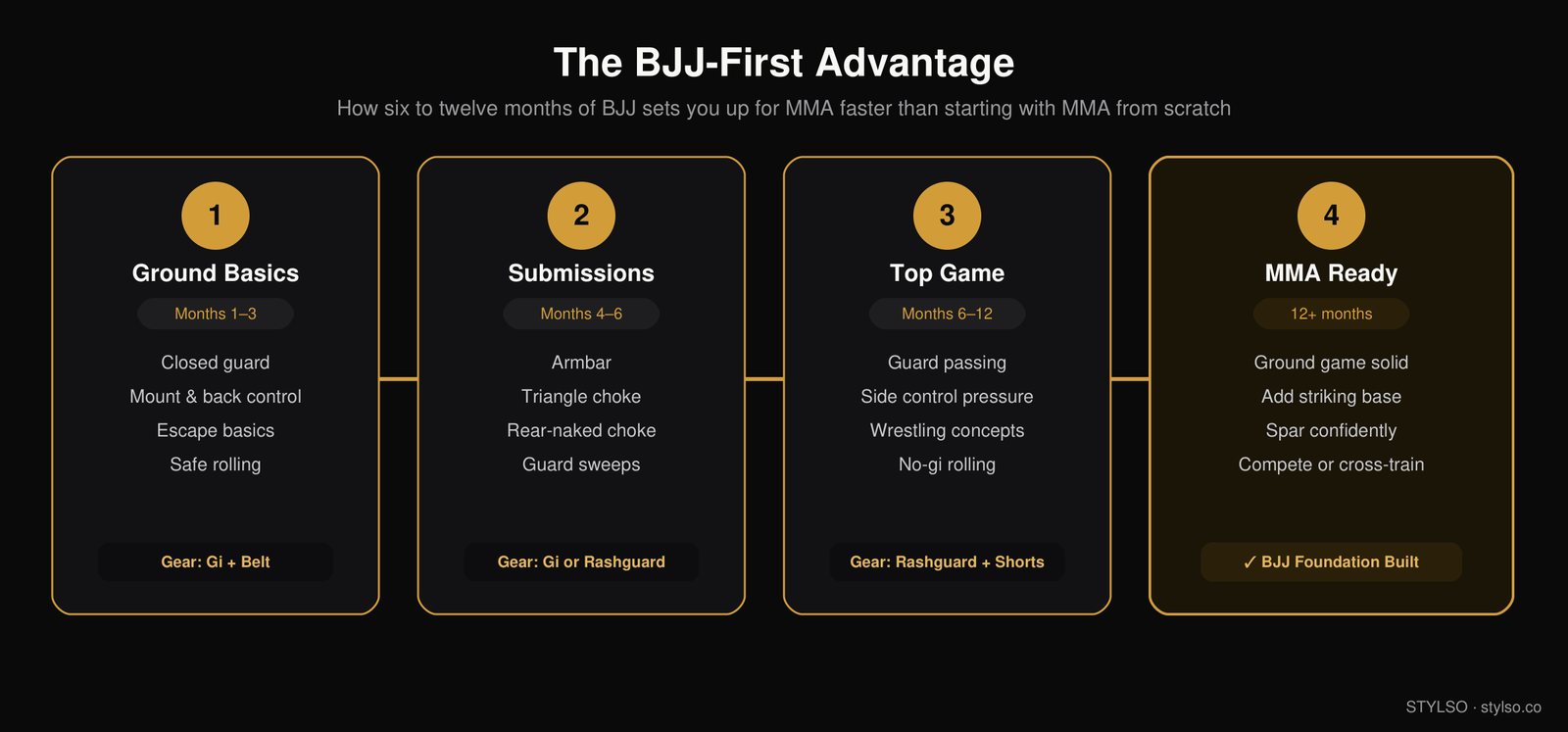
So when you train BJJ first, you’re not delaying your MMA journey. You’re building the hardest part of it — the ground game — before you layer in striking.
Six months of consistent BJJ rolling means you can defend takedowns, survive bad positions, and go for submissions without panicking. That’s the foundation your future MMA coach is hoping you already have.
The wrestling lesson that speeds everything up. Once you’ve been rolling a few months, borrow one habit from wrestling: never be flat on your back. Wrestlers are drilled from day one to always be on their side, bridging or rotating — never pinned square and still. When someone’s passing your guard in BJJ, the same instinct applies: turn into your elbow and shrimp away. Flat = stuck. On your side = still in the fight. Try it in your next roll and you’ll feel the difference immediately.
The 3 Questions That Settle It
Not sure if BJJ is right for you? Answer these honestly:
1. What’s your actual goal?
Self-defence → BJJ. Sport competition → BJJ. Eventually MMA → BJJ first, then add striking. Pure striking (boxing, kickboxing) → skip BJJ for now. If the goal has ground fighting anywhere in it, BJJ is the move.
2. What’s the gym situation near you?
A good BJJ gym with rolling classes is worth more than a mediocre MMA gym with fancy branding. If you have a quality BJJ coach nearby and a decent MMA gym a bit further, start local. Build your ground game first.
3. How much contact do you want early on?
BJJ sparring (rolling) is intense — but it’s all grappling, no strikes, and you tap when you need to. MMA sparring at a beginner level varies a lot by gym. Some are safe and structured; some are rough. If you’re nervous about getting hit early on, BJJ is the right call. Get comfortable on the mat first.
What Gear You Need to Start BJJ
You don’t need much. A gi and a belt is all it takes to walk into your first class.
The key is getting one that fits properly. A gi that’s too big gives your training partner extra handles — they’ll use every loose inch of fabric to control you. Too small and the seams go in month two.
How to size it right:
- Measure your height barefoot, head to floor.
- Note your weight — gi sizing uses both. If you’re in between, size up for rolling comfort.
- Check the size chart for the specific brand — cuts vary. Stylso gis run true to BJJ sizing with an athletic cut for grapplers, not street wear.
For no-gi or MMA cross-training, swap the gi for a rashguard and shorts. Check what to wear under a gi if you’re doing both.
Once you know your size, the best starting point is a gi built for training — not flashy, just durable and clean-fitting.
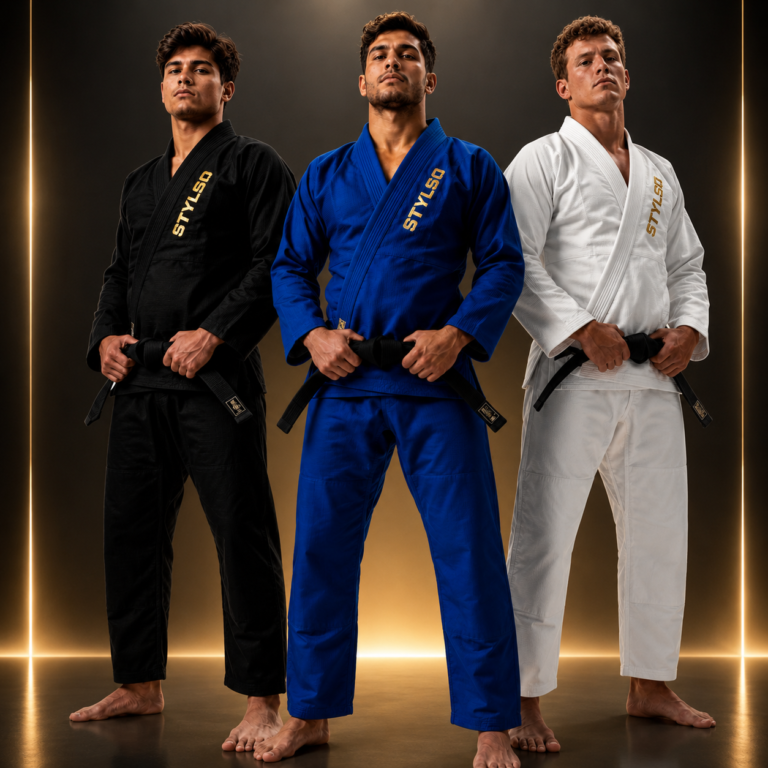
Shop the Stylso Men’s Gi on Amazon
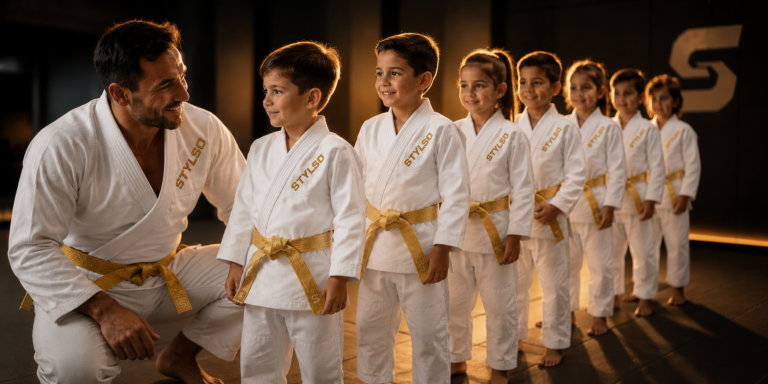
Shop the Stylso Kids’ Gi on Amazon
If you’re not sure which size or have questions about the Stylso line, the best BJJ gi for beginners guide breaks it all down in one place.
Free: BJJ Starter Guide (PDF)
BJJ vs MMA comparison chart, beginner gear checklist, and a 4-week starter plan — one printable you’ll actually use. Instant download.
Frequently Asked Questions
Is BJJ good for complete beginners with no martial arts background?
Yes — it’s one of the most beginner-friendly martial arts out there. Technique is the equaliser: a lighter, less athletic person who understands position can often control someone much bigger who’s just muscling through. No striking experience needed. You’ll tap out constantly at first. That’s normal and fine.
Can you go straight into MMA without learning BJJ first?
Some gyms offer beginner MMA classes designed for people with zero base — padwork, basic takedown drills, positional grappling. If the programme and coach are solid, it can work. But most reputable MMA coaches will eventually point you toward focused BJJ or wrestling to build your ground game. You’ll get there faster by building the base first.
Is BJJ useful in a real fight or self-defence situation?
Yes. Most real confrontations that escalate go to the ground — or at least to a clinch. BJJ’s ability to control a person and apply submissions without striking makes it effective for self-defence. It won’t give you striking skills, but it’s one of the most practical ground-game arts for real situations.
How long before BJJ rolling improves my MMA grappling?
Most people feel noticeably more comfortable on the ground within three to six months of consistent BJJ training (two to three sessions per week). Submissions take longer to land on experienced people, but basic position survival and escape comes quickly.
What’s the difference between gi BJJ and no-gi for someone planning to do MMA?
No-gi is closer to what you’ll do in MMA — no fabric to grip, more scrambling, more wrestling-influenced. Gi BJJ builds tighter technique and grip awareness. Both are valuable. If MMA is the goal, add no-gi after your first few months of gi training. The habits carry across.
Which is cheaper to start — BJJ or MMA?
BJJ is generally cheaper to start. You need a gi and belt (or rashguard and shorts for no-gi). MMA requires gloves, shin guards, a mouthguard, and usually a rashguard and shorts — more pieces upfront. Gym fees vary; classes-only BJJ academies often cost less than full-service MMA gyms.