A BJJ warm-up should take 10–15 minutes and move through five phases: joint circles, dynamic leg work, mat movement, grip activation, and specific drilling. You don’t need a partner. Hit all five and you’ll show up to sparring ready — not just present.

Key Takeaways
- Skip the jogging laps — warm up with BJJ-specific movements instead.
- 12 minutes is plenty when every phase has a purpose.
- Your warm-up is also training: shrimping and bridging count as reps.
You walk onto the mat and your hips feel like concrete. The first round goes badly — not because you’re unfit, but because you didn’t warm up right. It happens to everyone, especially in the first few months.
Here’s what nobody tells you: the warm-up isn’t just about avoiding injury. It’s about priming the exact movements you’re going to use under pressure. Every shrimp you do in warm-up is a rep your nervous system banks. By the time live rolling starts, those patterns are online.
Here’s a 12-minute routine you can run solo, every session, before your coach even calls everyone in.
Why Your Warm-Up Is Actually Training
Most beginners treat the warm-up like a tax — something to get through before the real work starts. That’s backwards.
Shrimping, bridging, and technical standups are fundamental BJJ movements. If you drill them fresh — before your heart’s pounding and your mind’s in survival mode — they go in cleaner. Your body memorizes the pattern at full quality, not the tired, compromised version from the middle of a hard round.
Wrestlers know this better than anyone. They warm up with their shots and sprawls, not random jogging. Judo players run breakfalls and grip games before the first match. BJJ is the same — specific movement gets you more than general sweat.
Cross-discipline tip: yoga breathing works here too. Slow exhales through Phase 1 switch your nervous system from tense to ready. It’s a 30-second investment that changes how the first five minutes of class feel.
The 5-Phase BJJ Warm-Up Routine
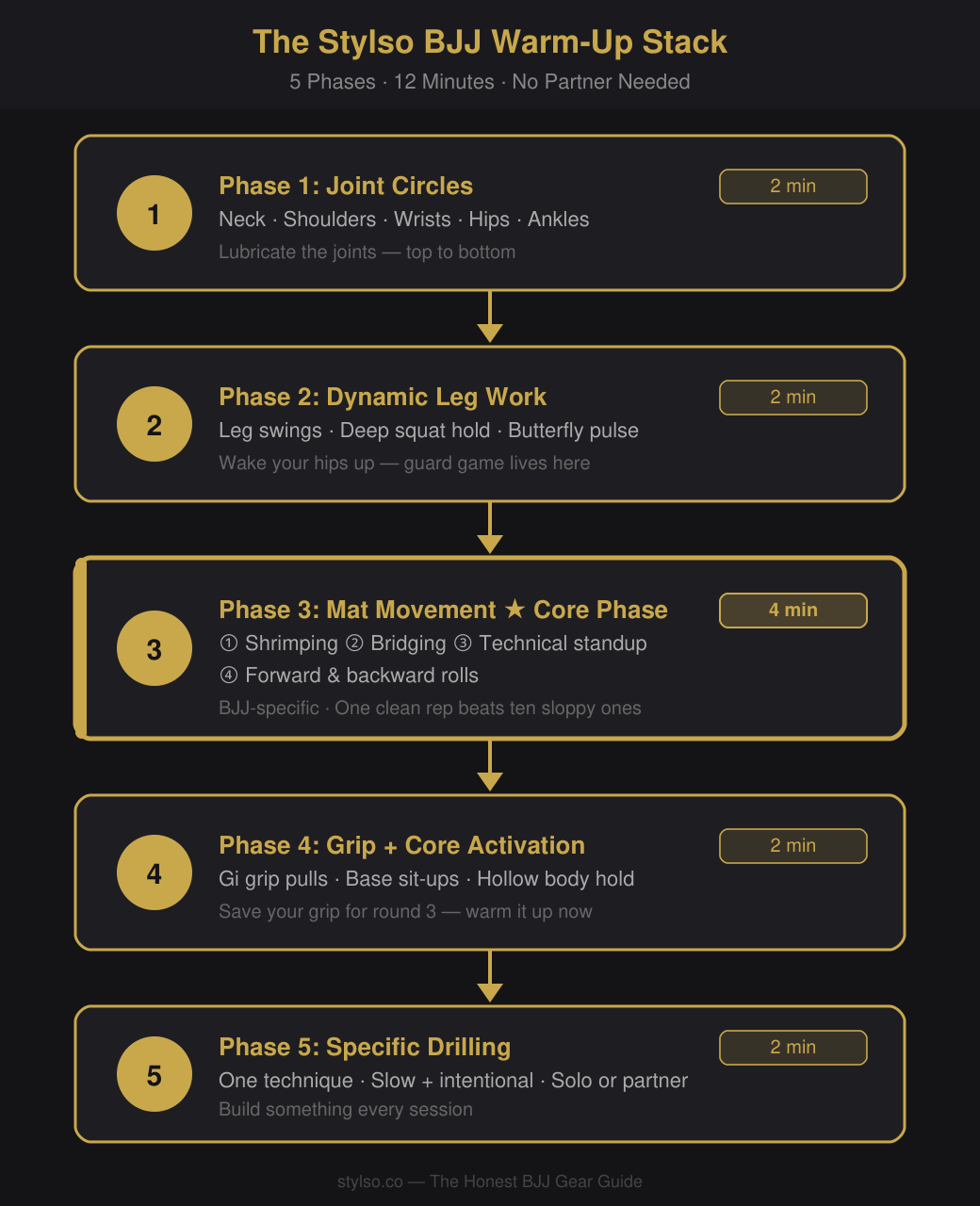
Run these in order. Each phase flows into the next. Total time: 12 minutes.
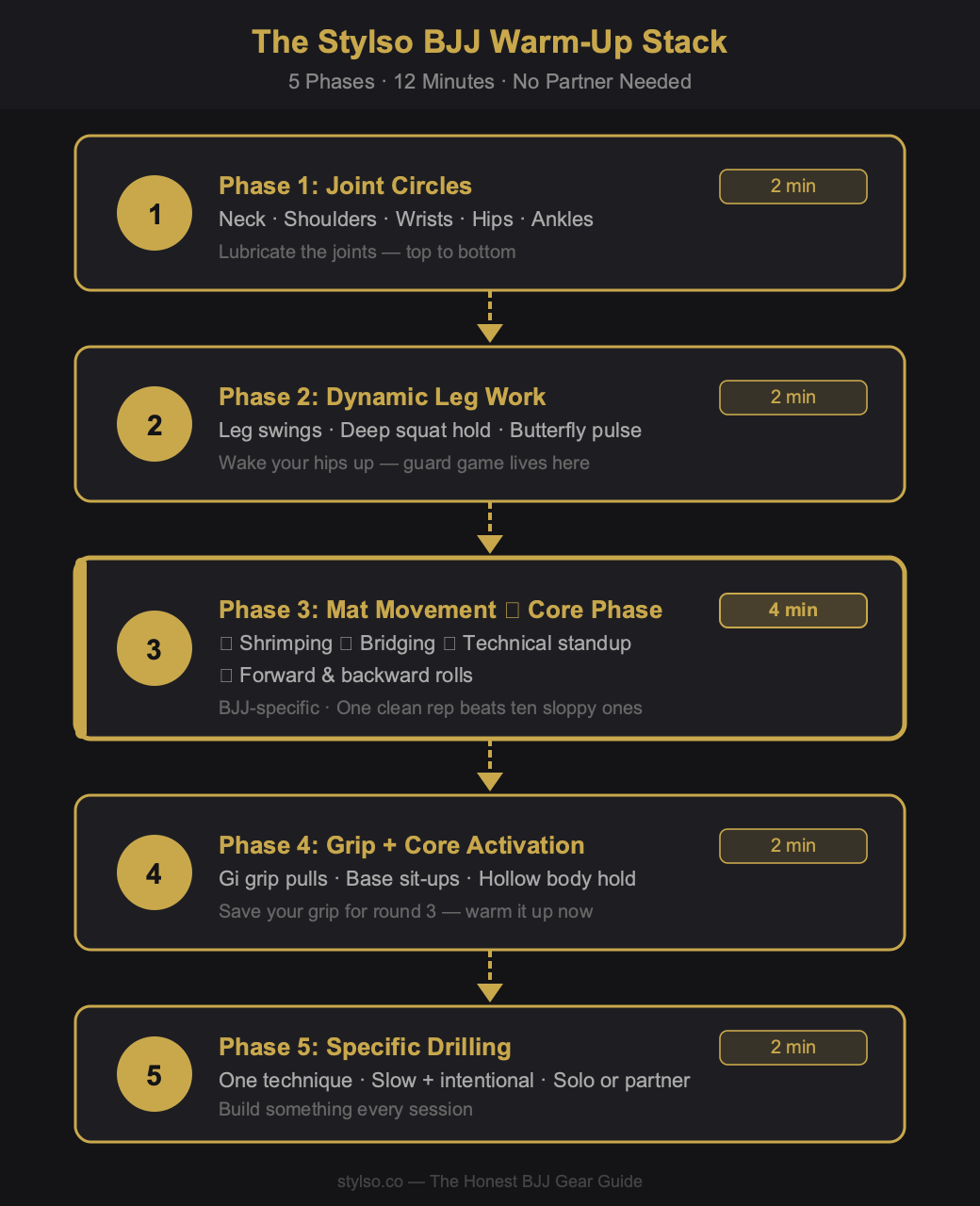
Phase 1: Joint Circles — 2 Minutes
Start from the top and work down. Neck rolls (5 each direction). Shoulder circles (10 forward, 10 back). Wrist rotations (10 each way — your grip depends on them). Hip circles (10 each way). Ankle rolls.
This isn’t stretching. It’s lubricating. Cold joints crack and complain. Warm joints bend and absorb. Two minutes here saves you a sprained finger or a cranky hip later in class.
Phase 2: Dynamic Leg Work — 2 Minutes
Leg swings front-to-back (10 per leg). Side-to-side swings (10 per leg). Deep squat hold (30 seconds — work your way down if your hips are tight). Butterfly stretch with a gentle pulse, not a hold.
Your guard game lives in your hips. If they’re stiff when rolling starts, you’ll spend the first five minutes fighting your own body instead of your partner.
Phase 3: Mat Movement — 4 Minutes
This is the core of the warm-up. All BJJ-specific.
- Shrimping (hip escape): 2 lengths of the mat. Keep your elbow in. Your feet push the floor, not the air.
- Bridging: 10 reps. Drive through your feet and shoulder — big bridge, not a half-rep. Think “push the ceiling.”
- Technical standup: 5 per side. Plant one hand, post the foot, come up controlled.
- Forward roll → backward roll: 3 lengths. Tuck your chin. Roll through the shoulder, not your neck.
Don’t rush these. One clean shrimp is worth ten sloppy ones. Phase 3 is your fundamentals practice — treat it like training, because it is.
Phase 4: Grip and Core Activation — 2 Minutes
- Gi grip pulls: Grab your lapel and pull to your chest, 20 reps. Warms up the forearm flexors so your grip doesn’t die at the three-minute mark.
- Standing sit-ups from base: 10 reps. Start in base position, lower slowly, come up fast.
- Hollow body hold: 10 seconds, 3 sets. Flatten your lower back to the floor and breathe through it.
Your grip dies in long rolls because it never got warmed up. This phase fixes that.
Phase 5: Specific Drilling — 2 Minutes
Pick one movement you’re struggling with this week — a guard break, a single-leg setup, a guard retention hip escape. Do it slow and intentional for 2 minutes. Solo if you have to, with a partner if you can.
Two minutes of deliberate drilling beats 20 minutes of distracted rolling. Use Phase 5 to build something every session. For drill ideas, see our BJJ solo drills guide.
What to Wear for Your Warm-Up (and Why It Matters)
The gi you warm up in should feel like a second skin. If you’re tugging on your collar every hip circle, that’s focus stolen from your movement.
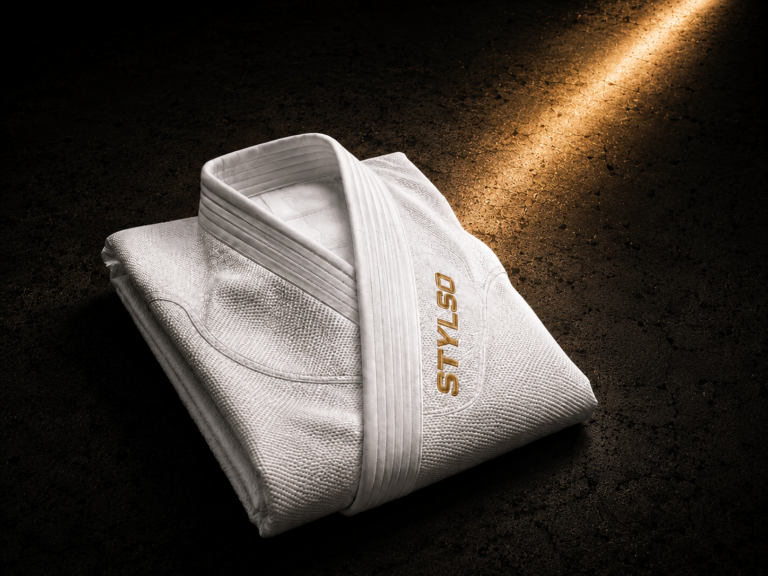
A lightweight pearl-weave gi lets you run the mat movement phase without fighting the fabric. Avoid anything with a stiff collar or bulky shoulder seams — you’ll feel them in every roll and technical standup.
For no-gi drilling and solo warm-ups at home, spats and a quality rashguard keep your joints warm without the weight. Especially useful during Phase 3 when a gi jacket adds drag to every roll.
| Warm-Up Setup | Best Gear | Why It Works | Shop |
|---|---|---|---|
| Gi class warm-up | Pearl-weave gi | Moves with you; durable for drilling | Shop on Amazon |
| No-gi drilling | Rashguard + spats | Lightweight, keeps joints warm | See guide |
| Solo home practice | Shorts + tee or spats | Comfort — no formality needed | — |
Check the current price on Amazon
Common Warm-Up Mistakes (Fix These First)
Skipping it entirely. One casual roll doesn’t count. Your connective tissue needs 5–8 minutes to actually loosen — skip that window and you’re risking a sprained finger in the first round. Not worth the saved time.
Jogging laps for 10 minutes. Cardio isn’t the point. You need specific movement patterns. General jogging doesn’t prepare your hips, wrists, or grip for grappling. Save conditioning for the end of class — or follow a proper BJJ training schedule.
Static stretching cold. Holding a long stretch on a cold muscle doesn’t improve mobility — it stresses the tissue. Save pigeon pose and frog for after training when your body’s warm and your parasympathetic system is on.
Mindless repetition. Same routine, same pace, zero awareness, every class. Use Phase 5 to drill what you’re working on that week. For the bigger picture, see how to get better at BJJ faster.
Free: The BJJ Warm-Up Checklist
Free: BJJ Warm-Up Checklist (Printable PDF)
All 5 phases, every drill, on one page. Print it, post it at your gym, and run it before every class.
FAQ
How long should a BJJ warm-up be?
Aim for 10–15 minutes. Less than 5 and your tissue hasn’t warmed through; more than 20 and you’re burning energy you need for sparring. The 12-minute framework above fits most class schedules.
Can I warm up solo before class?
Yes — and you should. The 5-phase routine is entirely solo-friendly. The mat movement phase (shrimping, bridging, rolls) is especially valuable to run before your coach calls everyone together.
Is a general cardio warm-up good for BJJ?
Running laps raises your heart rate, but it doesn’t prepare your hips, wrists, or grip for grappling. BJJ-specific movements prime your nervous system for the patterns you’ll actually use in class.
What’s the best stretch before BJJ?
Skip static stretches before training. Dynamic movements — leg swings, hip circles, deep squats — are more effective pre-class. Save long holds for after class when muscles are warm and receptive.
Should beginners warm up differently?
Use the same 5-phase framework, but go slower in Phase 3. Rolling and shrimping at 60% pace teaches the pattern without the injury risk of going full speed before your body knows the movement.
Affiliate disclosure: Stylso participates in the Amazon Associates Program. Some links above are affiliate links — we earn a small commission at no cost to you. We never state a price and never fabricate specs or ratings. Check the current price on Amazon.