You’ve been showing up. Drilling. Getting smashed, tapping, learning to fall right. The question hits every white belt eventually: when does the blue belt happen?
Here’s the honest answer.
Most grapplers who train 3–4 times a week get their blue belt in 18 months to 2.5 years. But “average” doesn’t mean much when two training partners start on the same day and one promotes in 14 months while the other is still in white at year four. The difference isn’t talent. It’s three specific things your coach watches — and most white belts don’t even know the list exists.
This post breaks down the real timeline, the mat-hours math behind it, and what you can control starting this week.
The 3 Things That Actually Drive Your Timeline
Forget talent. Your coach isn’t measuring talent. They’re watching three things:
- Mat hours, not calendar months. A grappler who trains twice a week for three years has fewer mat hours than someone training five times a week for one year. The blue belt is a mat-hours milestone, not a seniority badge. The calendar is a trap.
- Technical retention. Can you remember and apply what you drilled six weeks ago? Not just on a Tuesday during technique class — but on a Friday when someone bigger is trying to smash your guard. Retention under pressure is the real test.
- Ego management. This one surprises people. Your coach watches how you respond when a two-stripe white belt taps you. Do you get weird? Make excuses? Skip class for two weeks? Or do you tap, reset, and ask what happened? The mat reveals your character. That matters before you promote.
The Real Training Frequency Table
Here’s what the BJJ community consistently reports across Reddit, coaching forums, and academies that have promoted hundreds of students:
| Training Frequency | Typical Blue Belt Timeline | Est. Mat Hours |
|---|---|---|
| 5–6× per week | 10–16 months | ~400–600 hrs |
| 3–4× per week | 18 months–2.5 years | ~400–600 hrs |
| 2× per week | 3–5 years | ~400–600 hrs |
| 1× per week or less | 5+ years (very slow) | Slow accumulation |
Notice what’s the same in every row: the total mat hours. The belt doesn’t move on time — it moves on hours. Training more frequently compresses the calendar. That’s the one lever you actually control.
The 400–600 hour estimate is community-sourced, not a hard rule. Some gyms promote earlier; some have stricter standards. Ask your coach directly what their criteria are — it’s a fair question and a good conversation.
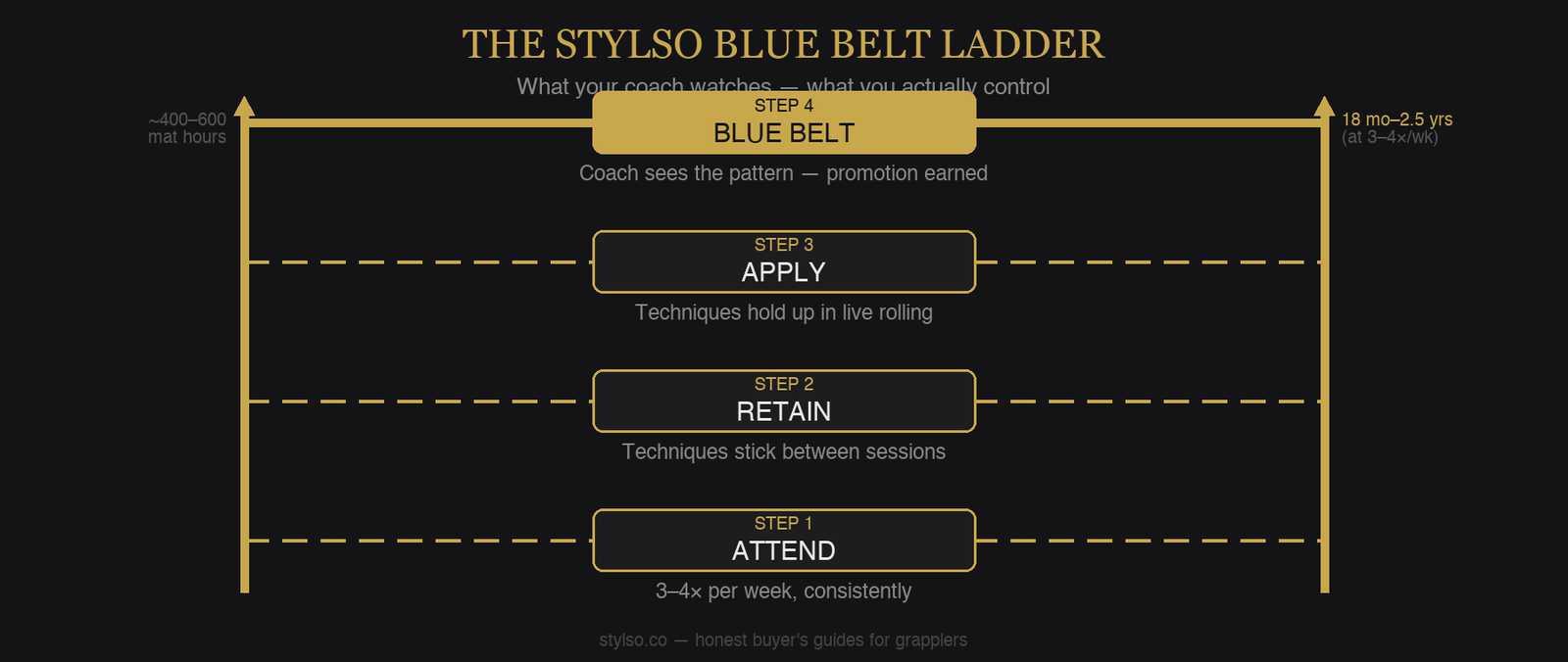
What Your Coach Is Actually Watching
Here’s what nobody tells white belts: the blue belt isn’t a test you pass on one day. It’s a pattern your coach has been reading for months.
They’re not waiting for you to tap a purple belt. They’re watching for this:
- Do you show up when you don’t feel like it? Missing class after a hard session is the single biggest delay. Consistent attendance beats occasional intensity every time. Your coach tracks the pattern, not the good weeks.
- Do you survive before you attack? A blue belt defends first. Many white belts want to go straight to offense. Your coach wants to see you handle bad positions without panicking — before they put a blue belt on you.
- Do you help white belts who are newer than you? This sounds soft, but it matters. Teaching reinforces retention. If you can explain a basic guard pass to a total beginner in plain words, you understand it. Coaches notice who mentors and who hides from new students.
The Wrestling Lesson: Consistency Over Peaks
In wrestling programs, the athletes who make the national team aren’t usually the most talented in year one. They’re the ones still in the room in year three when the talented quitters had gone.
Wrestling coaches call it coachability. BJJ coaches call it mat presence. Both mean the same thing: you show up, you absorb, you improve without being told twice. The belt is the outcome. The discipline is the process.
If you want to accelerate your timeline, train with more frequency before you worry about intensity. Three focused sessions a week beats five ego-driven ones.
When You Get Promoted — Upgrade Your Gear
There’s a real marker. When your coach is getting close to promoting you, your current starter gi starts to feel off. Not broken — just wrong. Too heavy for the faster sessions. Too loose in the collar for the details you’re starting to understand.
A lot of grapplers get their blue belt and immediately think about upgrading. That moment is a real gear crossroads. A gi that works for a white belt (any gi) and a gi that performs for a blue belt in training (lighter weave, consistent pre-shrunk construction, correct IBJJF colourways) are different things.
The Stylso men’s gi is built for exactly that crossroads — pearl weave, pre-shrunk, IBJJF-approved. It’s what you step into when you stop needing a starter gi.
Shop Stylso Men’s Gi on Amazon
For younger grapplers working toward their first promotion, the Stylso kids’ gi is sized for real junior training — same construction, not a costume.
Shop Stylso Kids’ Gi on Amazon
Free: BJJ Blue Belt Training Log
Track your mat hours, measure the 3 non-negotiables, and know where you stand. Instant download.
Common White Belt Mistakes That Delay Promotion
Most delays aren’t skill gaps. They’re habit gaps:
- Skipping class after a hard session. The week you most want to skip is often the week you most need to be there. Your coach notices the absences, not just the sessions.
- Only rolling with people your size. Training with a variety of bodies — bigger, smaller, faster, stronger — builds a real game. A blue belt adapts. A white belt who only knows how to handle one body type isn’t ready.
- Not asking questions. “Can you show me what you just did to me?” is the fastest learning tool on the mat. Coaches respect grapplers who want to understand. It shows you’re building a framework, not just reacting.
- Treating every roll like a competition match. Drilling is training. Rolling at full intensity every session burns you out and slows technical absorption. Relax in training. Compete at competition.
Key Takeaways
- Mat hours drive promotion, not calendar months — training 3–4× per week puts most grapplers at blue belt in 18 months to 2.5 years
- Your coach watches attendance, technical retention under pressure, and ego management — not raw talent
- The blue belt is a gear crossroads: it’s when a serious training gi makes a real difference
Frequently Asked Questions
How long does it take to get a blue belt in BJJ on average?
Most grapplers training 3–4 times a week get promoted in 18 months to 2.5 years. Training 5+ times a week, some people see their blue belt in 12–16 months. Training twice a week, it typically takes 3–5 years. Mat hours matter more than the calendar.
Can you get a blue belt in BJJ in 1 year?
Yes — grapplers training 5–6 times a week sometimes promote in 12–16 months. It’s not common, but it happens. The driver is mat hours, not calendar months.
What do coaches look for before promoting to blue belt?
Coaches typically watch for consistent attendance, the ability to survive bad positions under pressure, ego management, and whether you help newer students. It’s a pattern over months, not a single test day.
Does talent affect how fast you get your blue belt?
Less than you’d think. Consistency and coachability matter more than natural athletic ability. A consistent attendee with average skills will often promote before a talented athlete who skips class.
How many mat hours does it take to get a blue belt in BJJ?
The BJJ community commonly estimates 400–600 mat hours as a rough threshold, though academy standards vary widely. Your gym may promote earlier or later. Ask your coach what they specifically look for — it’s a fair question.
Should I switch gyms if I haven’t been promoted yet?
Only if the gym isn’t the right fit overall. Lack of promotion alone is rarely a good reason to switch. Talk to your coach first — ask what they need to see. That conversation is more useful than switching academies.