Stylso is a BJJ gear brand. “Shop on Amazon” buttons link to Amazon product listings — our own and third-party. We may earn a commission on qualifying purchases at no extra cost to you.
Full disclosure →
Here’s the short answer — then we explain why.
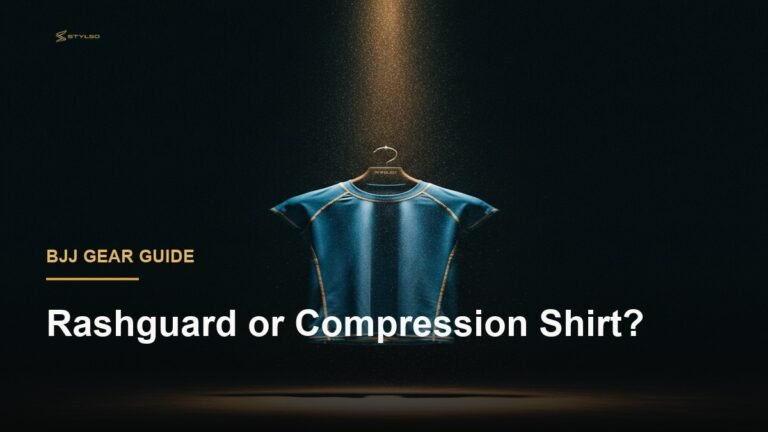
Stylso — BJJ gis and combat-sports apparel. The right BJJ rashguard has flatlock seams that don’t cut skin, antimicrobial fabric that resists mat bacteria, and a compression fit that moves under a gi. Generic gym shirts fail on all three. Here are the four myths that send most beginners to the wrong choice — and how to fix them.
By Stylso Editorial Team — Stylso BJJ rashguard guide, updated 2026-06-24.
Key Takeaways — 3 Myths Busted Upfront
-
✓
Myth 1: Any compression shirt works for BJJ. Wrong — BJJ-specific seams and antimicrobial fabric make a real difference on the mat. -
✓
Myth 2: More expensive always means better. Wrong — mid-range from the right brand beats premium from the wrong one every time. -
✓
Myth 3: Short sleeve is always fine. Wrong — many competitions require long sleeve and mat conditions matter too.
Best Rashguard for BJJ — Quick Comparison
Each category below represents a real buying scenario. Click “Shop on Amazon” to browse and compare real options in that category.
| Category | Best For | Sleeve | Shop |
|---|---|---|---|
| Budget Pick | Beginners, occasional training, testing the sport | Short or long | Shop on Amazon |
|
Long Sleeve Everyday Most Popular Pick |
Regular training, gi + no-gi, competition-eligible | Long (recommended) | Shop on Amazon |
| Short Sleeve Everyday | Hot gyms, casual no-gi drilling, warm-weather training | Short | Shop on Amazon |
| Competition Pick | IBJJF events, serious competitors, rule-compliant fit | Long (required by IBJJF) | Shop on Amazon |
The best rashguard for bjj is the one that matches your training volume, rule set, and sleeve length requirement. Most grapplers end up owning two: one long sleeve for competition and gi training, one short sleeve for hot-gym no-gi sessions.
The Stylso Rashguard Fit Method
At Stylso, every BJJ rashguard recommendation runs through three criteria before it gets published. We call this the Stylso Rashguard Fit Method. Use it to evaluate any rashguard before you buy.
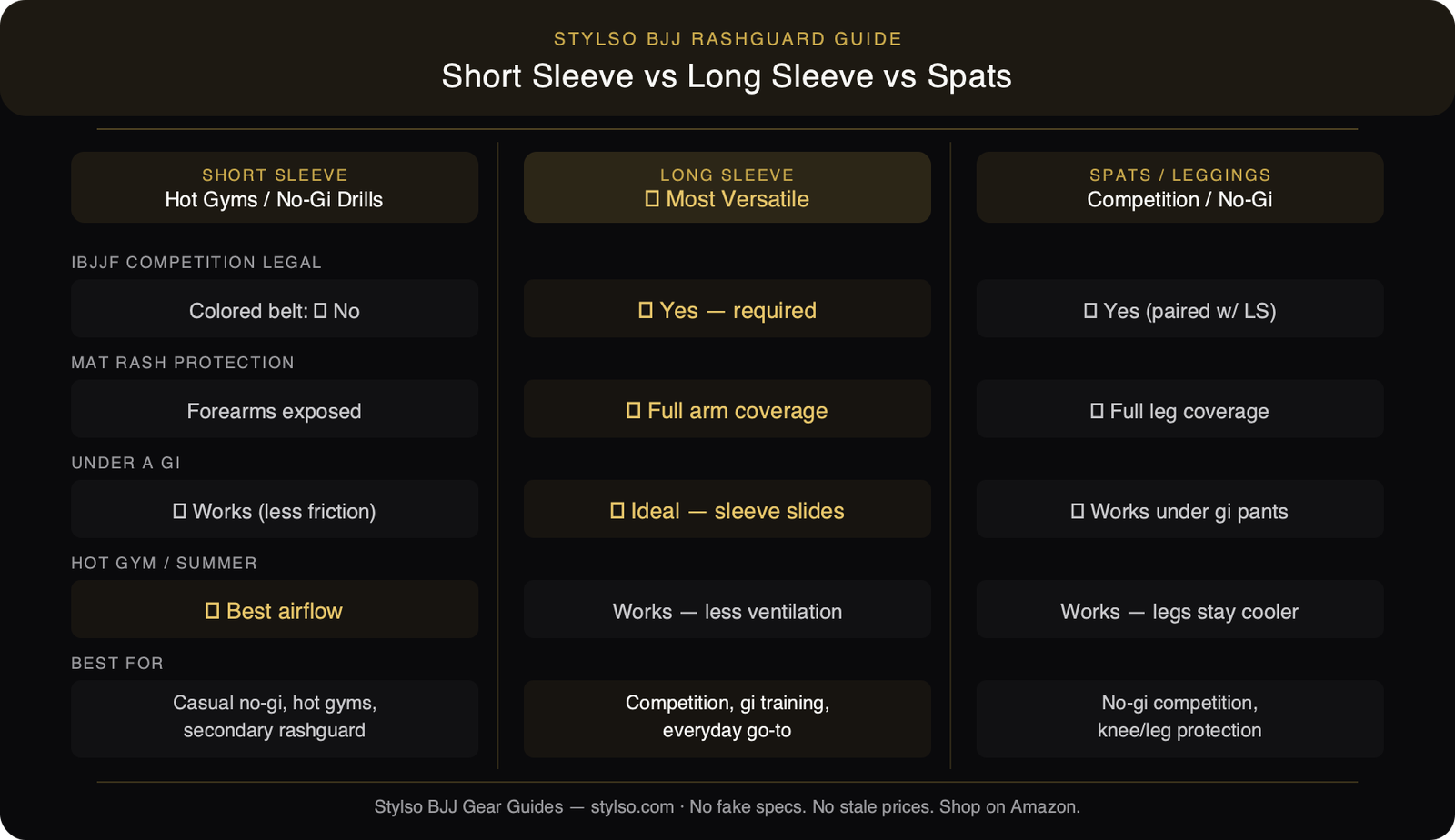
- Compression weight. The fabric needs to be firm enough to stay in place during scrambles, but not so restrictive that it limits shoulder or hip rotation. If you can’t raise your arms overhead without the hem pulling out, the compression is too tight for your torso length.
- Sleeve choice. Pick based on your rule set first, not comfort. Long sleeve covers more situations. If you compete under IBJJF rules, long sleeve isn’t optional — it’s required for colored-belt no-gi divisions. Short sleeve is a secondary option for heat management, not a default.
- Seam check. Run your thumb along every seam before your first session. Flatlock seams lie flat — zero ridge. Raised seams have a ridge you can feel. Any ridge means mat burn. Don’t roll in it until you’ve confirmed the seams are flat.
What Actually Matters When You Buy
- Seam construction. Flatlock only. If the seams are raised, put it back on the shelf.
- Fabric blend. Look for a polyester-spandex blend — avoid cotton blends, which soak up sweat and wear out faster.
- Antimicrobial treatment. Grappling mats carry bacteria. Treated polyester slows bacterial growth between washes. This isn’t optional — it’s a mat hygiene requirement.
Myth 1 — “Any Compression Shirt Works”
Walk into any sporting goods store and you’ll find a wall of compression shirts. They look like BJJ rashguards. They aren’t.
Regular compression shirts are built for running or the gym. They use raised seams. In BJJ, those seams press into your skin during every grip and every scramble. After 20 minutes on the mat, the result is raw skin — mat burn that has nothing to do with the mat itself.
A BJJ rashguard solves this with flatlock stitching. The seam lies flat. There’s no raised ridge to dig in. You roll for two hours and feel nothing.
The second difference is fabric treatment. Grappling mats carry bacteria. Regular compression shirts offer no protection. A proper BJJ rashguard uses antimicrobial fabric — typically a treated polyester blend — that slows bacterial growth between washes. This isn’t a marketing feature. Skin infections are common in grappling. Antimicrobial treatment reduces that risk.
The third difference is how fabric behaves under a gi. Generic compression fabrics can grip the inside of a gi top and restrict your movement. BJJ rashguards use fabrics engineered to slide. Your gi moves with you instead of fighting you.
Three real problems. One solution: buy from a brand that builds specifically for grappling.
Myth 2 — “Expensive Means Better”
Price matters. But not the way most people think.
Here’s what extra money actually buys in a BJJ rashguard:
- Stitching durability. Higher-end rashguards use tighter flatlock seams that survive more washes and more hard rolls before the stitching fails.
- Print longevity. Cheap prints fade and crack inside six months. Quality sublimation is dyed into the fabric, not layered on top — it lasts the life of the garment.
- Antimicrobial treatment grade. Better brands use treatments that hold up through more wash cycles. Budget rashguards can lose antimicrobial effectiveness faster, especially with daily washing.
- Compression longevity. Quality spandex blends hold their shape after months of washing. Budget rashguards can go loose after 30 to 40 cycles.
What extra money does not buy you is protection, compliance, or flat seams. Those are available in mid-range BJJ-specific rashguards. The honest rule: buy from a brand that builds for BJJ. Mid-range from the right brand beats premium from the wrong one — every time.
Myth 3 — “Short Sleeve Is Always Fine”
Short sleeve rashguards are comfortable. They breathe well. For casual no-gi training in a warm gym, they work. But “always fine” is wrong — and most beginners find this out the hard way, at a weigh-in.
Common mistake: buying short sleeve because it feels more comfortable during class, then discovering your event requires long sleeve the week before competition. At IBJJF events, colored-belt no-gi divisions require long sleeve rashguards. Show up in short sleeves and you may not be allowed to compete. That’s an entry fee gone.
Mat rash protection. Your forearms take constant friction during guard passing, arm drag setups, and scrambles. Long sleeves protect that surface. Short sleeves leave it exposed. On rough mats, this shows up from week one.
Cold training conditions. Larger gyms and outdoor training spaces run cold. Long sleeves keep muscles warm through early-morning or winter sessions. A cold forearm going into a tight armbar is a joint injury waiting to happen.
The practical answer: own at least one long sleeve rashguard. Use short sleeves for hot no-gi drilling. Use long sleeves when the rules require it or conditions call for it.
Myth 4 — “One Size Fits All Compression”
Rashguard sizing isn’t the same as your T-shirt size. Compression gear is designed to be snug — but there’s a difference between proper BJJ compression fit and a rashguard that cuts off circulation or rides up mid-roll.
Common mistake: buying your usual shirt size because it fits at the chest, without checking torso length. Taller athletes with longer torsos often find that a correctly sized rashguard is too short — it pulls out of their shorts on every takedown, leaving a gap that bunches under a gi top. Always check the torso length measurement, not just the chest.
In BJJ, the fit needs to be close enough that an opponent can’t grab fabric, but still allow full shoulder and hip rotation. Too loose and it bunches. Too tight and movement is restricted.
Sizing varies by brand. Always check the specific brand’s size chart before ordering. The ranges below are general guidelines only.
| Size | Chest (in) — general range | Height (approx.) | Build guidance |
|---|---|---|---|
| S | 34–37 in | 5’4″ – 5’7″ | Lean build, lighter frame |
| M | 37–40 in | 5’6″ – 5’10” | Athletic build, average frame |
| L | 40–43 in | 5’9″ – 6’1″ | Broader chest, muscular build |
| XL | 43–46 in | 6’0″ – 6’3″ | Large frame, wide shoulders |
Between sizes? Go up one. A rashguard stretches slightly with wear. One that starts too tight doesn’t get better.
Need to size your full BJJ kit? Our BJJ Gi Size Guide covers adult, women’s, and kids’ sizing across brands — use it alongside the rashguard size table above. Looking for gis and training apparel? Browse the full Stylso shop for IBJJF-approved gis built for daily training and competition.
Free Download
BJJ Rashguard Buyer’s Checklist
4 myths busted, Stylso Rashguard Fit Method, size guide, care tips, and Amazon links. One page. Take it to the mat.
Free: BJJ Rashguard Buyer’s Checklist
4 myths busted, the Stylso Rashguard Fit Method, size guide, care tips, and Amazon links. One page. Take it to the mat.
FAQ
What is the best rashguard for BJJ?
The best rashguard for BJJ has flatlock seams, antimicrobial fabric, and a compression fit that stays in place under a gi or during no-gi rolls. The right choice depends on your use case: no-gi class, competition, or both. One detail most buyers miss: rashguard hem length matters as much as sleeve length — a short hem that rides up mid-roll will catch inside your gi top and disrupt your movement. Check Amazon for current options across all four categories in this guide.
Bottom line: match your sleeve length to your rule set, your size to your chest measurement, and your brand to grappling — not the gym floor.
Can I wear a regular compression shirt for BJJ?
No. Regular compression shirts use raised seams that press into skin during grappling. They lack antimicrobial treatment and often grip the gi in ways that restrict movement. A BJJ-specific rashguard is built differently from the ground up. One more issue most guides skip: some competition referees will physically check your rashguard and disqualify you for non-grappling-grade fabric — loose fabric or raised seams can be flagged at weigh-in even if no rule explicitly lists it as a violation.
Short answer: generic compression shirts fail on seams, antimicrobial protection, and competition compliance.
Should I get a short sleeve or long sleeve rashguard for BJJ?
It depends on your rule set and training conditions. Many competitions — including IBJJF events — require long sleeve rashguards for colored-belt no-gi divisions. Long sleeves also protect from mat rash and keep muscles warm in cold gyms. Short sleeves are fine for casual no-gi training but may disqualify you in competition. One detail not covered in the main guide: if you train under a gi, long sleeve rashguards also prevent the gi sleeve from gripping your bare forearm skin during cross-collar chokes, which can cause friction burns in a different way than mat rash.
Own at least one long sleeve; use short sleeves for heat management only.
Do more expensive rashguards perform better in BJJ?
Not always. Price buys build quality — tighter flatlock stitching, more durable antimicrobial treatment, and longer-lasting sublimated prints. A mid-range rashguard from a BJJ-specific brand often outperforms a premium gym rashguard in grappling durability. What most guides don’t mention: high-end rashguards sometimes use heavier fabric weights that feel premium in your hands but trap more heat during hard rolls — a mid-weight fabric from a grappling brand can outperform on comfort over a full training session.
Buy from a grappling brand at mid-range; premium gym brands don’t outperform on the mat.
What size rashguard should I buy for BJJ?
Use your chest measurement as the primary guide and always check the brand’s own size chart — sizing varies significantly between brands. Between sizes, go up one. A rashguard that starts slightly large will settle in with wear; one that starts too tight stays too tight. One thing not mentioned in most size guides: if you train with a gi, buy slightly longer in the torso than you think you need. A rashguard that hits your hip bone will pull out of your shorts on every standing takedown and bunch under your gi top.
Chest first, then torso length — always check the brand’s own chart, not a generic guide.
How do I wash a BJJ rashguard?
Wash cold (30°C / 86°F max), turn inside out, and hang dry. Never tumble dry — heat degrades the elastic and antimicrobial treatment. Wash after every session. Bacteria buildup breaks down fabric from the inside and shortens the life of any rashguard, regardless of price. One care tip most guides leave out: avoid fabric softener entirely. Fabric softener coats the fibers with a waxy residue that blocks moisture-wicking, degrades antimicrobial treatment faster, and shortens compression life — even in small doses.
Cold wash, hang dry, no fabric softener — every single session.
The right best rashguard for bjj is the one that matches your training schedule, your rule set, and the Stylso Rashguard Fit Method: right compression weight, right sleeve for your competition rules, and seams you check before your first roll. Browse the Stylso BJJ rashguard range on Amazon and check current availability below.
By Stylso Editorial Team
Stylso builds BJJ gis and combat-sports apparel for athletes who train. Earned, not hyped.