Your first hard scramble where your ear takes a beating, you won’t think about headgear. The second time — when it’s still sore three days later — you will. The best BJJ headgear for most grapplers is a soft ear guard: light, stays on, doesn’t block collar grips. Hard trainers (four or five sessions a week) should step up to full wrestling headgear with a chin strap.
- Cauliflower ear comes from friction and pressure — not impact. Headgear stops it before it starts.
- Soft ear guards work for most grapplers; wrestling headgear is the pick if you roll hard four-plus times a week.
- Fit matters more than brand — a guard that shifts mid-roll protects nothing.
What Actually Causes Cauliflower Ear (It’s Not What You Think)
Most people assume it’s impact — getting hit or slammed. It’s not. It’s friction and pressure. Your ear getting squeezed, rubbed, or folded against someone’s arm, hip, or gi fabric, over and over again.
The ear’s cartilage doesn’t have great blood supply. Repeated compression causes a blood clot to form under the skin. Leave it long enough and it hardens. That’s the cauliflower shape — and once it’s there, it doesn’t reverse.
Here’s the thing: wrestlers figured this out decades ago. They’re required to wear headgear in competition because the friction mechanics are identical — clinch work, head-to-body contact, constant pressure on the outer ear. BJJ has the same problem. Guard passes, collar grips, being smashed in someone’s side control — your ear gets ground against forearms and hip bones the whole time. The solution is the same one wrestling landed on: cover the ears before the damage accumulates.
Judo players run into the same issue. During uchi-mata and osoto-gari, the ear is right up against the opponent’s lapel. Grip-heavy styles mean high ear contact. Same friction, same result.
The 3 Types of BJJ Headgear (and Who Each One Is For)
| Type | Best For | Coverage | Gi-Friendly | Shop |
|---|---|---|---|---|
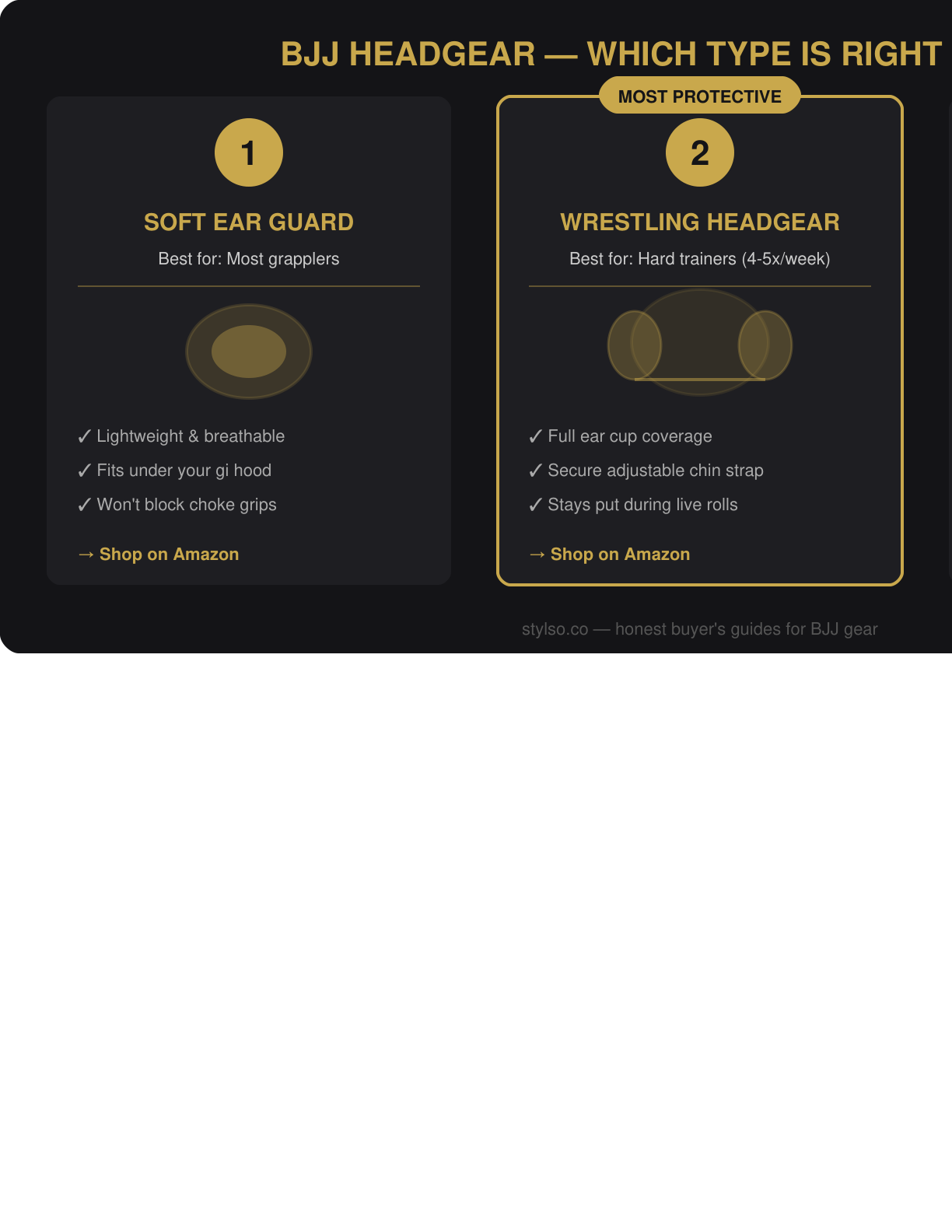
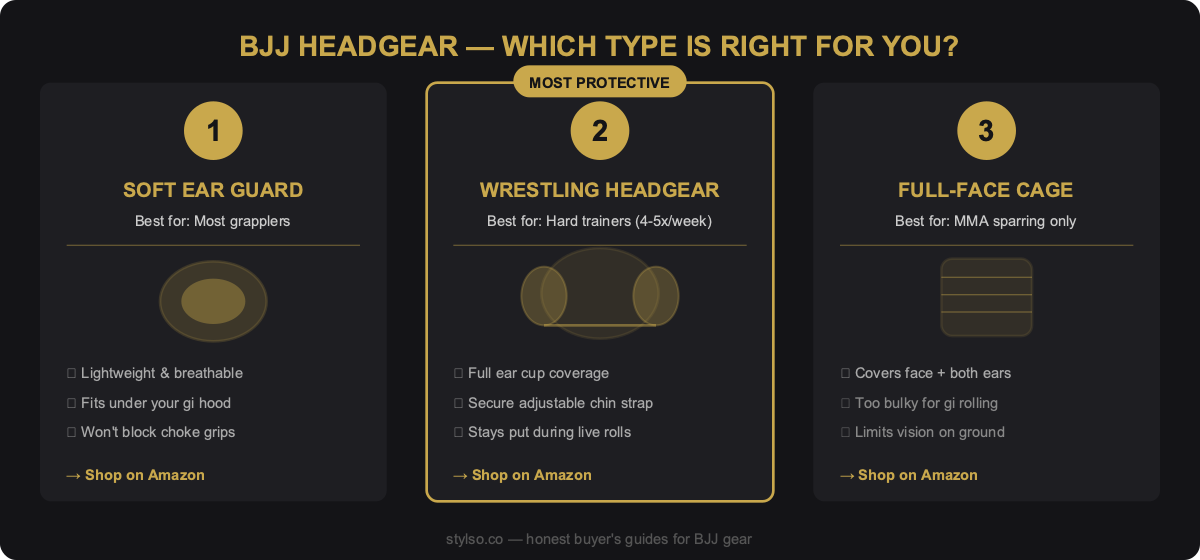
| Soft Ear Guard | Most grapplers / 1–3x/week | Ear cups only | Excellent | Shop on Amazon |
| Wrestling Headgear | Hard trainers / 4–5x/week | Full ear + chin strap | Good | Shop on Amazon |
| Full-Face Cage | MMA sparring only | Face + ears | Not ideal | Shop on Amazon |
Type 1 — Soft Ear Guard
This is the most common choice in BJJ. Light foam or silicone cups that sit over your ears, usually held by a thin strap over your head. You barely notice it during rolling. Doesn’t block your hearing. Doesn’t get tangled in collars. Works well with most gi hoods and doesn’t restrict choke grips.
The trade-off: a soft guard can shift if someone really grinds your head in a bad position. For regular training at one to three sessions a week, it does the job. It’s where most grapplers should start.
Shop Soft Ear Guards on Amazon
Type 2 — Wrestling Headgear
If you’re rolling four or five times a week, or you’ve already started noticing ear soreness, this is the better pick. Full ear cups plus an adjustable chin strap. It stays put — even in hard scrambles, even when someone posts on your head during a leg lock defense.
The chin strap is what makes the difference. A guard that shifts mid-roll isn’t protecting anything. Wrestling headgear was engineered for constant clinch pressure and head-to-body contact. The same friction mechanics that hit BJJ grapplers hit wrestlers — and this design solved it.
It’s slightly bulkier. You’ll notice it for a few sessions. After that, you stop thinking about it.
Shop Wrestling Headgear on Amazon
Type 3 — Full-Face Cage Headgear
Skip this for regular BJJ. Full-face cage headgear is built for MMA sparring — it protects your nose and teeth alongside your ears. In a gi context, it limits peripheral vision, can interfere with collar grips, and adds weight you don’t need. If you cross-train and spar with light strikes, it becomes relevant. For pure BJJ, it’s overkill.
Shop Full-Face Headgear on Amazon
How to Get the Right Fit (This Matters More Than Brand)
A headgear that doesn’t fit is headgear that won’t protect you. Here’s a 3-step check — run it before you commit, then test it on your first roll.
- The cup check. Ear cups should cover your entire outer ear without pressing the ear canal. You’re blocking friction — not squeezing cartilage. If the edges dig in, size up.
- The chin strap check. Adjust until you can open your mouth, breathe normally, and tap — but the guard doesn’t shift when you nudge it from the side. Loose is useless. Too tight means a headache by round three.
- The roll test. Put it on and do a forward roll. Does it shift? Does the chin strap catch on your gi collar? Does it ride up so the cup no longer covers your ear? If yes to any — adjust or try a different model.
The mistake most people make: they test the fit standing up, then are surprised when it slides during rolling. Always test on the mat, on your first light round.
One more thing — if you’re also thinking about your full training kit, check out the BJJ gear list for white belts or the Stylso rashguard guide for what goes under your gi. Headgear is one piece of a smart protection setup.
3 Mistakes New Grapplers Make with Headgear
Mistake 1: Waiting until it hurts. By the time your ear is sore and swollen, the damage has already started. Headgear is prevention, not treatment. Start wearing it before you notice a problem — your ears in five years will thank you.
Mistake 2: Buying the wrong type for their training load. A soft ear guard is right for two or three sessions a week. If you’re rolling every day, you need the security of a wrestling headgear chin strap. Match the protection level to how hard you actually train.
Mistake 3: Taking it off “just for this round.” This is the one that gets people. You’re a few rounds deep, the headgear felt warm, you take it off for one roll. That’s usually the round where your ear gets ground against someone’s forearm for four solid minutes. Keep it on.
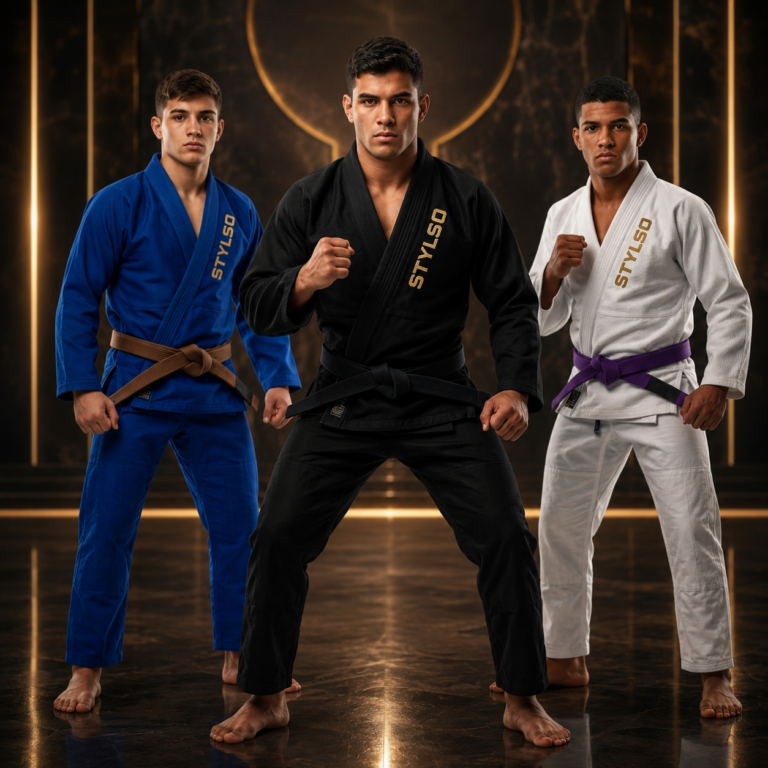
And while you’re building out your training gear, it’s worth pairing protective gear with the right gi for your level. A well-fitting Stylso gi means less fabric shifting against your neck and ears during scrambles — another small way the right gear reduces friction over time.
Free: BJJ Headgear Buying Checklist (PDF)
A one-page printable — 3-type comparison, fit checklist, and the 5-step rolling test. Get it instantly.
Frequently Asked Questions
Do I actually need headgear for BJJ?
No one’s going to make you wear it — but cauliflower ear is permanent and preventable. If you plan to train for years, protecting your ears costs less than fixing them later. Most serious grapplers add headgear once they understand how the damage actually happens.
Will headgear interfere with my collar grips or choke defense?
Soft ear guards generally don’t. Wrestling headgear is slightly bulkier, but most grapplers adapt within two or three sessions. Full-face cage headgear can get in the way of some grips — which is why it’s not the move for regular gi training.
Can I wear BJJ headgear in competition?
Check the rules for your specific tournament. IBJJF rules generally don’t prohibit soft ear guards, but confirm with your tournament director before competing. Cage and full-face headgear is almost never permitted in pure BJJ competition.
Is BJJ headgear the same as wrestling headgear?
Mostly yes. Many BJJ grapplers use wrestling headgear because it was designed for the same friction mechanics — constant clinch, head-to-body contact. If you’re shopping for BJJ specifically, look for wrestling headgear with adjustable ear cups and a secure chin strap.
How do I know if I need wrestling headgear vs a soft ear guard?
Training twice a week, no soreness → soft ear guard. Training four or five times a week, or you’ve already felt tenderness → wrestling headgear. Already developing cauliflower ear → wrestling headgear and a chat with a sports medicine doctor.