You’ve drilled takedowns for years. Now your coach wants you on the mat in a gi. First thought: “Do I need to buy something different?”
Short answer: a good BJJ gi works great for wrestling cross-training. But not all gis are equal for it — and a few choices now save you a torn seam or a restricted sprawl later.
A BJJ gi works for wrestling cross-training, but you want a heavier weave (double or gold weave), reinforced knee panels on the pants, and a true-to-size fit — not the slim cut some competition gis run. Pick those three things right and the gi holds up through both disciplines without limiting your movement.
- Double or gold weave handles the abrasion and grip loads wrestling puts on the collar
- Reinforced pants knees matter — wrestlers spend more time in the shot position than most BJJ players
- Fit: size up if you’re between sizes — wrestlers often carry more muscle through the shoulders
What Makes Wrestling Hard on a Gi
BJJ and wrestling both involve grips, takedowns, and ground work. But wrestling adds something a pure BJJ class doesn’t: constant collar grabbing and sleeve pulling from a standing position under real force.
Think about a double-leg shoot. The partner posting on the collar during the sprawl. The grip fighting at range. All of that loads the gi fabric differently than guard work alone.
Three stress points most wrestlers don’t think about:
- The collar seam. Sustained collar grips and snap-downs pull along the shoulder seam. Single weave gis — which are lighter and cheaper — can tear here in the first few months of heavy use.
- The knee panels. Wrestlers shoot more than most BJJ players. The knee of the pant takes constant abrasion from the mat. Standard pant knees aren’t built for that rate.
- The shoulder/yoke area. Wrestlers tend to carry more muscle through the trap and upper back. A slim-cut gi — fine for a leaner BJJ build — can pull across the shoulders mid-shot.
What to Look for in a BJJ Gi for Wrestling Cross-Training
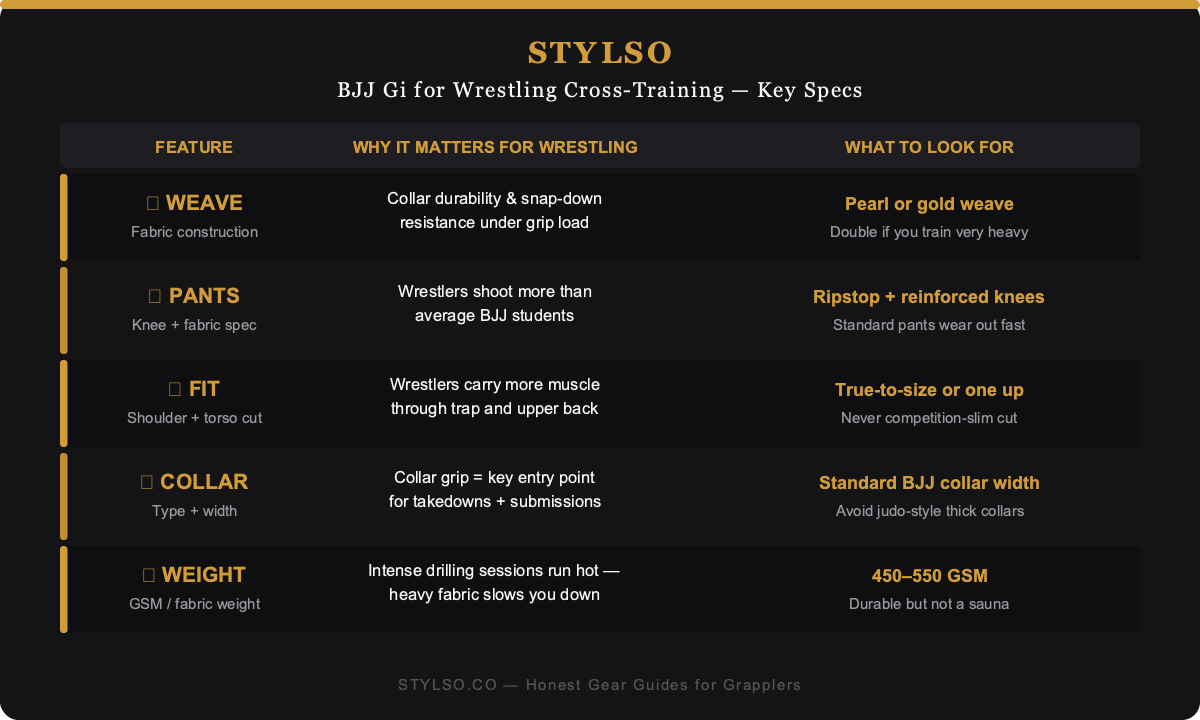
You don’t need a specialty “wrestling gi” — that’s not a thing. You need a BJJ gi with the right specs:
| Feature | Why It Matters for Wrestling | What to Look For |
|---|---|---|
| Weave | Collar durability, snap-down resistance | Double weave or gold weave (heavier, tighter) |
| Pants | Knee wear from mat shooting | Ripstop fabric + reinforced knee panels |
| Fit | Shoulder freedom for takedowns | True-to-size or one up — never competition slim |
| Collar width | Easier collar grip = more realistic drilling | Standard BJJ collar (not judo-style thick) |
| Weight (GSM) | Heat management during intense drilling | 450–550 GSM — durable but not a sauna |
The Stylso pearl weave gi sits right in this range — durable enough for collar work, light enough to roll and shoot in without overheating. Check the current price on Amazon:
Sizing When You Come from a Wrestling Background
Here’s what trips up a lot of wrestlers: gi sizing is not like singlet sizing.
Wrestlers often carry significant muscle through the neck, trap, and upper back — especially at heavyweight and upper-middle weights. A BJJ A2 might fit your height but bind at the shoulders. The fix: use height as your base size (A2 fits 170–178 cm), then try one size up (A3) if your shoulders pull the yoke tight.
The Stylso A-series runs true-to-size for athletic builds. Between sizes? Size up. A little extra room through the shoulder means a cleaner sprawl and a better collar grip.
Our adult BJJ gi size guide has the full A-series chart with height and weight ranges.
A Takedown Drill That Transfers to Both Sports
Here’s a drill that works in wrestling AND sharpens your BJJ within the first few weeks of cross-training. It’s the collar-and-wrist tie-up — the most common standing clinch in gi grappling.
Setup: Face your partner standing. One hand grabs the collar at the base of the neck (four fingers inside, thumb outside — the BJJ collar grip). The other hand grabs the opponent’s sleeve at the wrist.
The drill: With the collar hand, create downward pressure — like a snap-down without actually shooting. Hold for 2 seconds, release. Repeat 10 times each side. This builds the grip endurance that wrestling cross-trainers often lack in their first BJJ classes.
Why this matters: In freestyle wrestling you don’t hold a collar — you shoot from a collar tie. In BJJ, sustained collar pressure IS the setup. This drill builds the wrist and forearm strength for the gi version. After two weeks of this, your guard passing and takedown setups both improve.
The right gi helps here: fabric that’s taut enough to grip but not so stiff you’re fighting the collar just to hold it. That’s why weave matters for cross-trainers.
No-Gi + Gi Cross-Training: Managing the Transition
If you’re training no-gi wrestling and adding gi BJJ, a few weeks of adjustment is normal. Here’s what changes:
Grips: You can grab anything. Collar, sleeve, belt, lapel. That’s slower to register than a snap-down but gives you control once you have it.
Takedowns: Your double-leg and single-leg still work — but from a collar tie, not a collar + snap. Most wrestlers shoot from the collar grip, which transfers directly to BJJ standing work.
Recovery: Gi rolls are slower but more technical. Your cardio from wrestling covers you in the early weeks. Focus on survival guard and not getting collar-choked before your grip strength for defence catches up.
Also see our guide on gi vs no-gi: what to buy first — useful if you’re still deciding which format to prioritise.
Free: BJJ Gi Buyer’s Guide PDF
Full spec comparison, sizing chart, and care notes in one printable page. Handy when you’re at the gym or shopping on Amazon.
Free: BJJ Gi Buyer’s Guide (Cross-Training Edition)
Weave comparison, sizing chart, and care tips — one page. Get it free.
Ready to shop? The Stylso gi ships fast and holds up to both disciplines:
FAQ
Can I use a BJJ gi for wrestling practice?
Yes — a BJJ gi works well for wrestling cross-training and most wrestling-style drilling in a BJJ class. For pure freestyle wrestling competition you’d use a singlet, but for mat practice and technique drilling, a BJJ gi is the right tool.
What’s the difference between a BJJ gi and a judo gi for wrestling?
A judo gi has a thicker collar and wider sleeves — designed for sleeve and collar grips in a judo-specific way. A BJJ gi has a tighter collar and slimmer sleeves, which trains the more precise grips used in BJJ. For wrestlers adding BJJ, the BJJ gi is the right choice. For pure judo, use a judo gi.
Should wrestlers size up in a BJJ gi?
Often yes — especially if you carry extra muscle through the shoulders and upper back. Use your height as the base (the A-series chart), then go up one size if you’re between or if your upper body is muscular. A fit that lets you shoot and sprawl freely is more important than a slim silhouette.
Does the weave type matter for wrestling cross-training?
Yes. Pearl weave is the best balance — durable, lighter than double weave, and strong enough to handle collar grips and takedown drilling. Double weave is extremely durable but heavy and can slow you down in no-gi-influenced drilling. Single weave is too light for regular wrestling sessions.
How long does a BJJ gi last with wrestling use?
A good pearl weave gi lasts 2–4 years of regular training when washed cold after each session. The pants knees wear fastest with heavy shooting — look for reinforced knee panels on any gi you plan to use for wrestling cross-training.
Also see: BJJ Gi Size Guide (Adult A-Series) · Gi vs No-Gi: What to Buy First · Best BJJ Gi for Beginners