Your instructor said “just get a gi.” Then you hit Amazon at 11 PM and there are 47 options, half with names you can’t pronounce and reviews that tell you nothing. What does a white belt actually need — and what’s the gear industry hoping you’ll waste your money on?
Here’s the short version: you need three things. After your first month, you can fill in the rest. Buying more upfront doesn’t make you a better grappler — it just means more gear shoved under your bed before you’ve decided you love this sport.
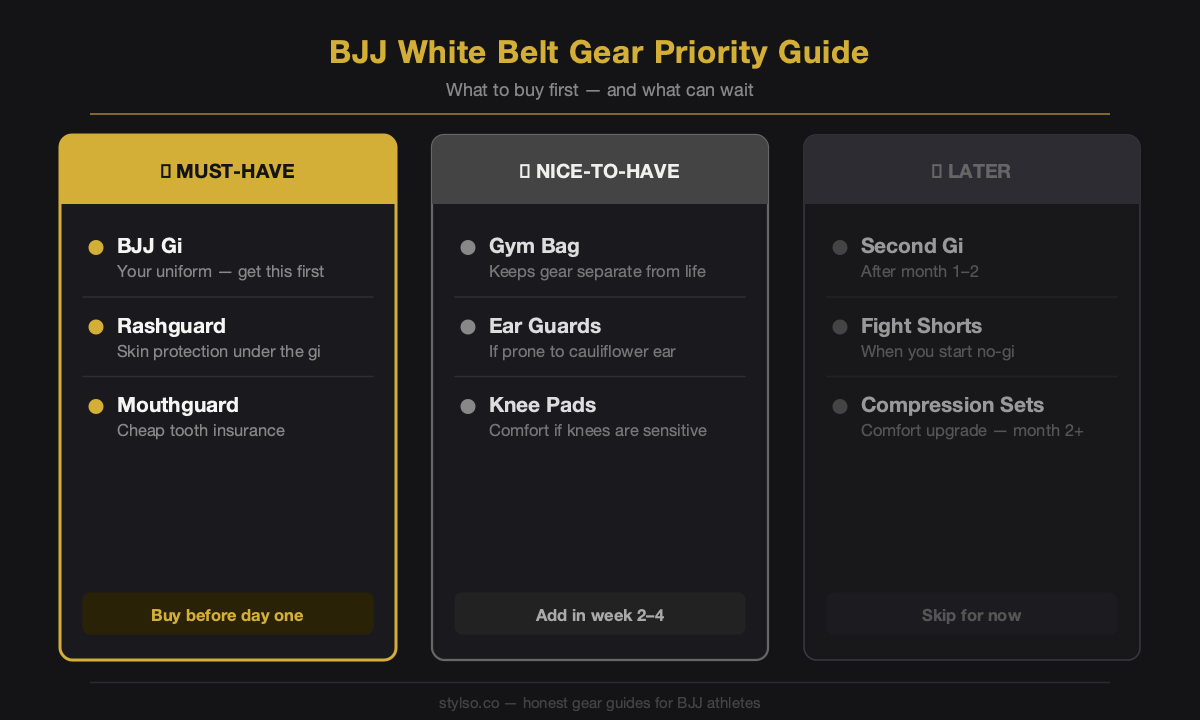
For BJJ white belts, the must-have gear is a gi (your uniform), a rashguard (skin protection and comfort under the gi), and a basic mouthguard. A gym bag, ear guards, and knee pads are useful eventually — but they’re not needed on day one. Start simple, train consistently, then upgrade.
Key Takeaways
- Three items get you on the mat: a gi, a rashguard, and a mouthguard.
- Get your gi size right from the start — a bad fit slows your learning and means re-buying.
- Everything else (bags, ear guards, compression sets) can wait until month two.
The 3 Must-Have Items for Your First BJJ Class
1. A BJJ Gi
This is non-negotiable. Most schools let you borrow a gi for a trial class or two, but you’ll need your own fast. The gi is your uniform — every choke, every grip, every sweep uses the fabric. Without one, half the drills don’t make sense.
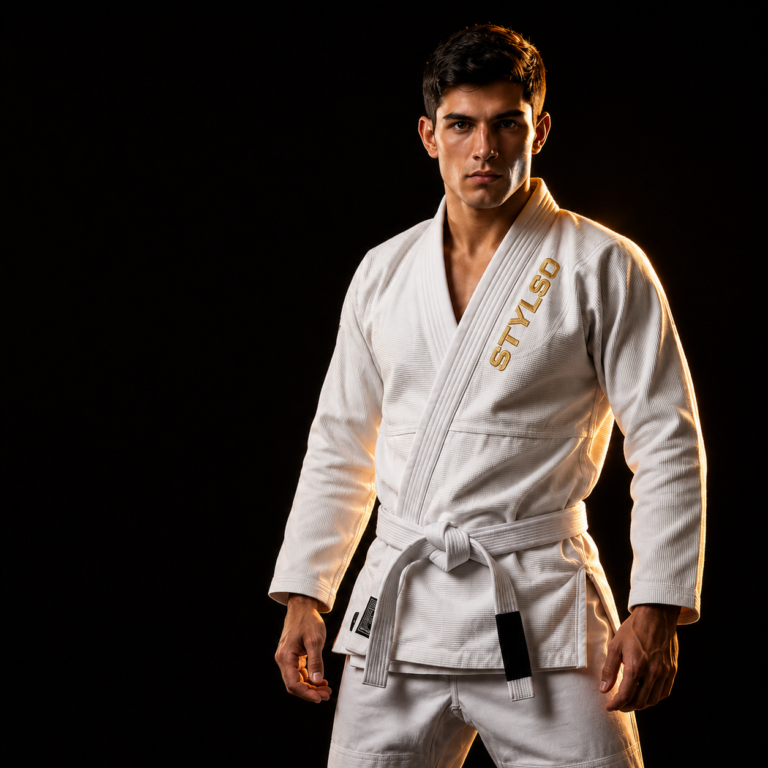
For a white belt, white is the safest choice. It’s IBJJF-legal, accepted at every academy, and keeps things simple on the mat. The Stylso men’s gi is built from premium pearl weave, pre-shrunk, and reinforced at the stress points that actually get tested — collar, sleeve seams, knee panels. Check the current price before you buy.
Starting with a kid? The Stylso kids’ gi fits the K-series sizing and holds up to the extra energy young athletes bring to every session.
2. A Rashguard
Wear this under your gi. It wicks sweat, keeps you cooler during rolls, and protects your skin from mat burns and friction during drilling. Short or long sleeve is personal preference — most people go short in summer, long in winter.
Don’t skip this. A compression-fit rashguard means your partner isn’t accidentally grabbing bare skin in a scramble. More comfortable for both of you.
3. A Mouthguard
Cheapest insurance on this list. A basic boil-and-bite from any sports store works perfectly for training. You’re not competing at IBJJF yet — you just need something that fits without distracting you mid-roll.
BJJ White Belt Gear — Priority Table
| Gear Item | Priority | Why It Matters | When to Buy |
|---|---|---|---|
| BJJ Gi | ✅ Must-Have | Your uniform — schools require it | Before week one Shop |
| Rashguard | ✅ Must-Have | Skin protection + comfort under gi | Before week one Shop |
| Mouthguard | ✅ Must-Have | Tooth protection — cheap insurance | Before week one |
| Gym Bag | 🟡 Nice-to-Have | Keeps your gi separate from daily gear | Week 2–3 |
| Ear Guards | 🟡 Nice-to-Have | Prevents cauliflower ear if prone | Month 1 if needed |
| Knee Pads | 🟡 Nice-to-Have | Comfort for guard play or sensitive knees | Only if knees hurt |
| Second Gi | ⏳ Later | Useful when training 4×/week or more | After month 1–2 |
| Fight Shorts | ⏳ Later | No-gi specific — not needed for gi class | When you start no-gi |
| Compression Sets | ⏳ Later | Upgrade over a rashguard; same function | After month 2 |
Getting Your Gi Size Right
This matters more than which gi you pick. A gi that’s too big gets grabbed constantly; one that’s too small restricts your movement. Both slow you down.
Here’s the Stylso A-series sizing for adults (men and women — STYLSO uses the same cut, one chart):
| Size | Height | Weight |
|---|---|---|
| A0 | 162–168 cm (64”–66”) | 64–70 kg (141–154 lb) |
| A1 | 168–170 cm (66”–67”) | 70–77 kg (154–170 lb) |
| A2 | 170–178 cm (67”–70”) | 77–86 kg (170–190 lb) |
| A3 | 178–188 cm (70”–74”) | 86–102 kg (190–225 lb) |
| A4 | 185–193 cm (73”–76”) | 104–118 kg (229–260 lb) |
| A5 | 190–200 cm (75”–79”) | 118–136 kg (260–300 lb) |
Between sizes? Size up. Gis settle slightly after a few washes, so the fit you buy is a bit roomier than the fit you’ll train in a month from now. For kids, check our full BJJ gi size guide for the K-series chart.
Not sure how to measure yourself? Here’s the step-by-step: How to Measure for a BJJ Gi.
What to Wear Under Your Gi
The rashguard is your base layer, but you’ve got options. Board shorts, spats, compression shorts, or just the rashguard — all are common. What works depends on your size, your temperature preference, and how warm your school’s mat room gets. Some academies are cold warehouses; some are swampy.
Start with a rashguard plus whatever athletic shorts or compression gear you already own. Don’t buy a full “BJJ base layer set” before you know what you actually prefer wearing.
Full breakdown: What to Wear Under a BJJ Gi.
One Drill to Do Before Your First Class
Here’s something the gear guides never mention: the single most useful movement in BJJ — the hip escape, or “shrimp” — needs no partner, no gi, and just five minutes of floor space.
Try this tonight:
- Lie flat on your back, knees bent, feet flat on the floor.
- Turn to one side, push off your bottom foot, and drive your hips away from that foot. Your hips move; your shoulders stay put. Your body slides sideways along the floor.
- Reset. Other side. Ten reps each direction.
That’s it. That’s the shrimp. It shows up in every guard recovery, every scramble escape, every back defense you’ll ever learn. Wrestlers know a cousin of this — the “granby roll” hip escape uses the same hip-driving principle, just entered differently. The cross-discipline lesson: good grapplers in every style escape with their hips, not just their arms.
If you can shrimp 10 smooth reps per side before your first class, you won’t look like a fish on a dock during your first drill. That’s the only physical prep that actually matters.
What to Skip — For Now
This is the gear the industry hopes you buy before you know better:
- Multiple gis: You don’t need two until you’re training four or more times a week. One gi, washed after every session, is enough for your first month.
- Fancy headgear: Cauliflower ear is rare in gi grappling for white belts. Monitor it — if your ears feel warm and puffy after a session, get a simple guard. Don’t buy preemptively.
- Fight shorts: Great for no-gi, unnecessary for gi class. Wait until you actually start no-gi training.
- A $200 gear bag: The large backpack you already own works fine. Upgrade when the zipper breaks.
Free: BJJ White Belt Gear Checklist
A printable one-page checklist with the full gear priority table, the Stylso size chart, and a quick shrimping drill guide — everything from this post in a single PDF you can save and share.
FAQ
What gear do I need to start BJJ?
Three things: a gi, a rashguard, and a mouthguard. That’s your day-one kit. Everything else — bags, ear guards, knee pads — follows once you’re training regularly.
Do I need a rashguard for BJJ?
Yes. It’s not required at every school, but it protects your skin, cuts down on mat burns, and makes drilling more comfortable for both you and your partner. Get one before your first week.
How much does a BJJ starter kit cost?
Check the current prices on Amazon — the right answer depends on what’s available when you shop. A solid gi, a rashguard, and a basic mouthguard shouldn’t set you back a fortune, especially at white belt where you’re still finding out if you love the sport.
Can I start BJJ without a gi?
Most schools let you train a class or two in athletic wear, but you’ll need a gi quickly. Some academies have loaner gis — ask before your first session so you’re not turned away.
When should I buy a second gi?
When you’re training three or more times a week, or when your single gi doesn’t dry in time between sessions. For most white belts, that’s somewhere around month one or two.
What size gi should a beginner get?
Use the height and weight sizing chart above. When you’re between sizes, size up — gis shrink slightly after washing and stretch a bit with training time on the mat.