Gi smell is bacteria — not just sweat. They live deep in the weave, survive a standard warm wash, and multiply every time the gi sits damp. The fix: pre-soak in white vinegar, wash cold, then air-dry in direct sunlight. Seven steps done in the right order end the smell for good.
- Pre-soaking in white vinegar disrupts bacterial cell walls before the wash cycle even starts.
- Cold water works as well as hot on bacteria — and it won’t shrink your gi.
- Don’t let a damp gi sit. Bacteria double fast in warm, wet fabric.
Why Your BJJ Gi Smells Even After You Wash It
You open your bag. Your training partner shifts to the other side of the room. You’ve washed the gi — twice — and it still reeks.
Here’s the part most people miss: the smell isn’t from sweat itself. It’s from bacteria — Staphylococcus, Pseudomonas, and others that live in the fabric weave and thrive in warm, wet gear. A warm wash loosens surface grime, but it doesn’t reliably reach them deep in the cloth. Leave the gi damp for a few hours and they double. Leave it overnight and you’ve got a real problem.
There’s a health reason to care too. Those same bacteria cause mat staph, ringworm, and skin infections. A clean gi isn’t just about your training partners’ noses — it’s about protecting your skin at every roll. Bacteria from a dirty gi can enter through small mat burns or shaving nicks. It happens more than people talk about.
The 3-Step Odor-Killer Method (7 Steps)
Here’s what actually works. The order matters as much as the steps — this is more specific than “just wash it.”
Phase 1 — Break the Bacteria (Before the Wash)
- Wash within 2 hours of training. Don’t toss a damp gi in your bag and deal with it tomorrow. Every hour it sits wet, the bacteria count climbs. If you can’t machine-wash right away, at least hang it somewhere dry — but get it washed within a day at most.
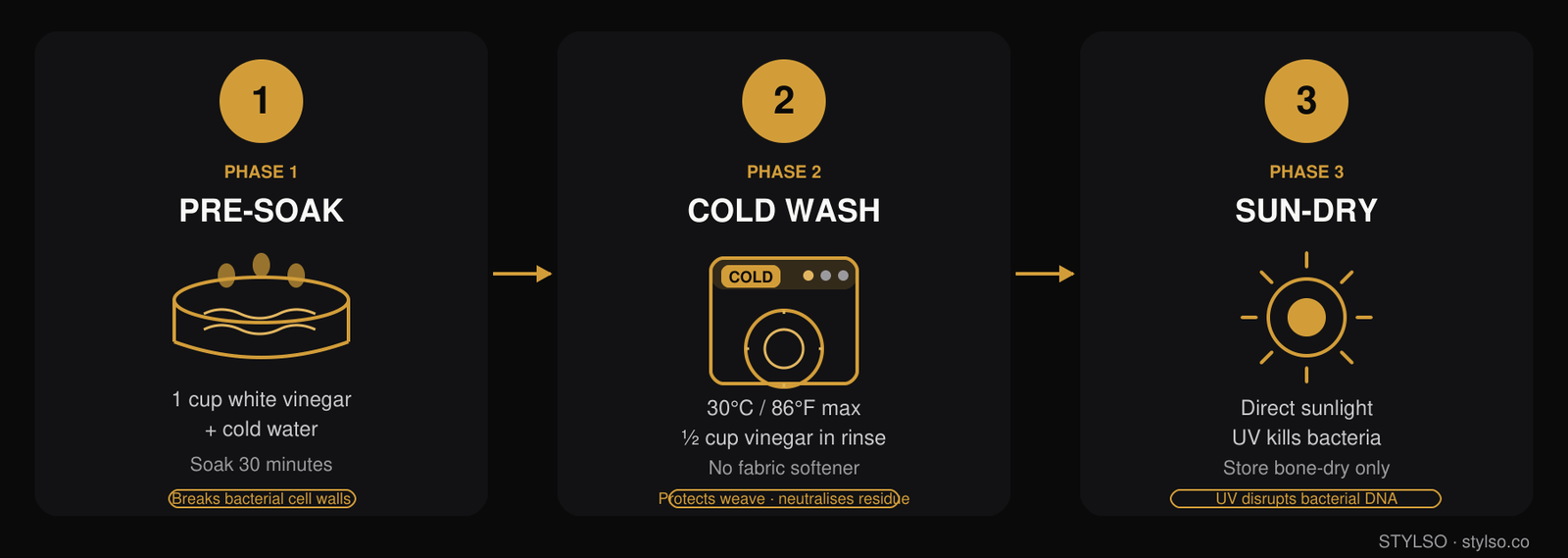
- Pre-soak in white vinegar + cold water. Fill a clean sink or tub with cold water. Add 1 cup of plain white vinegar. Submerge the gi and leave it 30 minutes. White vinegar’s acidity (around pH 2.4) disrupts bacterial cell walls — the same chemistry that makes it a standard kitchen sanitiser. You won’t smell vinegar once the gi dries.
- Wring it out without rinsing. Keep the vinegar working through the fabric. Wring it and go straight into the machine.
Phase 2 — Clean It Cold
- Machine wash on cold. Cold (30°C / 86°F or below) is just as effective on bacteria as warm — and it won’t shrink your gi the way heat does. If shrinkage is a concern, see our guide to stopping your gi from shrinking.
- Add ½ cup white vinegar to the rinse cycle. Pour it into the fabric-softener compartment. It rinses clean, neutralises soap residue that bacteria can hide behind, and leaves no smell.
- Skip the fabric softener entirely. Softener coats the weave fibers in a waxy layer — bacteria cling to it and survive the rinse. It also blocks moisture-wicking. Drop it from your gi wash for good.
Phase 3 — Kill It with Sunlight
- Air-dry in direct sunlight. UV light disrupts bacterial DNA — it’s a natural disinfectant that gets what the wash didn’t. Two or three hours in direct sun kills the bacteria that survive the cycle. Hang the gi flat or on a rack. Never store it until it’s completely dry: collar, lapels, inside the sleeves. Damp storage restarts everything.
| Phase | What to Do | Why It Works |
|---|---|---|
| Pre-Soak | 1 cup white vinegar + cold water, 30 min | Disrupts bacterial cell walls before washing |
| Cold Wash | 30°C max · ½ cup vinegar in rinse · no softener | Cleans without shrinking; neutralises residue |
| Sun-Dry | Direct sunlight · bone dry before storing | UV kills surviving bacteria; prevents mildew |
3 Habits That Keep Bringing the Smell Back
Fix the 7 steps above and these habits will undo it all. Drop them first.
Washing on hot. Hot water (above 40°C) doesn’t kill more bacteria than cold in a home washing machine — contact time and dilution are the same either way. What it does is shrink pearl weave and stress reinforced stitching over time. Cold, every time.
Using fabric softener. It feels wrong to skip, but the waxy coating it deposits is exactly what bacteria need to survive a rinse. Softener also makes the gi less breathable, which means more sweat transfer, which means more smell. Drop it.
Storing with any moisture left. The bacteria that survived the wash finish their work in the dark. Even a slightly damp collar is enough. Make sure the gi is completely dry — every seam, every lapel — before it goes anywhere but an open drying rack.
A Rashguard Reduces Gi Smell (Here’s Why)
A rashguard under your gi creates a physical barrier between your skin and the fabric. Your sweat wicks into the rashguard; the gi picks up less direct bacterial contact. Most people who start using one regularly notice their gis need the deep vinegar treatment less often.
Wrestling, judo, and MMA athletes use rash layers specifically for this reason — not just for comfort, but as a hygiene layer. Judo players in particular figured this out early: tournament gis go through brutal washing conditions, and a rash layer protects both the gi and the skin underneath. The principle is the same whether you’re rolling BJJ or drilling uchi-mata. Fewer bacteria on the gi means fewer on you, and fewer entry points for mat staph.
It also covers small mat abrasions that bacteria can enter through. One layer, two problems handled.
If you’re starting fresh, a Stylso pearl-weave gi washed right from day one stays fresh far longer than one that gets bacteria baked into the weave early. Check the current price on Amazon and build the habits in from the start.
Shop Stylso Men’s Gi on Amazon
For rashguard picks, read our full guide: Best Rashguard for BJJ.
Free: BJJ Gi Care Checklist
A one-page printable — the 7 wash steps, the 3 habits to drop, and a 4-week tracker so your gi never goes sour again. Get it instantly.
FAQ
How long should I soak my gi in vinegar?
30 minutes in cold water with 1 cup of white vinegar. A full hour won’t hurt if you forgot about it — but 30 minutes is enough for the acidity to work through the fabric.
Will white vinegar damage my BJJ gi?
No. Diluted white vinegar (1 cup to a sink of cold water) is safe for cotton and pearl-weave blends. Rinse it through the machine cycle and it won’t leave a smell or weaken the fabric. Avoid pouring undiluted vinegar directly onto coloured embroidery or patches — the acid can lift the dye.
Does baking soda help with gi smell?
It works as a booster, not a replacement. Add half a cup to the drum with your detergent on a bad-smelling gi — it raises the wash’s odour-neutralising capacity. Use it alongside the vinegar soak, not instead of it.
Can I use bleach on a BJJ gi?
Not on a coloured gi — bleach destroys dyes and weakens cotton fibers over time. On a white gi with stubborn mould-type smell that won’t shift with vinegar, a diluted chlorine bleach soak is sometimes the only fix. Use it sparingly and accept it shortens the gi’s life. Vinegar first; bleach is the last resort.
How often should I wash my BJJ gi?
After every training session. Every single one. Even a light drill session transfers bacteria to the fabric. The “I’ll get it after the next class” rule compounds fast into the problem you’re trying to solve.
My gi still smells after all this — what now?
Try a longer pre-soak: 1–2 hours with 2 cups of vinegar instead of one. If the smell concentrates in the collar or armpit seams, make a paste of baking soda and a small amount of water, work it into those spots, leave 20 minutes, then run the full 7-step process. Persistent mould-type smell on a white gi may need a diluted bleach soak. After 2–3 years of hard training, a gi whose smell won’t shift may simply need replacing — some odours set too deep to shift.