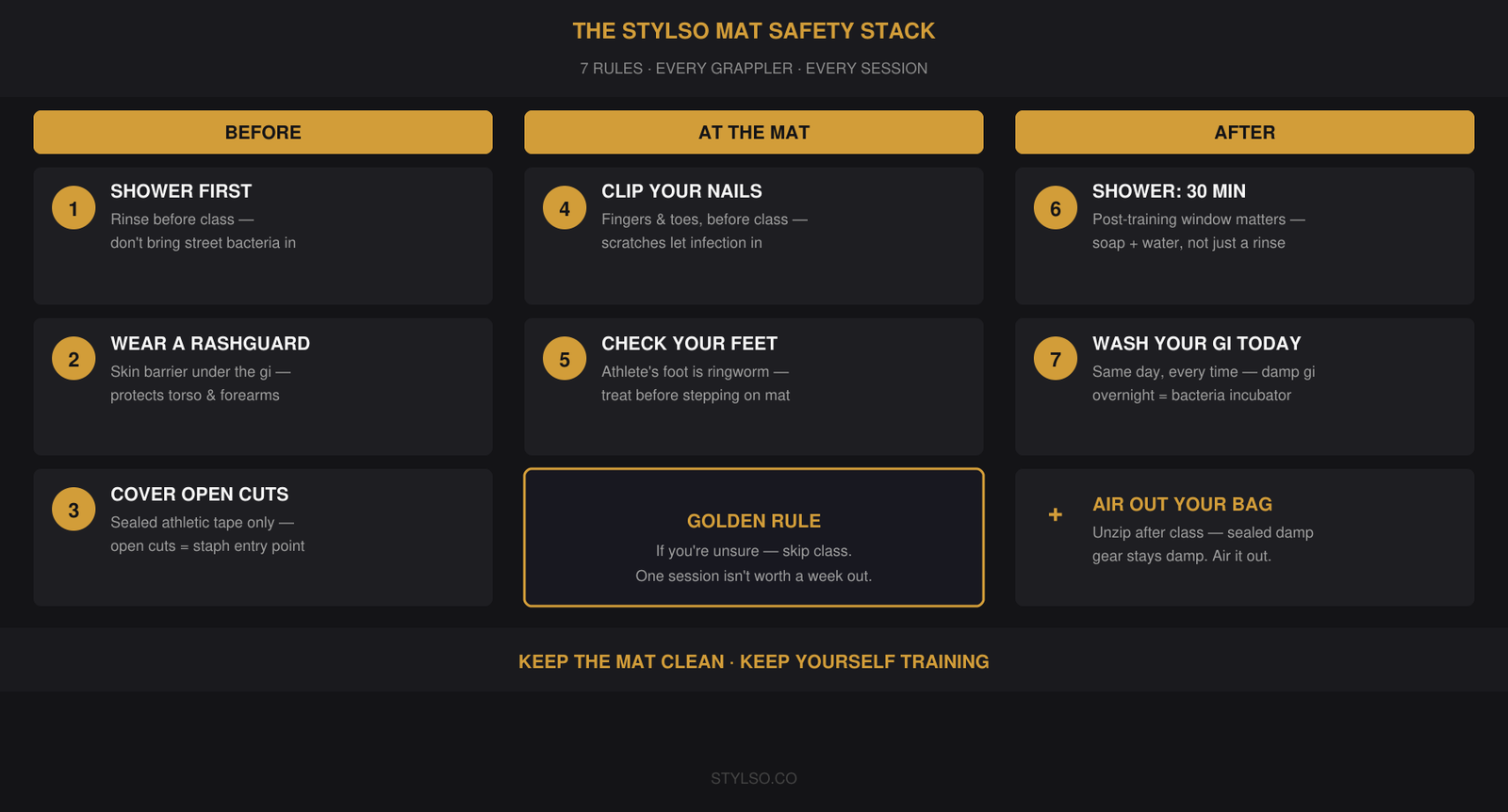
Good BJJ mat hygiene comes down to seven rules: shower before and after training, wear a rashguard under your gi, cover any open cuts with sealed tape, clip your nails, wash your gi the same day you train, and never step on the mat if your feet show signs of athlete’s foot. Seven habits. Every session.
Why Skin Infections Hit BJJ Players Hard
You don’t think about the mat until you can’t train. That’s usually ringworm week.
Here’s what nobody tells you at your first class: grappling arts rank among the highest-risk sports for skin infections — not because grapplers are dirtier, but because of the contact. In any five-minute round, your skin touches your partner’s skin dozens of times: forearms, necks, hands, shoulders. Ringworm, staph, and impetigo don’t care how technical your game is. They just need a pathway in.
Wrestling and judo coaches figured this out decades ago. Serious wrestling programs call it “mat hygiene culture” — every team develops its own cleaning rituals, and the gyms that hold the line lose far fewer athletes to infections. Most BJJ gyms are still building that culture. That’s your responsibility to fill in.
The good news: the rules are simple, they’re consistent across every grappling sport, and they actually work.
The Stylso Mat Safety Stack: 7 Rules
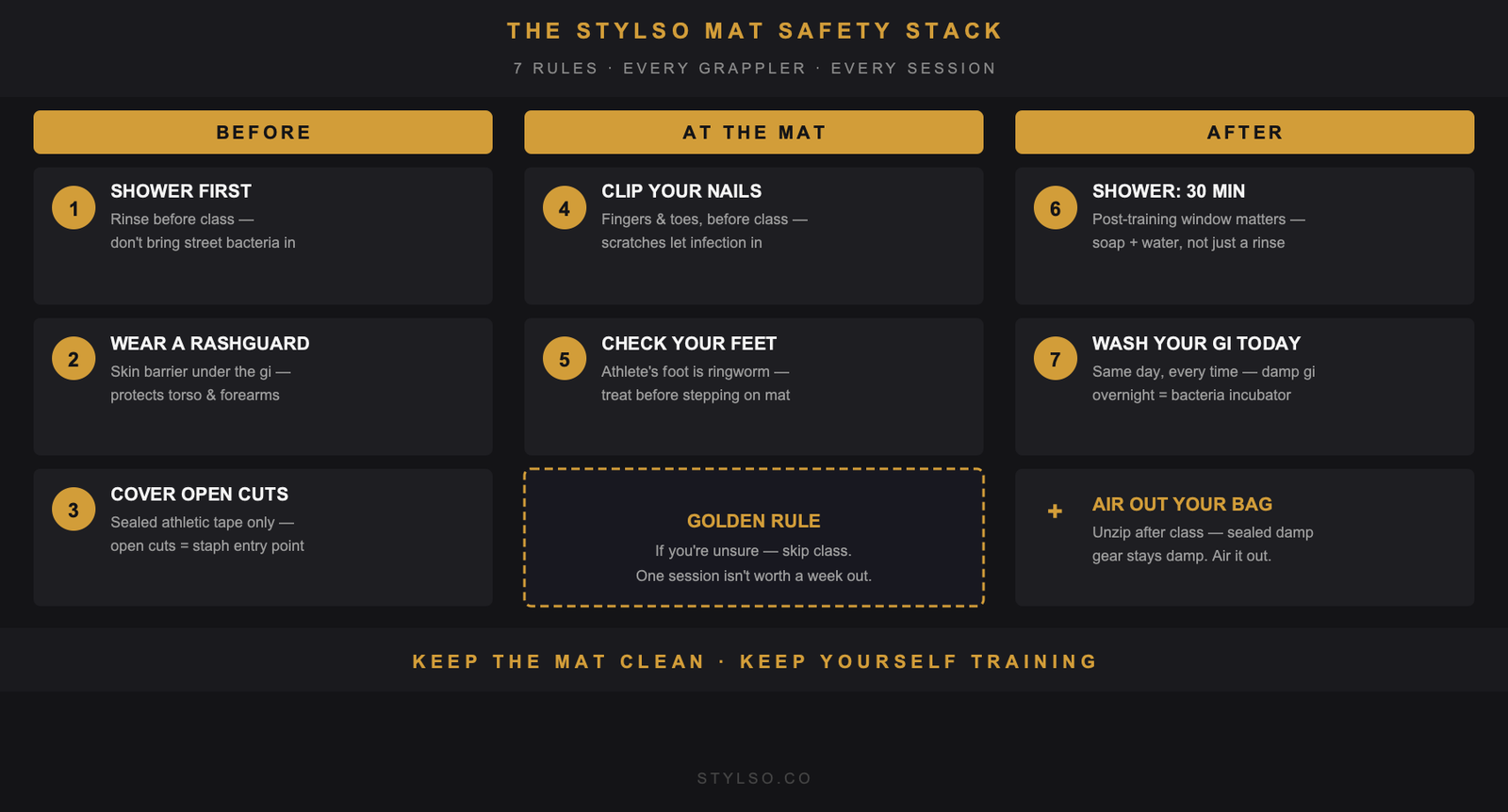
Rule 1: Shower Before You Train
This one gets skipped most because it feels backwards. You’re about to sweat — why shower first? Because the bacteria on your skin after a commute, a gym session, or a day at work don’t belong on your training partners’ skin. A three-minute rinse before class cuts that transfer significantly. Old-school wrestling coaches call this “arriving clean” — it’s the first rule in every serious grappling room.
Rule 2: Wear a Rashguard Under Your Gi
A rashguard isn’t just for no-gi. Under the gi, it creates a fabric barrier between your skin and your partner’s skin — especially on your torso and forearms, the highest-contact zones. It also keeps your gi cleaner between the fabric layers. If you’re a beginner wondering whether it’s worth it: yes. A good rashguard is one of the cheapest injury-prevention tools you’ll own.
Shop on Amazon — Stylso Men’s Gi
Rule 3: Cover All Open Cuts Before Class
You’ve got a split knuckle. You’re tempted to tape it and go. You should — but the tape needs to actually seal it. An open wound on the mat is a direct entry point for staph. Athletic tape works well for finger cuts; see our full guide on how to tape fingers for BJJ for the three methods that hold through a full round. If a cut is too deep to seal cleanly, skip class. It’s one session.
Rule 4: Clip Your Nails (Fingers and Toes)
Short nails are a grappling courtesy, not just a personal preference. Long fingernails scratch skin during grip work; long toenails catch in the mat or tear a partner’s skin during guard passes. Small cuts from nails are exactly where staph and ringworm take hold. Two minutes before class. Every time.
Rule 5: Check Your Feet
Spend ten seconds before stepping on the mat looking at your feet. Athlete’s foot (tinea pedis) is the same fungal species as ringworm — it just colonises between your toes first. It spreads through mat contact. If you notice flaking skin, redness, or itching between your toes, treat it before you train. Over-the-counter antifungal cream clears most cases in one to two weeks. Don’t rush it back — you’ll spread it and end up out longer.
Rule 6: Shower Within 30 Minutes of Training
The 30-minute window matters. After training, there’s a relatively short time before bacteria from mat contact can take hold on your skin. Shower — with soap, not just a rinse — within 30 minutes of stepping off the mat. Don’t wait until you get home. Keep a small bag in your gear kit with a travel-size soap and a towel. Judo players at the national level get told this on their first day. Same rule, same reason.
Rule 7: Wash Your Gi the Same Day. No Exceptions.
Not tomorrow. Same day, same night. A damp gi sealed in a bag overnight is one of the best bacterial incubators you’ll ever accidentally build. The population of microorganisms on a sweaty gi can multiply fast enough to cause infections on your next wear. Cold wash with good detergent is fine — it’s consistency, not temperature, that matters most. Check our full routine in the BJJ gi cleaning guide if you’re dealing with persistent odour or stiffness after washing.
The Gear That Makes Hygiene Easier
Good habits carry most of the weight. But the right gear removes friction and adds a second layer of protection.
| Gear | What It Does | Why It Matters | Shop |
|---|---|---|---|
| Clean gi (pearl weave) | Primary fabric barrier every session | Stops bacteria transfer through fabric; IBJJF-approved | Shop on Amazon |
| Rashguard (under gi) | Skin barrier on torso + forearms | Reduces direct skin-to-skin contact in the highest-risk zones | Best rashguard guide |
| Athletic finger tape | Seals cuts and split skin | Prevents staph entry; also protects finger joints | — |
| Mesh or vented gym bag | Airflow after training | Stops moisture buildup in gear between sessions | — |
Shop on Amazon — Stylso Men’s Gi
What Wrestling and Judo Teach About Mat Culture
Every close-contact combat sport has its own version of these rules. In wrestling, coaches track skin infection outbreaks carefully — a ringworm case in a team can sideline multiple athletes before a tournament. Most serious wrestling rooms have a posted hygiene protocol and a culture where showing up unclean or with an open cut gets you sent home, no argument.
Judo has the same “shower before and after” standard at serious clubs. In Japan, it’s not even discussed — it’s just what you do before you bow onto the mat.
BJJ is younger as a competitive sport, and many gyms — especially newer ones — haven’t built that culture yet. You don’t have to wait for the culture to build around you. Seven habits, applied every session, protect you regardless of what the gym next to you is doing. Also worth reading: our BJJ injury prevention guide covers the training-load side of staying on the mat.
Key Takeaways
- Shower before training — don’t bring street bacteria onto the mat
- Wear a rashguard under your gi for a skin barrier on high-contact areas
- Seal every open cut before class; skip class if you can’t seal it properly
- Clip nails before class, fingers and toes; check feet for signs of athlete’s foot
- Shower within 30 minutes of training — the window matters
- Wash your gi the same day, every session — damp gi overnight = bacteria incubator
- Air out your gym bag after every class — sealed damp gear stays damp
FAQ
How do I know if I have ringworm from BJJ?
Ringworm shows as a circular, red, scaly patch — usually on the torso, arms, or neck. It’s itchy and tends to have a slightly raised, ring-like border. If you see something like this, stop training immediately and see a doctor or pharmacist. It’s treatable with over-the-counter antifungal creams in most cases, but confirm the diagnosis first before treating.
Is mat cleanliness the gym’s job or mine?
Both. Gyms should clean mats with an approved disinfectant after every class — that’s their side of the deal. You’re responsible for your own body: showering, washing your gi, covering cuts, clipping nails. Your hygiene habits matter just as much as the mat cleaning, because person-to-person transfer during rolls happens regardless of how clean the surface is.
Can you get staph even from a clean-looking mat?
Yes. Staph often comes from skin-to-skin contact with a carrier — which is common and usually asymptomatic. A clean mat reduces the surface load, but it doesn’t stop person-to-person transfer during training. Your own hygiene habits are the line of defence that actually follows you everywhere on the mat.
Does cold water actually kill bacteria in a gi wash?
Cold water removes bacteria mechanically — the agitation and detergent do the real work, not the temperature. A cold wash with good detergent after every session beats a sporadic hot wash by a wide margin. If you’re fighting stubborn gi odour, an occasional warm wash plus an extra rinse cycle helps reset the fabric.
Should I use antifungal spray on my gi or rashguard?
Some grapplers swear by a diluted tea tree oil spray after washing. It can add antifungal protection to fabric, and it’s a reasonable supplement for high-volume trainers. It’s not a substitute for washing, though — spray on clean fabric, not as a shortcut to skip a wash.
What’s the single highest-impact hygiene habit?
Washing your gi the same day you train. It’s the one habit with the most direct impact on your skin health and on your training partners’. The 30-minute post-training shower is a close second. Both together are the baseline of every serious grappling hygiene culture — wrestling, judo, BJJ.
Free: The Stylso Mat Safety Stack Guide
A printable 7-rule checklist + gear reference for BJJ mat hygiene. Get it free — instant download.