For no-gi BJJ you need two things: a rashguard and a pair of shorts or spats. That’s it. Most beginners show up with way too much — or the wrong stuff. Here’s the honest list so you spend your money on gear that actually helps on the mat.
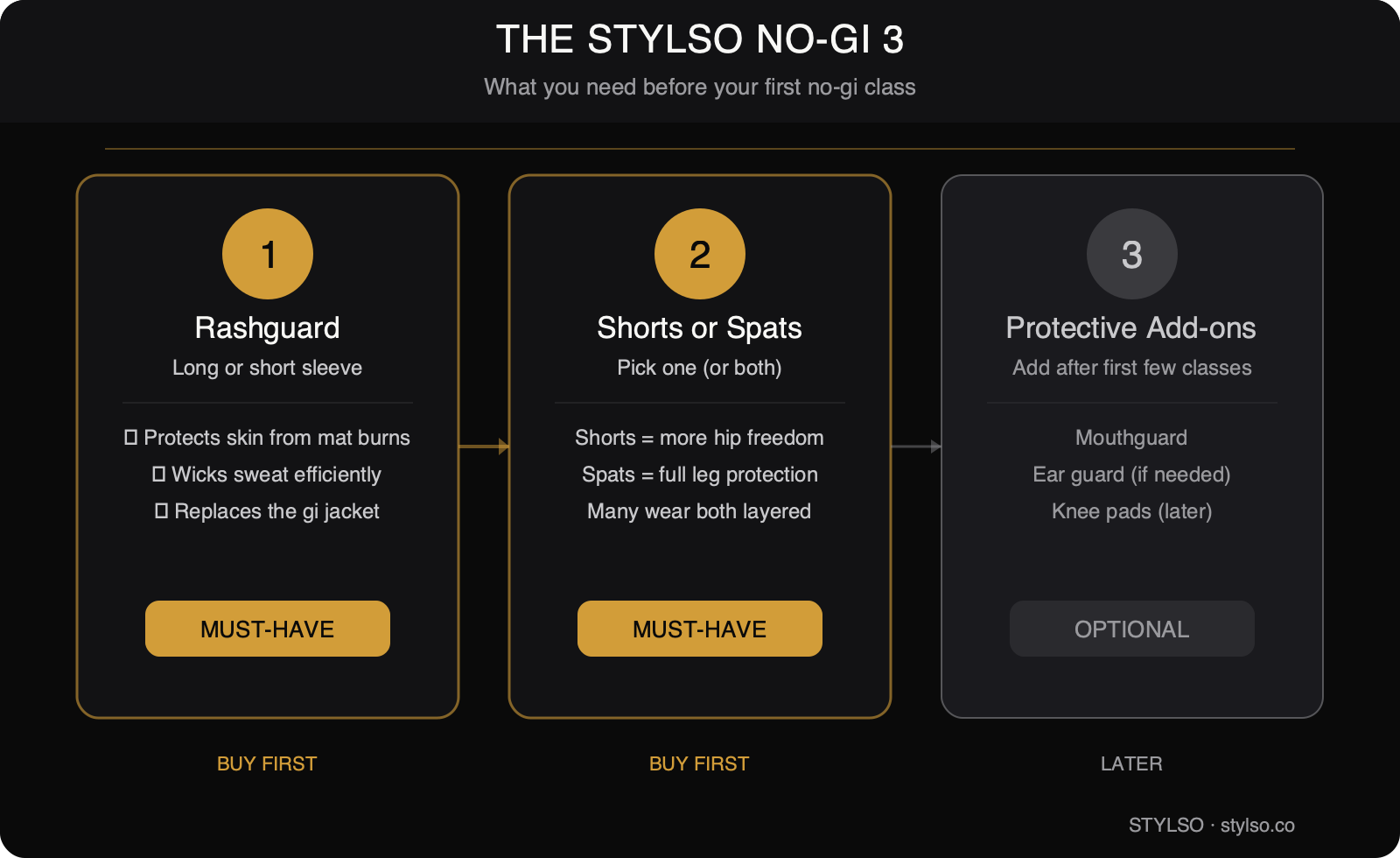
- A rashguard (long or short sleeve) is your first buy — it protects your skin and replaces the gi jacket.
- Shorts or spats (or both) cover the bottom half — pick based on how you train.
- Everything else — mouthguard, ear guard, knee pads — can wait until after your first few classes.
Stylso — BJJ gis and combat-sports apparel.
Why No-Gi Gear Is Simpler Than You Think
Your first no-gi class feels different. No lapels to grip, no belt to tie. Just you, a mat, and a partner who’s about to show you something humbling.
The gear should match that simplicity. Wrestlers have trained in compression shorts and tight tops for over a hundred years. No-gi borrowed the same logic — minimal fabric, nothing to grab, maximum movement. You don’t need a gear bag full of stuff. You need two items that fit right and can take a few hundred mat sessions.
Here’s what nobody actually tells you: you can walk into your first no-gi class in a plain gym rashguard and athletic shorts, and you’ll be fine. The “no-gi gear” category exists mostly to sell you branded versions of things you may already own. What matters isn’t the brand — it’s the fit, the seam quality, and whether the shorts restrict your guard work. That’s it.
The No-Gi Gear Checklist: Item by Item
| Item | Why You Need It | What to Look For | Shop |
|---|---|---|---|
| Rashguard | Protects skin, wicks sweat, gives grip reference without a gi | Flatlock seams, compression fit, long or short sleeve | Shop on Amazon |
| No-Gi Shorts | Free hip movement, no fabric to snag | No pockets, no belt loops, soft inner liner, stretchy waist | Shop on Amazon |
| Spats (optional) | Full leg coverage, fewer mat burns on shins and knees | Compression fit, four-way stretch, worn under shorts or solo | Shop on Amazon |
Two items. That’s the whole list to start.
Rashguard First — Here’s Why It’s Non-Negotiable
The rashguard does three things your skin can’t. It covers abrasions before they happen. It pulls sweat away so you don’t slide out of grips at the worst moment. And it gives your training partner reference points — a wrist, a shoulder — even without a gi collar.
Long sleeve or short? Here’s a real answer. Long sleeve protects your elbows and forearms from mat burn — common in the first few months when you’re still learning how to fall. Short sleeve is cooler in a hot gym and perfectly fine once you’ve got your breakfalls sorted.
Before you buy, check the seams. Flatlock stitching — where the seam lies flat against the skin — is what you want. Raised overlocked seams will rub your elbows raw by the third round, every time. It’s a five-second check that saves you real pain.
Compression fit means the rashguard should feel snug but not restrictive. If you can pinch a fistful of fabric away from your body, go down a size. If you feel it pulling across your shoulder when you reach, go up.
See the full breakdown: Best Rashguards for BJJ.
Shorts vs Spats: The Honest Answer
This is the question every beginner asks. Here’s what experienced grapplers actually do.
Shorts give more freedom. If you play open guard, butterfly guard, or any style with a lot of active hip movement, shorts won’t restrict you. They also feel natural at first — you’ve been wearing shorts your whole life.
Spats protect more. They cover the knees, thighs, and calves against mat burns — common when you’re drilling takedowns, shooting single-legs, or doing ground-and-pound defence. A lot of experienced no-gi players wear both: spats underneath, shorts on top.
Start with shorts. Add spats after your first month if mat burns are bothering your shins and knees.
Try the pull test before committing. Step into a deep lunge. If the shorts pull tight at your hip crease — cutting off your hip extension — they’re too small or the wrong cut. That hip restriction will cost you your guard position at exactly the wrong moment. On the mat, tight shorts equal limited options. Don’t find that out mid-roll.
More detail: BJJ Spats vs Shorts for No-Gi and Best BJJ Shorts for Training.
The Stylso No-Gi 3: A Visual Checklist
What You Can Skip (For Now)
Mouthguard — you’ll want one eventually. Start training, see how hard your gym drills. A simple boil-and-bite from a sporting goods store is fine to start. You’ll know when you want an upgrade.
Ear guard — wait until you actually feel your ears. Cauliflower ear takes time to develop, and not everyone gets it. Don’t buy gear for a problem you don’t have yet. See: Best BJJ Ear Guards.
Knee pads, ankle braces, finger tape — these come after you figure out your body’s weak spots. Your training will tell you what you need. Buying them on day one just means they sit in a bag unused while you discover what actually bothers you.
A Wrestling Lesson Worth Knowing
Wrestlers have a word for the first thing you notice in no-gi: scramble. Without a gi to grip, position changes faster. Every time you lose the back, the other person can slip out in a way they couldn’t with a collar. Every guard pass is contested differently.
The gear lesson from wrestling? Less is more. Tight, flat-seamed compression gear means nothing snags during a scramble. Nothing for your opponent to grab. Wrestlers train this way for exactly that reason — clean mat work starts with clean gear. No floppy fabric. No belt knots. Just movement.
So don’t overthink the shopping list. A rashguard, a pair of shorts or spats, and you’re ready to scramble.
Free: BJJ No-Gi Gear Checklist PDF
A one-page printable — the Stylso No-Gi 3, the pull test, and the gear priority list. Get it free.
Key Takeaways
- Start with a rashguard and one pair of shorts or spats — that’s your whole no-gi kit.
- Check for flatlock seams and do the lunge test before buying shorts.
- Skip the extras until your training tells you what your body actually needs.
FAQ: No-Gi Gear for Beginners
What gear do I need for no-gi BJJ?
The essentials are a rashguard (long or short sleeve) and a pair of no-gi shorts or spats. That’s it. Everything else — mouthguard, ear guard, knee pads — is optional and can wait until you’re training regularly.
Do I need special shorts for no-gi BJJ?
Not specifically “BJJ shorts” — but you do need shorts without pockets, belt loops, or zipper pulls. Board shorts with a soft inner liner work well. MMA shorts are also popular. Regular gym shorts aren’t ideal because the extra fabric gives your partner something to grab.
Can I wear a regular compression shirt instead of a rashguard?
You can to start, but a proper rashguard holds its shape better, lasts longer on the mat, and has flatlock seams to prevent abrasion. It’s worth the upgrade once you know you’ll keep training. See: BJJ Rash Guard vs Compression Shirt.
Do I need spats for no-gi?
No, not at first. Shorts are fine to start. Add spats when mat burns on your shins and knees become a regular annoyance — usually after your first month of regular training.
Can I wear my gi pants to a no-gi class?
Most gyms won’t allow it — the drawstring and fabric give too much to grab. Check with your gym first, but standard advice is no-gi shorts or spats only.
How do I wash no-gi gear?
Cold water, gentle cycle, hang to dry. Never a hot dryer — it degrades the compression fabric and breaks down the seams faster. Wash after every session. See the full guide: How to Wash a BJJ Rashguard.