Ten years in. Your technique is there before your brain catches up. You’ve worn through at least two gis — maybe four. And your current one, the one you’ve been rolling in for the past year, has a frayed collar and knees soft enough to pass through airport security. It earned that. Now it’s time to replace it.
Here’s what most people searching “best BJJ gi for black belts” miss: the question has changed from when you were a white belt. You’re not buying your first gi. You’re buying your next one. And that means the priorities are different.
What Actually Changes at Black Belt
At white belt, you needed something that fit, washed well, and didn’t fall apart in the first six months. Any decent gi did the job.
At black belt, you train more often. You might compete more seriously. And after a decade on the mat, your body isn’t the same shape it was when you first bought a gi. Most black belts need two gis — not out of vanity, but because competition and daily training are genuinely different jobs that need different tools.
Here’s the part nobody mentions in most buyer’s guides: a lighter competition gi worn every day in the dojo burns out fast. You’re slamming it against the mat multiple times a week, washing it constantly, drilling collar grabs for an hour straight. That gi shows up to your next tournament tired and worn. The right move is a dedicated daily trainer that takes the punishment, and a lighter gi you save for competition week.
The Three Black Belt Gi Profiles
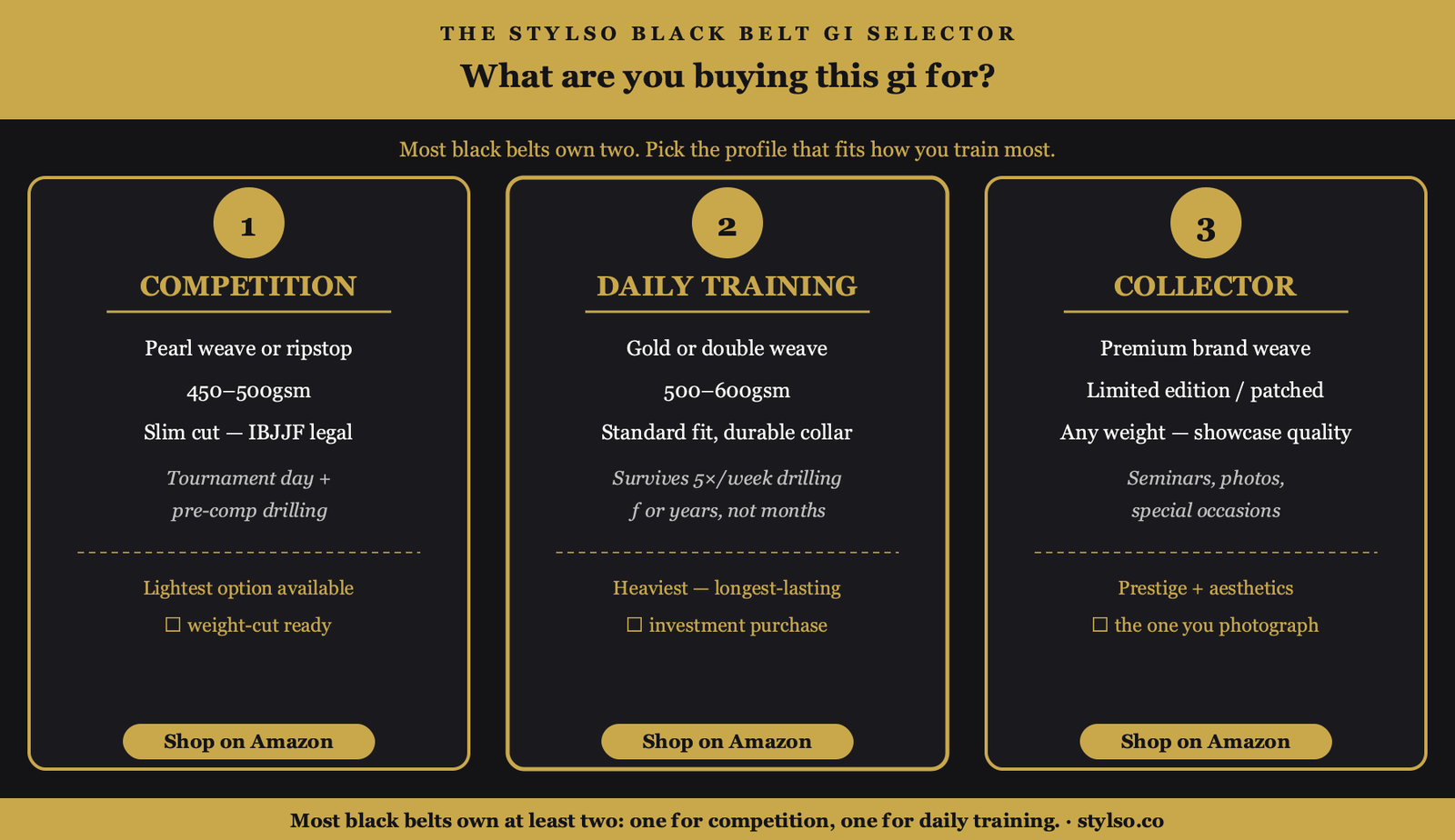
1. Competition
Pearl weave or ripstop, 450–500gsm, slim cut. Built for one job: tournament day. Every gram trimmed without losing IBJJF compliance. Narrow lapels to reduce your opponent’s collar grip. Pre-shrunk so you know your weight-class window before you register.
Don’t drill in it daily. Save it. Two tournament cycles per year, maybe three — it’ll outlast your competition career.
Shop Competition Gis on Amazon
2. Daily Training
Gold weave or double weave, 500–600gsm. Built to survive. You’ll put this through 200+ washes, 500+ sessions, and the kind of daily collar grinding that wears through cheaper fabric in under a year. A heavier gold weave collar holds its shape longer. The knees and seat are reinforced. This is the workhorse.
It’s heavier, yes. That’s by design. Training in a heavier gi builds your collar defence — more grip surface for your training partners means more reps developing your break. Switch to the lighter competition gi a week out from a tournament and you’ll feel immediately faster.
3. Collector
Limited edition, premium branding, any weight. You know the one — the gi you bought for a seminar or pulled out for a photo. Maybe it’s a colourway you can’t get anywhere else, or a gi from a brand that’s discontinued the design. It’s not your workhorse. It’s the one you keep nice.
Buy it if something genuinely calls to you. Don’t buy it expecting daily performance — that’s not what it’s for.
Gi Comparison: Black Belt Profiles
| Profile | Weave | Weight | Best For | Fit Note | Shop |
|---|---|---|---|---|---|
| Competition | Pearl / Ripstop | 450–500gsm | Tournaments, weight cuts | Slim — fewer collar handles | Shop on Amazon |
| Daily Training | Gold / Double | 500–600gsm | Hard daily drilling | Standard — survives collar grabs | Shop on Amazon |
| Collector | Any premium | Varies | Seminars, photos | Any — aesthetics first | Shop on Amazon |

The Judo Lesson — Weave Weight Is a Grip Strategy
Here’s something judo players figured out decades before BJJ black belts started talking about it.
In judo, the switch from a heavy training gi to a lighter competition gi isn’t just about weight class. It’s a grip decision. A lighter gi collapses in your opponent’s fist — they get less friction, less leverage, less to work with. A heavier gi gives them more surface, more structure, more to attack.
Smart judo competitors train in heavier gis on purpose. They build grip defence on the hard version, then compete in the easy version. Their hands know how to break grips from a heavier collar — the lighter collar feels almost slippery by comparison.
This works in BJJ too. Train daily in your gold weave trainer. Drill collar breaks and lapel grips until your hands are fast. Then wear your lighter competition gi to a tournament. You’ll feel the difference — and so will your opponent.
The drill: next training session, focus on break grips against a partner wearing a heavier gi. Then try the same breaks against a lighter rashguard. Notice how your timing adjusts. That’s the muscle memory you want going into competition.
Re-Measure Before You Buy
If you’ve been training for ten or more years, your body has changed. Most black belts have added shoulder and lat muscle while leaning out through the waist. An A2 that fit at white belt might now need an A2L (long) for shoulder room, or a trim-cut A3 if your frame lightened.
Measure chest circumference, height, and weight fresh. Every brand sizes differently — the sizing chart on Amazon is your guide, not what you remember ordering four years ago. A gi that doesn’t fit right is a gi you don’t wear.
| A-Size | Height (approx) | Chest (approx) | Weight (approx) |
|---|---|---|---|
| A1 | 5’5″–5’7″ | 34–38 in | 130–165 lbs |
| A2 | 5’6″–5’9″ | 38–42 in | 155–185 lbs |
| A3 | 5’9″–6’0″ | 42–46 in | 180–210 lbs |
| A4 | 5’11″–6’2″ | 46–50 in | 210–250 lbs |
| A2L | 5’9″–6’1″ | 38–42 in | 155–185 lbs (longer torso) |
Always check the specific brand’s chart on Amazon — these figures are starting points only.
Free: Black Belt Gi Buying Checklist
Competition vs. daily training vs. collector — a one-page printable that helps you buy the right gi without second-guessing.
Key Takeaways
- At black belt, split your gi between two jobs — competition (light) and daily training (durable)
- Competition gi: pearl weave or ripstop, 450–500gsm, slim cut, IBJJF legal — save it for tournament week
- Daily trainer: gold or double weave, 500–600gsm — takes the daily punishment so your competition gi stays fresh
- Training in a heavier gi builds faster break grips — the lighter competition gi feels easier on tournament day
- Measure fresh — ten years of training changes your body; don’t order from memory
- Never train in cotton — synthetic only; cold wash, hang dry, no tumble dry
For more on the belt-level gi series, see our brown belt gi guide and purple belt gi guide. If you’re heading to a tournament, our competition gi breakdown goes deeper on IBJJF legal specs. For a full view of how the belt system works, see our BJJ belt ranking guide.
Frequently Asked Questions
What gi do most BJJ black belts use?
Most black belts use different gis for different purposes — a lighter pearl weave or ripstop for competition, a heavier gold or double weave for daily training. Brand preferences vary, but the competition/training split is nearly universal at this level.
Do black belts need a lighter gi for competition?
Yes. A lighter gi (450–500gsm pearl weave or ripstop) keeps you closer to your weight class and reduces the grip surface on your lapel. For daily training, a heavier, more durable gi usually makes more sense — it outlasts a lighter gi by years of intensive use.
Should a black belt gi be IBJJF approved?
If you compete in IBJJF events, yes — check lapel thickness, sleeve length, and patch placement before tournament day. For gym training, IBJJF rules don’t apply. Many competition gis advertise IBJJF compliance; verify against the current rulebook for your division.
Can a BJJ black belt wear any gi colour?
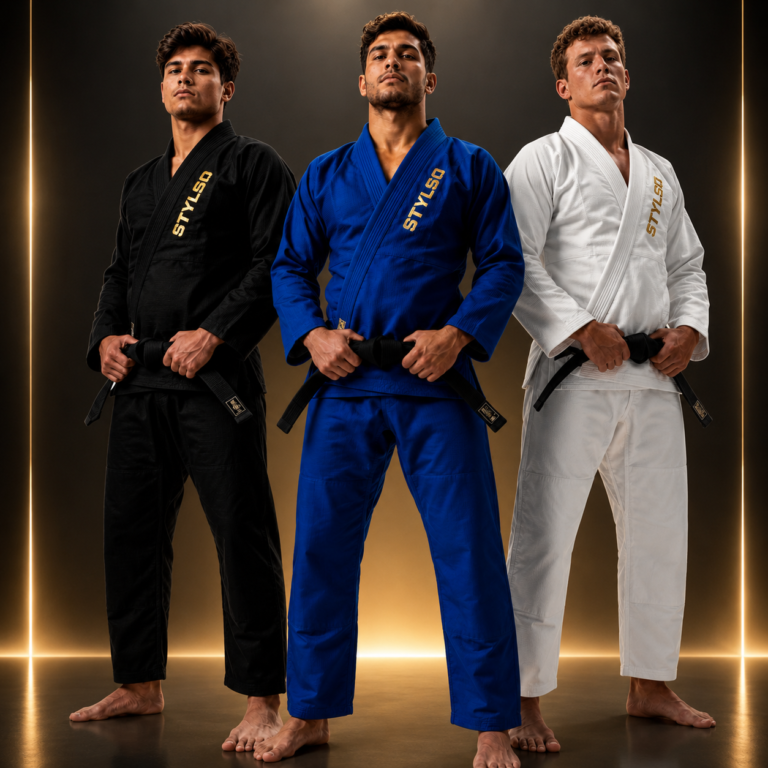
In class, most academies allow any colour at black belt — the belt signals rank. For IBJJF competition, gi colour rules still apply (white, blue, or black). Check your specific event rules before ordering a non-standard colour for competition use.
How long should a black belt BJJ gi last?
With proper care — cold wash, hang dry, no tumble drying — a quality gi worn 3–4 times per week should last 2–4 years. Heavier weaves (gold, double) outlast lighter competition gis. The collar and knees wear first; inspect those when evaluating a gi’s condition.
Is it worth owning two gis at black belt?
Yes. A dedicated daily trainer takes the punishment. A dedicated competition gi shows up fresh on tournament day. Using one gi for both shortens its life and means you’re competing in a tired gi. Most black belts who train seriously end up here naturally — it’s practical, not extravagant.
Stylso — BJJ gis and combat-sports apparel. About us.