You bought the gi. You picked your gym. Now where does your training gear actually live?
Most grapplers just throw everything into whatever bag they own. That works — until a soaking-wet gi sits in a regular backpack for four hours and turns into a mold experiment. Or until you show up to class and realise your belt is still at home. Neither scenario is fun.
A good BJJ gi bag isn’t luxury gear. It’s hygiene. It’s your gi lasting longer. It’s not hauling a dripping sleeve across your work laptop. Here’s the honest breakdown — three bag types, who each one’s right for, and how to pack one correctly.
What to Look For in a BJJ Gi Bag
Not every gym bag is built to carry a gi. Here’s what actually matters before you buy:
- Capacity: at least 40 liters. A gi, belt, rashguard, mouthguard, and a change of clothes take up real space.
- Wet/dry compartment: non-negotiable. Your soaked gi shouldn’t touch your clean clothes, phone, or electronics.
- Ventilation: mesh panels or a ventilated zip cut the smell — not eliminate it, cut it. The wet pocket does more work here than any air hole.
- Durable base: bags live on locker room floors and changing room benches. A reinforced bottom lasts years longer than a soft canvas base.
3 BJJ Gi Bag Types Compared
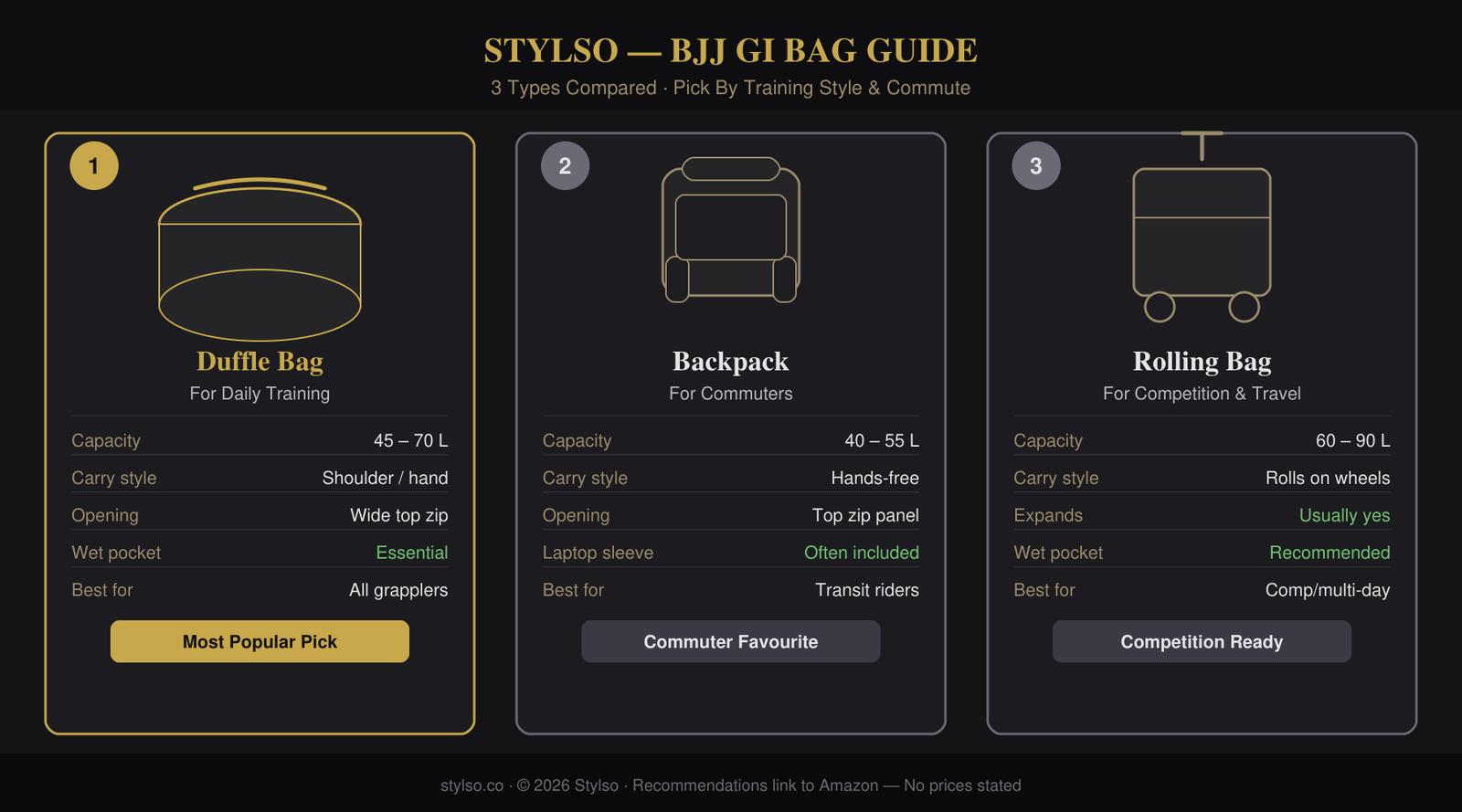
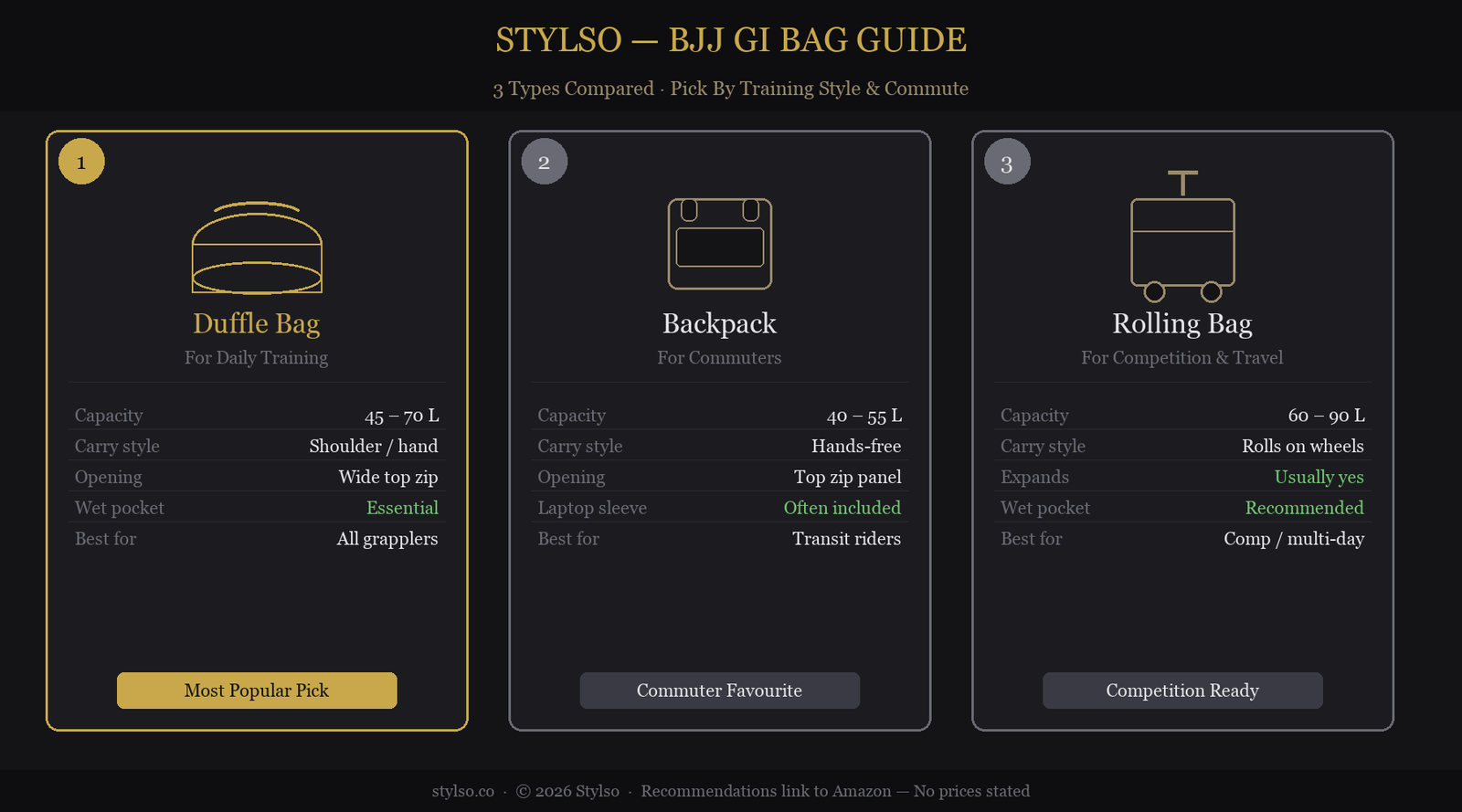
| Type | Best For | Capacity | Key Feature | Shop |
|---|---|---|---|---|
| Duffle Bag | Daily training, most grapplers | 45–70 L | Wide opening, easy pack/unpack | Shop on Amazon |
| Backpack | Commuters, cyclists, transit riders | 40–55 L | Hands-free, laptop sleeve included | Shop on Amazon |
| Rolling Bag | Competition trips, multi-day travel | 60–90 L | No shoulder strain, expands for big hauls | Shop on Amazon |
The Duffle Bag: The Default Pick
This is what most grapplers use — and it’s the right call for daily training. You can stuff a gi in fast, pull it out in seconds, and the wide-open top makes packing after class easy when you’re tired and just want to get out the door.
Look for 45 liters or more. Anything smaller and a gi plus belt plus spare rashguard plus water bottle gets tight fast. The best BJJ duffle bags have a separate wet compartment at the base — your soaked gi goes there, your clean gear stays clean.
One thing most duffle reviews skip: check that the straps are padded. A heavy bag on a bare shoulder from class to the car is just another injury waiting to happen on a tired body.
Shop BJJ Duffle Bags on Amazon
The Backpack: For Commuters and Cyclists
If you train before work or commute by bike or public transit, a backpack changes the game. You’re hands-free on the train, on the bike, in the elevator. Some BJJ-specific packs run 50 liters — big enough for a gi, laptop, and a change of clothes for after class.
The trade-off is access. A duffle opens wide; a backpack asks you to dig. That’s a minor inconvenience for most people. It gets more annoying when you’re rushing out after a hard roll and can’t find your belt in the dark bottom panel.
If you commute and train several days a week, a backpack is worth the trade-off. If you drive to training and park nearby, stick with a duffle.
The Rolling Bag: For Competition and Long Trips
You don’t need wheels for Tuesday night class. But pack for a two-day tournament — two gis, rashguard, gear, competition paperwork, food, hotel essentials — and the case for a rolling bag becomes obvious fast.
Wheeled bags take the shoulder load off completely. That matters when you’re competing at 8 AM and you’ve been up since 5. They also tend to expand — most roll out an extra zip panel that adds 20 more liters when you need it.
The downside: they’re bulky in a crowded gym or on a narrow train platform. For daily training, they’re overkill. For competition season, they pay for themselves in spared back and shoulder strain.
The Judo Lesson: How to Pack a Gi Bag Correctly
Here’s something most BJJ guides skip: judo players take bag packing seriously. In traditional judo culture, the gi is folded a specific way before going in the bag, and the obi (belt) wraps around it. The reason isn’t ceremony — it’s space and respect for the fabric. A gi that gets crumpled into a bag every session breaks down faster at the collar and sleeve seams.
Here’s the same idea, updated for BJJ: the Stylso Gi Packing Method.
- Fold the jacket in half — collar to collar — then fold the sleeves flat across the back.
- Roll the pants from waist to ankle. Rolling takes up less space than flat-folding and reduces creasing on the knee reinforcement panels.
- Place the belt on top, loosely coiled. It’s your visual check that everything made it into the bag before you zip up.
- Wet gear goes in last, into the dedicated wet pocket — never the main compartment.
Four steps. Your gi arrives at the next session in decent shape, and your bag doesn’t smell like a changing room left in the sun.
Bag Size Guide: What Fits Where
| Bag Size | What It Holds | Best Match |
|---|---|---|
| 40–44 L | 1 gi + belt + rashguard + small extras | Light commuter, solo sessions |
| 45–59 L | 1–2 gis + belt + rashguard + change of clothes + water | Most daily training setups |
| 60–90 L | 2+ gis + full gear + travel essentials | Competitions, seminars, multi-day travel |
Free: BJJ Gi Bag Packing Checklist
The Stylso 4-step packing method plus a full training-day gear checklist — one printable page. Never leave your belt at home again.
What to Pair With Your Bag
Once the bag is sorted, the rest of your gear kit comes together quickly. If you’re still picking a first gi, the beginner gi guide covers fit, weave, and what actually matters when you’re just starting out. For a full kit list — gi, belt, rashguard, mouthguard, ear guard — the white belt gear list breaks down what to buy first and what can wait.
If you’ve got kids training, the kids’ gi size guide and the kids’ gi guide cover sizing by weight class with real Stylso K-series measurements. The Stylso kids’ gi is available on Amazon — worth looking at if you want matching brand kit for the whole family.
Shop the Stylso Kids’ Gi on Amazon
Key Takeaways
- You need at least 40 liters. Less than that and a full training kit doesn’t fit comfortably.
- A wet compartment isn’t optional — it protects your clean gear and slows down mold growth in the gi.
- Duffle for daily training. Backpack for commuters. Rolling bag for competition.
- Fold the jacket, roll the pants, belt on top, wet gear in the pocket. Four steps, sorted.
- Check the current price on Amazon — prices shift, so skip any guide that quotes a specific dollar amount.
Frequently Asked Questions
What size bag do I need for BJJ?
Most grapplers do well with 45–60 liters. That holds a gi, belt, rashguard, mouthguard, change of clothes, and a water bottle with room to spare. Go bigger (60L+) if you compete regularly or travel to seminars — those trips add a lot of gear.
Do I really need a wet compartment in a gi bag?
Yes. A soaked gi sitting against your clean clothes for even two or three hours can start mold growth. The wet pocket keeps moisture contained and stops the smell from spreading to the rest of the bag. It’s the single most important feature — more than the brand name or price tag.
Can I use a regular gym bag for BJJ?
You can, but most generic gym bags are under 35 liters — too small for a full kit once you include the gi. The bigger problem is usually no wet compartment. If your bag has at least 40L and a way to isolate wet gear, it’ll work fine. Features beat labels here.
How do I stop my gi bag from smelling?
Empty it every single time you get home. Don’t let the wet gi sit overnight — take it out, hang it to dry, then wash it within a day or two. Leave the bag zipper open to air out. Washing the bag itself every few weeks helps. If your bag still smells after that, the problem is the gi — the gi smell guide covers exactly that situation.
What’s the best BJJ bag for competition?
A rolling/wheeled bag, 60L or more. Competition days are long — you arrive early, wait through brackets, warm up multiple times, and end up carrying gear across a big venue. Taking the load off your shoulders before you step on the mat is worth it. Look for one with an expandable panel for extra room and a telescoping handle that locks in place.
What’s the difference between a BJJ bag and any other sports bag?
Mostly the wet compartment and capacity. BJJ bags are sized for the gi’s bulk and include a dedicated wet pocket that general sports bags often skip. A general sports bag with those two features works just as well — the “BJJ” label is often just marketing. Check the spec sheet, not the label.