The mat’s locked. Your schedule broke. Or maybe you moved cities and haven’t found a gym yet. Whatever the reason — you’re off the mats and you can feel it.
Here’s what nobody tells you at white belt: a lot of what separates a good grappler from a great one isn’t sparring time. It’s the movement base underneath the techniques. The shrimping. The bridging. The hip escapes. You can build all of that in a hallway. You don’t need a gym to do it.
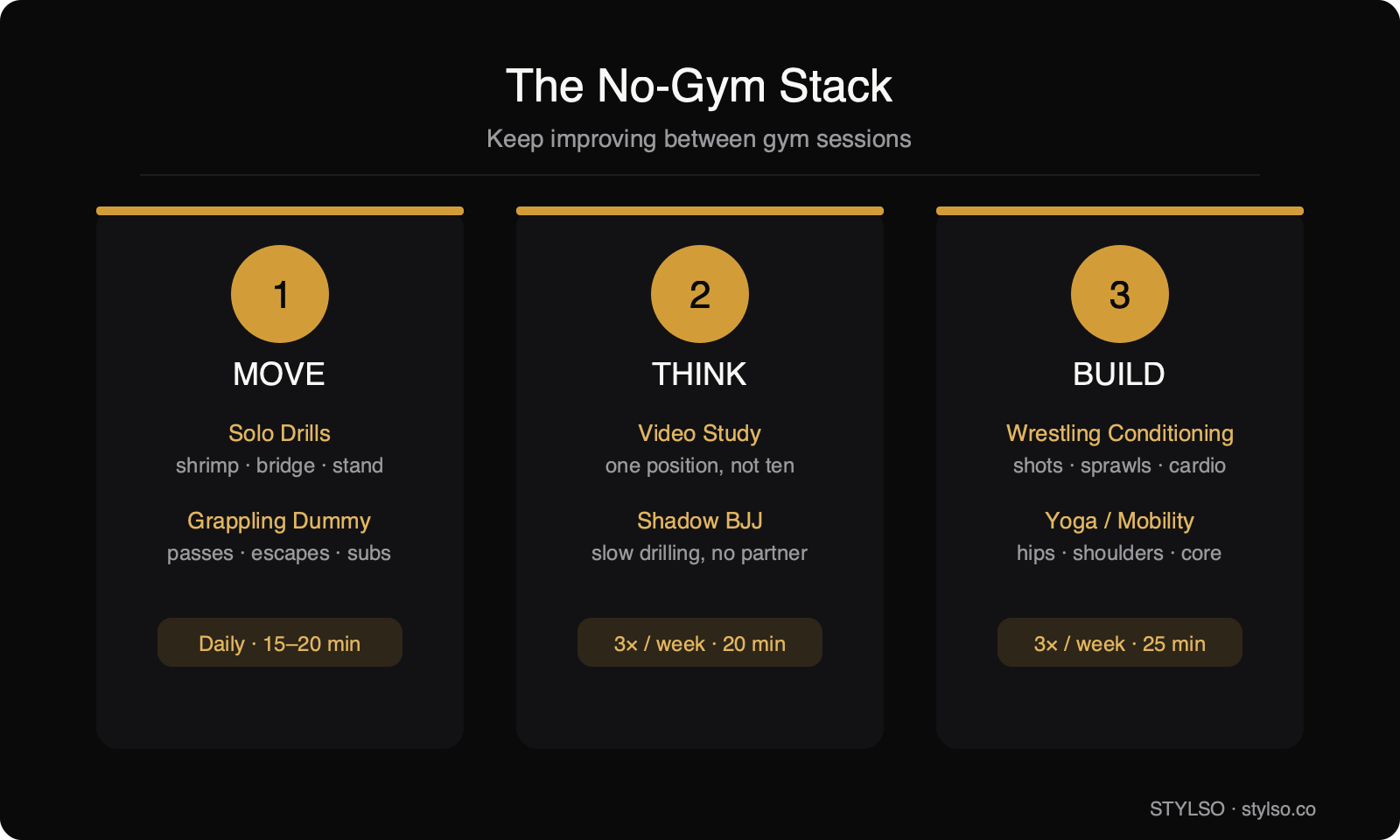
The short version: You can sharpen your BJJ solo with movement drills, a grappling dummy, smart conditioning, and focused video study. Here’s a seven-part system — practical, no filler — for training BJJ anywhere.
Key Takeaways
- Solo movement drills (shrimp, bridge, hip escape) build the patterns BJJ runs on — even in a small space.
- A grappling dummy lets you rep guard passes, escapes, and submissions without a training partner.
- Wrestling conditioning and yoga mobility transfer directly to the mat — your guard and your takedown defence will thank you.
Why the Gym Isn’t the Only Place You Improve
Think about any elite grappler you’ve watched. They didn’t get good just by showing up and rolling. They drilled the same movements thousands of times — in empty rooms, in small spaces, alone. Gordon Ryan doesn’t stop drilling because the gym is closed.
Sparring matters a lot. Rolling with real people, under real pressure, teaches things you can’t simulate. But if you’re stuck — injured, travelling, between academies, or just short on schedule — there’s more you can do than you think. Don’t let a closed mat pause your progress.
The 7-Part No-Gym BJJ Stack
Work these in whatever order fits your week. Some are daily. Some need a bit of space. One needs gear. All of them move the needle.
1. Solo Movement Drills
Shrimp. Bridge. Technical stand-up. These aren’t just warm-up filler — they’re the grammar of BJJ. When your hips don’t shrimp automatically, you get held in side control. When your bridge is weak, you can’t escape mount. Rep them daily. A hallway works. No mat needed.
Start small: ten shrimps down the hall, ten back. Add bridging sets. Finish with technical stand-ups. You’re done in ten minutes. Do this every morning for a month and watch what happens to your escape game.
2. Grappling Dummy Work
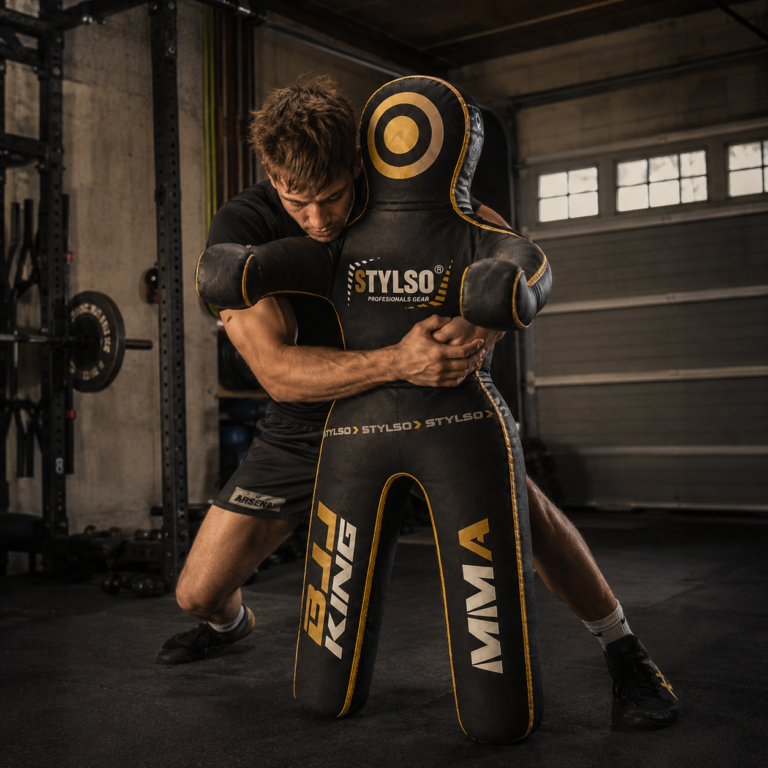
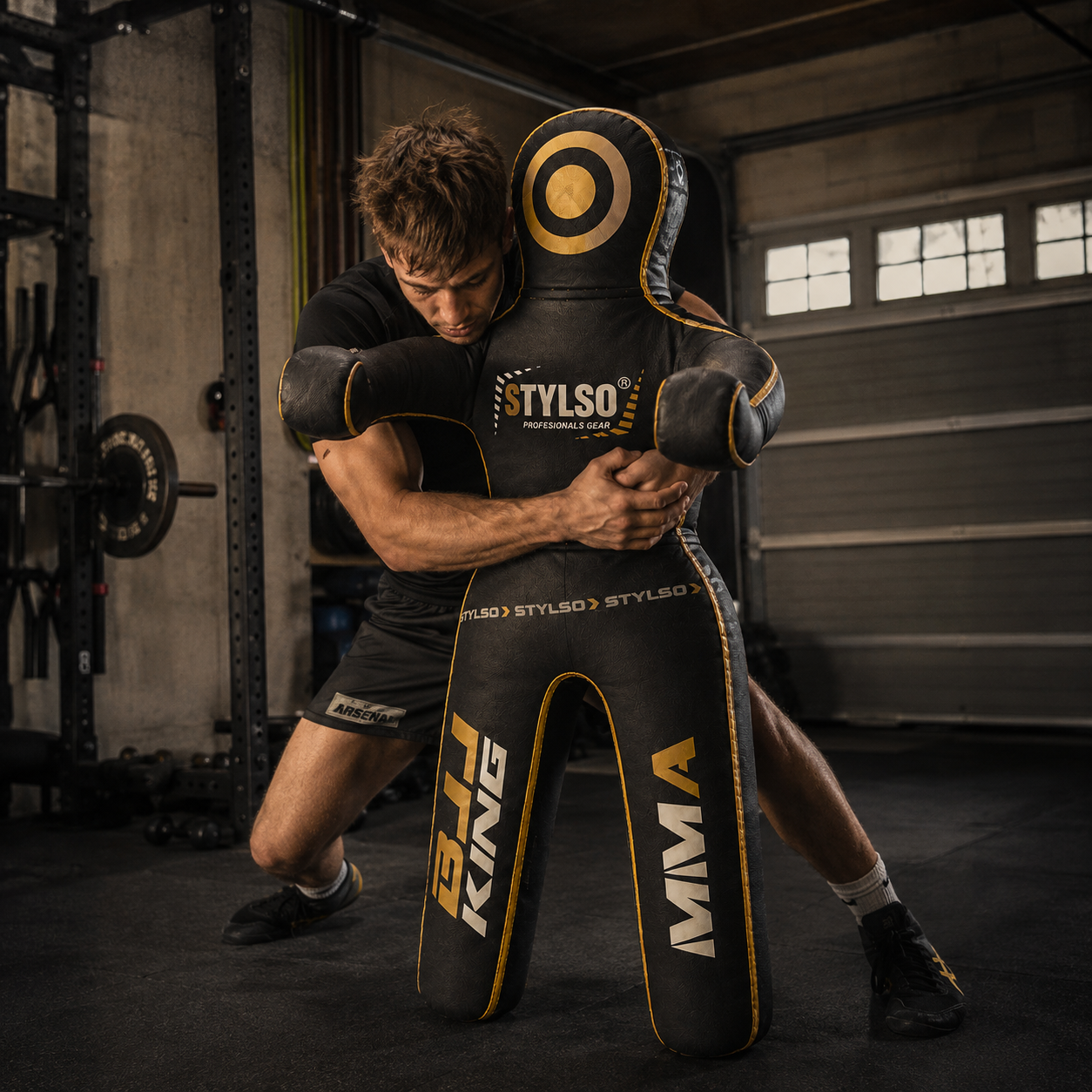
A grappling dummy changes solo training completely. You can drill guard passes, mount escapes, back control entries, and basic submissions with real resistance — not just air. The Stylso grappling dummy is built for this kind of work: solid enough for repeated rep work, stable enough not to tip over mid-pass.
3. Shadow BJJ (Conceptual Drilling)
Shadow boxing works in striking sports because it forces you to feel the movement without an opponent. BJJ has an equivalent — and almost nobody does it.
Pick one position: side control, half guard, mount. Move through it slowly, alone. Where should your weight be? What’s blocking your escape? Where’s the choke? This trains positional pattern recognition. It’s BJJ at 10% speed, for free, and it works.
4. Video Study
Don’t just watch matches. Pick one position you’re struggling with and go deep. Find the best instructional on that one technique. Watch it. Pause it. Watch it again. Then go drill it — solo, on a dummy, or in your head.
The mistake most people make is watching broadly. Broad watching won’t stick. Narrow, focused study — one technique, understood fully — will show up on the mat in your next session.
5. Wrestling Conditioning
Wrestling builds the cardio BJJ actually uses — not steady-state, but explosive, stop-and-go, full-body effort. Sprawl-to-shoot combos, level changes, penetration steps. These are the movements that build the gas tank you need to survive a hard third round.
Add fifteen minutes of wrestling-style conditioning to any workout: sprawl sets, shot levels, stance switching, lateral shuffles. It’s hard. It’s supposed to be. And it pays off the moment someone tries to take you down.
6. Yoga and Mobility
Stiff hips get submitted. Tight shoulders can’t reach escapes. Three yoga or mobility sessions per week — twenty minutes each — directly improve your guard retention and your ability to scramble out of bad spots.
This isn’t the gentle, slow class. Load the stretch. Hold it. Go through full range of motion under control. Hip flexors, hamstrings, thoracic rotation, shoulder capsule. If your guard is flat and your hips don’t move freely, that’s where you start.
7. Find Training Outside the Gym
You don’t need a formal class to get reps in. Most academies run open mats — typically on weekends, often free or low-cost for drop-ins. A training partner in a park works too. Even finding one person who trains and doing slow drilling twice a week makes a real difference.
Search for open mats near you. Show up humble, bring your own gi, leave your ego at the door. You’ll get more mat time than you expect.
The No-Gym BJJ Week
You don’t need hours. You need consistency. Here’s a week using The No-Gym Stack:
| Day | Session Focus | Time |
|---|---|---|
| Monday | Solo drills + Shadow BJJ | 20 min |
| Tuesday | Wrestling conditioning | 25 min |
| Wednesday | Video study — one technique, then rep it | 20 min |
| Thursday | Grappling dummy work | 25 min |
| Friday | Yoga / mobility | 20 min |
| Saturday | Open mat (or 30 min dummy + 20 min drills) | 50 min |
| Sunday | Rest + video review | — |
Gear That Supports No-Gym Training
You don’t need a lot. But the right kit makes it easier to stay consistent. Here’s what actually matters:
| Gear | Why It Helps | Who It’s For | Shop |
|---|---|---|---|
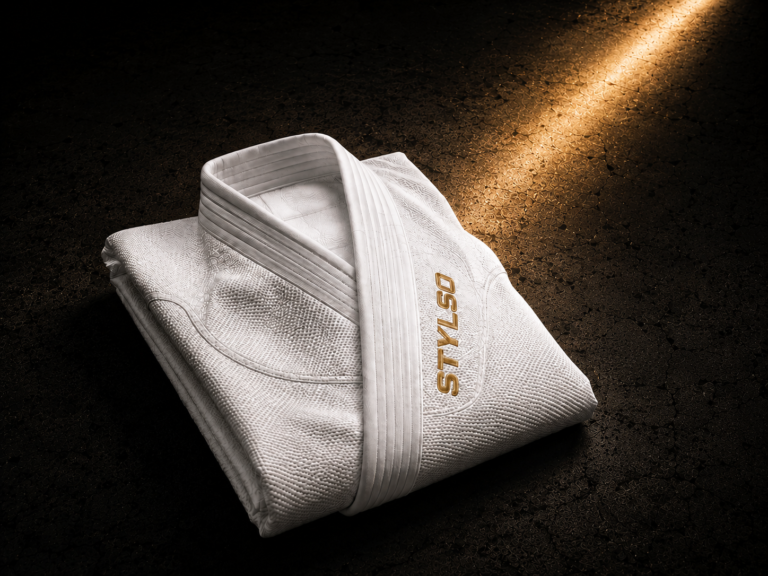
| BJJ Gi | Wearing your gi to solo sessions keeps the mindset locked in. Also essential for dummy work and open mats. | Everyone who trains gi BJJ | Shop on Amazon |
| Rashguard | For no-gi conditioning and dummy work — sweat management, skin protection, no jacket required. | No-gi and MMA crossover athletes | See our picks |
| Grappling Dummy | Adds resistance to solo reps. Guard passes, escapes, submissions — all drillable without a partner. | Anyone training without a consistent partner | Shop on Amazon |
Check the current price on Amazon — don’t pay more than the listed price on the product page.
Free: No-Gym BJJ Training Checklist
A printable weekly training plan — solo drill checklist, conditioning schedule, video study log, and gear guide. Drop your email and it’s yours instantly.
Common Mistakes When Training Without a Gym
- Drilling without a target. Don’t just shrimp for the sake of it. Pick the position you struggle with. Rep the movement that escapes it. Intention matters.
- Skipping the gi. Wear your gi to solo sessions. It sounds small — it isn’t. The right kit builds the right headspace.
- Watching without drilling. Video study only sticks when you follow it with reps. Watch → rep → watch again. One cycle does more than an hour of passive watching.
- Ignoring conditioning. Your technique looks fine at 30% intensity. Train your cardio so it holds up at 100% — third round, nothing left. That’s when conditioning wins.
Frequently Asked Questions
Can you actually improve at BJJ without a gym?
Yes — but you won’t replace sparring with solo work. You can sharpen your movement base, your conditioning, your positional understanding, and your technical knowledge. When you get back on the mat, you’ll feel the difference.
What’s the most effective solo BJJ drill?
Shrimping and bridging. These two movements are the foundation of BJJ defence. If you can only do one thing between sessions, rep those. A ten-minute shrimping session every morning builds muscle memory and discipline together.
How does a grappling dummy help with solo training?
It gives you real resistance. You can drill guard passes, mount escapes, and basic submission setups against a stable surface — far more useful than air-drilling. The Stylso grappling dummy handles repeated rep work. Check the current price on Amazon.
How often should I train solo to stay sharp?
Even fifteen to twenty minutes of focused solo work daily makes a meaningful difference over weeks. Add three conditioning sessions and you’re maintaining real progress between mat sessions.
What’s the biggest mistake beginners make with home training?
Going broad instead of deep. Watching a dozen techniques, drilling nothing. Pick one position you want to escape better. Go deep on it for a week. One solid improvement beats ten half-drilled ideas every time.
Related Stylso Guides:
- BJJ Solo Drills at Home: The Stylso Solo 7 Circuit — the specific drills to pair with this plan
- 7 Habits That Make You Better at BJJ Faster — when you’re back in the gym full-time
- Best BJJ Gi for Beginners — if you’re still looking for your first training gi
- Gi vs No-Gi: What to Buy First — before you commit to a training path