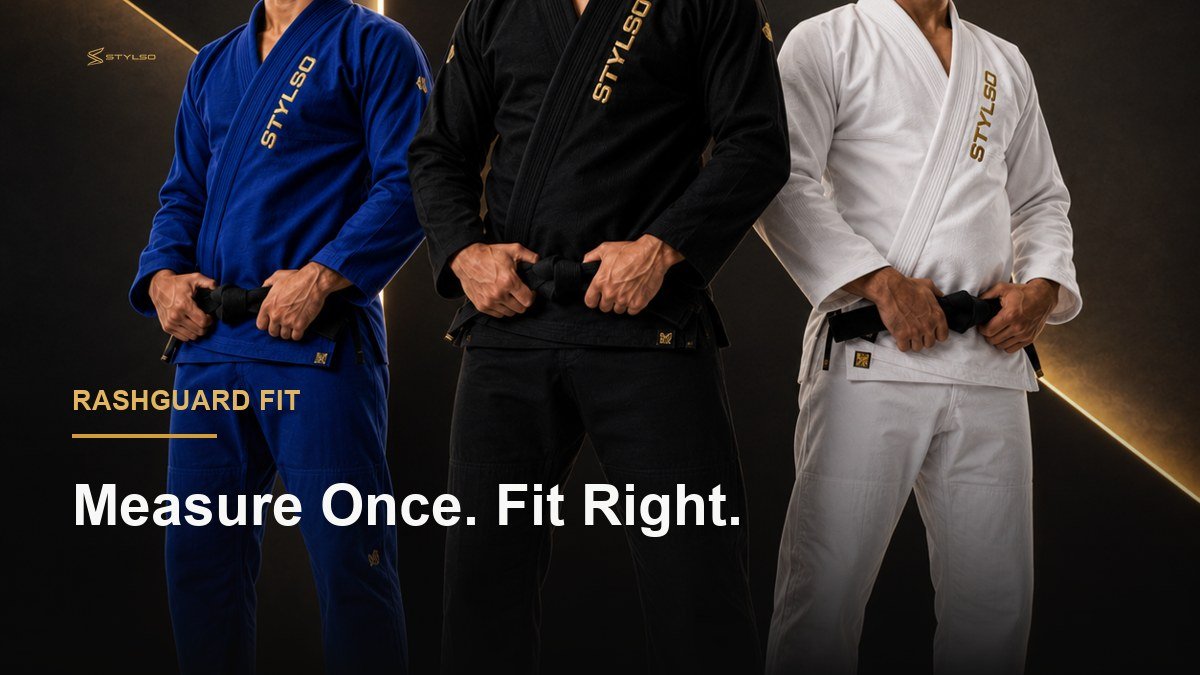
Measure your chest circumference and note your height — those two numbers put you in the right size. If you’re between sizes, go up. A slightly generous fit is better than one that pins your arms mid-roll. Always check the brand’s own chart before ordering.
- Chest + height = your two sizing numbers
- BJJ rashguards run slim — don’t size from a t-shirt
- Between sizes? Go up: you need full arm extension mid-roll
How to Measure for a BJJ Rashguard
Grab a soft measuring tape. This takes about 30 seconds.
Chest circumference. Breathe out normally. Wrap the tape around the widest part of your chest — just under the armpits, level all the way around. Don’t flex, don’t suck in. Natural standing posture.
Height. Barefoot, standing straight. If you’re on the boundary between two sizes, height is the tiebreaker.
Some brands also ask for weight. Use it as a cross-check — if your chest and height give you different answers, pick the larger size and use your weight to confirm. Two measurements is all you need.
BJJ Rashguard Size Chart
Most BJJ brands follow sizing close to this general guide:
| Size | Chest | Height | Best For |
|---|---|---|---|
| XS | 32–34″ (81–86 cm) | Up to 5’5″ / 165 cm | Lean, short frame |
| S | 35–37″ (89–94 cm) | 5’5″–5’8″ / 165–173 cm | Average build, lighter frame |
| M | 38–40″ (97–102 cm) | 5’8″–5’11” / 173–180 cm | Most common adult size |
| L | 41–43″ (104–109 cm) | 5’10″–6’1″ / 178–185 cm | Athletic, broader shoulders |
| XL | 44–46″ (112–117 cm) | 6’1″–6’3″ / 185–191 cm | Larger build, long torso |
| XXL | 47–50″ (119–127 cm) | 6’3″+ / 191 cm+ | Big frame, extra length |
General guide. BJJ brands cut differently — always verify on the product page before you order.
Check the current price and your size on Amazon:

Compression Fit vs. Looser Fit: What You Actually Need on the Mat
Here’s the part most people get wrong. A BJJ rashguard isn’t supposed to fit like a t-shirt — it’s compression gear, and it’s supposed to sit snug against the skin.
When it fits right, it stays put during rolls. No riding up. No bunching. And no accidental grips gifted to your training partner when your rashguard creases at the shoulder.
But it goes beyond comfort: compression actually helps your training. Tight-fit gear keeps muscle groups warm longer, improves local circulation, and reduces the fatigue that creeps in around round three and four — that point where your grip starts to slow and your hips stop firing fast.
Wrestlers figured this out decades ago. The wrestling singlet is compression by design — it reduces mat friction during scrambles and keeps muscles supported through explosive movement. MMA fighters wear compression shorts for the same reason. Yoga practitioners use compression gear to maintain blood flow during long sessions. The principle is the same across every discipline: snug fit = better performance and faster recovery.
One more reason to size right: a snug rashguard is a skin barrier. Less direct mat contact means fewer scratches, less bacterial transfer, and lower risk of mat burns or skin infections. After every session, wash your rashguard immediately — don’t let it sit in your bag. Cold wash, hang dry. Treated right, it’ll last for years.
The simple rule:
- Heavy training or competition? True-to-size compression. It won’t shift.
- Casual open mat or light no-gi? Size up once for a bit more room — you still get the compression benefit without the tighter grip.
Short Sleeve vs. Long Sleeve — Does the Sizing Change?
Not drastically, but it’s worth knowing before you order.
Short sleeve sits above the elbow. If you’ve got wide shoulders or bigger arms, check the shoulder width spec — short-sleeve rashguards tend to run tighter through the upper arm. Some athletes with a broad chest size up specifically to get the sleeve right.
Long sleeve covers to the wrist and offers more protection — elbows off the mat, arms covered during leg lock scrambles. Size it the same way (chest + height). If you’re between sizes, lean bigger so the sleeve doesn’t pull when you extend overhead or shoot for a takedown.
Most grapplers reach for long sleeve in pure no-gi or spats rolling. Short sleeve works well under a gi or in warmer gyms.
4 Sizing Mistakes That Lead to the Wrong Fit
1. Sizing from a streetwear medium. A medium from a standard brand is not a medium in BJJ compression. Rashguards are cut slim with stretch panels. Always measure first.
2. Buying for standing fit, not mat fit. It looks fine in the mirror. Then you get stretched into a triangle and the hem is around your ribcage. Test it: raise both arms overhead without the hem pulling up. Reach back like you’re defending a choke. A rashguard that passes those checks won’t betray you on the mat.
3. Ignoring torso length. Tall and lean? Your chest measurement might suggest one size, but your torso needs more. If you’ve got a long upper body, size up so the hem stays tucked.
4. Skipping the brand chart. Different brands cut differently — especially international ones. Thirty seconds on the product page can save a return trip.
Free: BJJ Gear Sizing Guide
Rashguard, gi, and spats sizing on one printable chart — plus the care rules that double their life. Instant download.
FAQ
How tight should a BJJ rashguard fit?
Snug against the skin without restricting movement. You should be able to raise both arms overhead without the hem pulling up, and reach back without the shoulders bunching. Compression, not suffocation.
Should I size up or down in a BJJ rashguard?
Default to true-to-size based on your chest measurement. Size up if you’re between sizes or if you want slightly more arm mobility. Don’t size down hoping it stretches — compression fabric has limits.
What if I’m right between two sizes?
Go bigger. A slightly generous rashguard gives you full range of motion. A too-small one restricts arm extension, which matters every single roll — especially in guard work and leg locks where you’re being stretched.
Do BJJ rashguards shrink?
Most are polyester or nylon blends, which hold their shape well. Wash cold and hang dry to keep the elastic intact. Hot dryers degrade the spandex over time and shorten the garment’s life significantly.
Can I just wear a regular compression shirt instead?
Short term, yes. Long term, no. BJJ rashguards are reinforced at high-stress seam points designed to take grabbing and twisting loads. A regular compression shirt is built for gym work, not grappling stress — the seams fail much faster.